Native Plants
Q. Who is Mr. Smarty Plants?
A: There are those who suspect Wildflower Center volunteers are the culpable and capable culprits. Yet, others think staff members play some, albeit small, role. You can torture us with your plant questions, but we will never reveal the Green Guru's secret identity.
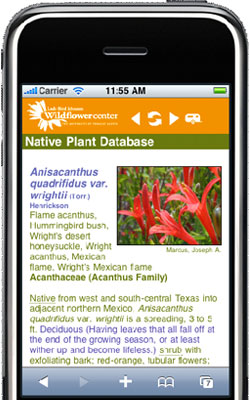
Did you know you can access the Native Plant Information Network with your web-enabled smartphone?

Ask Mr. Smarty Plants
Ask Mr. Smarty Plants is a free service provided by the staff and volunteers at the Lady Bird Johnson Wildflower Center.

rate this answer

Monday - September 26, 2005
From: Winchendon, MA
Region: Southeast
Topic: Non-Natives
Title: Non-native, invasive Datura sprouting from compost
Answered by: Nan Hampton
QUESTION:
Hi, I have a plant growing out of some compost we purchased this spring and no one can tell me what it is. It's about 4 ft. tall, the stem is maroon like rhubarb and it produces 4-5 in. tubular light purple flowers with a long stamen. It only opens in the early morning and late afternoon and dies off the next day. It has no smell and produces an oval, very thorny seed pod. The leaves look like oak leaves streched long. Someone said it was an angel trumpet or a red pigroot, but it's neither. It's driving me crazy!! Can you please help me?!!! Thank You in advance.ANSWER:
This sounds like one of the Datura, probably Jimsonweed (Datura stramonium). It is an introduced species from Asia, but can be found in nearly every state of the U. S. Another non-native is D. metel, a native of India. D. wrightii is a very similar native North American species. These plants belong to the Family Solanaceae (Potato Family). Like many members of this family, Datura spp. are toxic but have been used in folk medicine for various ailments and have also been used as a psychotropic drug.More Non-Natives Questions
Mexican feathergrass from Pflugerville, TX
January 23, 2013 - How deep are the roots of Nassella tenuissima? I'm looking for something that could possibly discourage my neighbors' bermuda grass from encroaching into my native plantings.
view the full question and answer
Non-native, invasive, poisonous Chinese yam
October 16, 2005 - I found a vine in my yard [central Indiana] which I believe is Dioscorea oppositiflora and I wanted first to confirm my identification and second to find out about edibility [especially of the airborn...
view the full question and answer
What are the differences between Arbutus xalapensis, A. unedo and A. marina
August 29, 2013 - One nursery lists madrone trees as arbutus uneda compacta and arbutus marina. The other lists it as arbutus xalapensis, which is the only name I can find in the data base. There is a very large pric...
view the full question and answer
Texas native plants in an indoor space in Dallas
July 31, 2009 - Is there a native Texas plant that would be suited for an indoor application, such as large planters in a lobby space?
view the full question and answer
Non-native avocado trees in Rio Grande Valley from Austin
January 05, 2013 - I just read the article in the Austin American Statesman about growing avocados outdoors. Don't know if they grow here, but they certainly don't just grow in south Florida. I used to live in Wesla...
view the full question and answer
| Support the Wildflower Center by Donating Online or Becoming a Member today. |