Native Plants

Q. Who is Mr. Smarty Plants?
A: There are those who suspect Wildflower Center volunteers are the culpable and capable culprits. Yet, others think staff members play some, albeit small, role. You can torture us with your plant questions, but we will never reveal the Green Guru's secret identity.

Did you know you can access the Native Plant Information Network with your web-enabled smartphone?

Ask Mr. Smarty Plants
Ask Mr. Smarty Plants is a free service provided by the staff and volunteers at the Lady Bird Johnson Wildflower Center.

rate this answer

Monday - September 07, 2009
From: Heron, NY
Region: Northeast
Topic: Erosion Control, Grasses or Grass-like
Title: Plants to prevent erosion in clay soil in Heron, NY
Answered by: Barbara Medford
QUESTION:
What plants could be used to plant on clay soil, Eastern exposure in full sun to stop erosion on a bay side hill with a steep grade?ANSWER:
The best ground cover for erosion control in any area is grasses native to that area. These are not going to be the "mowing type" grasses, but taller, ornamental grasses. They can be cut back to about 6 inches in Spring, and they are mostly self-propagating from both roots and self-seeding. The long fibrous roots of the grasses will grab onto the soil and keep it from eroding, and help to hold moisture and nutrition in the soil where it's needed. We will go to our Native Plant Database, go down to "Combination Search," search on New York, and "Grasses or grasslike plants" under habit and then click on "Submit Combination Search. Since you specified full sun, that is the Light Requirement we will specify on our search. We would also like to check to make sure these grasses are native in and around your area, so we know they are adapted to the soils and climate. Unfortunately, we couldn't find a Heron, NY, so we'll just have to go with the whole state; however, we will check that they grow in clay soil. You can use the same technique to make your own selections, possibly adding in Light Requirements or Soil Moisture in the specifications you select. We will also take a look at some low shrubs that might be able to cover the area, but they could be difficult to manage on your slope. As it turns out, the clay soil was the hardest specification to meet, but we found 4 grasses and a shrub that should fit your site.
However, seeding grass is not the whole process. It sounds like you have a steep grade to contend with, and just throwing seeds on the bank is not going to be sufficient. The seeds need moisture to germinate. If the moisture comes in the form of rain, it is likely to wash the seeds down the bank before that have a chance to germinate and take root. There are two possible solutions—an erosion control blanket or pneumatic compost/seed application. The erosion-control fabric works by slowing the runoff water and allowing sediments to fall out rather than be washed away. Seeds are sown under the erosion-control material and grow up through the matting when they germinate. You can also insert plants into the soil by cutting through the matting. The roots of the plants that are growing through the erosion-control material anchor the soil to stop the erosion. If you use erosion-control blankets made of biodegrable material, they will eventually disappear leaving the plants to control the problem. Many nurseries carry this erosion control fabric.
The compost/seed application may be a bit more complicated and expensive than you had in mind since it does require a pneumatic blower, or some mechanical means, to spread the compost/seed mix. The US Composting Council offers information about suppliers of compost and compost technology, but I don't really know if this could be a do-it-yourself project. You might check with a landscaping or environmental consulting company in your area who might have the machinery to do this to learn about the feasability and expense of applying the compost/seed mixture this way. You can find the names of Landscape Professionals and Environmental Consultants in your area that specialize in native plants by searching in our National Suppliers Directory.
Native grasses for clay slope in New York
Andropogon glomeratus (bushy bluestem) - 2 to 5 ft. tall, perennial, high water use, moist soil, sun
Calamagrostis canadensis (bluejoint) - 3 to 5 ft. tall, perennial, medium water use, sun, part shade or shade
Elymus canadensis (Canada wildrye) - perennial, 2 to 4 ft. tall, medium water use, sun or part shade
Schizachyrium scoparium (little bluestem) - perennial, 18 to 2 inches tall, low water use, sun or part shade
Shrub for clay slope in New York
Empetrum nigrum (black crowberry) - to 6 inches tall, perennial, low water use, sun
From our Native Plant Image Gallery
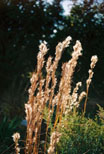

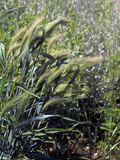
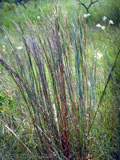
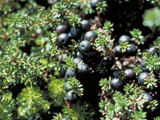
More Grasses or Grass-like Questions
Trees and other plants for privacy along lake shoreline
March 09, 2013 - We are purchasing a new home that has a 2 acre lake. We would like to add some plants/trees for privacy around the shore line. Can you suggest something that would fill in nicely and is strong enoug...
view the full question and answer
Native border plants to stop erosion
February 18, 2015 - I need native border plants to assist in stopping soil erosion due to water run off from rain and the Catawba River.
view the full question and answer
Plants for slope on Orcas Island, WA
July 21, 2011 - Hi! What a great site! Okay, I have a home on Orcas Island, WA. We live here from about June through September, but only visit once a month or so the other times of the year.
We are looking for somet...
view the full question and answer
Drought affecting non-native Zoysia grass in Austin
November 06, 2011 - Due to the extreme drought here in Austin this year and the watering restrictions our Zoysia lawn has suffered and appears to be dead in many areas of our lawn. Will it come back? Is there anything w...
view the full question and answer
Native Plants for Galveston
February 12, 2012 - I'm looking for low maintenance, drought tolerant plants for Galveston, on the bay side, in a well drained area with morning sun. I was thinking of Phlox, Muhly grass, Lantana.....and I am looking f...
view the full question and answer
| Support the Wildflower Center by Donating Online or Becoming a Member today. |