Native Plants

Q. Who is Mr. Smarty Plants?
A: There are those who suspect Wildflower Center volunteers are the culpable and capable culprits. Yet, others think staff members play some, albeit small, role. You can torture us with your plant questions, but we will never reveal the Green Guru's secret identity.

Did you know you can access the Native Plant Information Network with your web-enabled smartphone?

Ask Mr. Smarty Plants
Ask Mr. Smarty Plants is a free service provided by the staff and volunteers at the Lady Bird Johnson Wildflower Center.

rate this answer

Wednesday - July 29, 2009
From: Wilmington,, NC
Region: Southeast
Topic: Planting, Transplants, Trees
Title: Ensuring survival of wax myrtle in Wilmington, NC
Answered by: Barbara Medford
QUESTION:
I just transplanted some wax myrtle bushes. What do I need to do to insure they live?ANSWER:
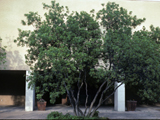
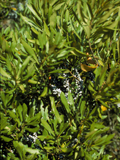
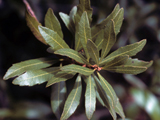
Two species of the Morella genus, Morella caroliniensis (southern bayberry) and Morella cerifera (wax myrtle) are native in or near to New Hanover County, in the southern tip of North Carolina. We don't know which you have, but they are similar in care requirements.
Morella caroliniensis (southern bayberry) - requires sun, moist soil, can grow in clay, loam or sand. More information and pictures
Morella cerifera (wax myrtle) - requires moist soil, sun or part shade, prefers sandy, lightly acidic soils
Since both of these plants are native to your area, you should not have to worry too much about their survival. They do need to be well-watered; when they are in the early days of planting, a hose stuck down in the dirt around the roots and allowed to dribble for a while a couple times a week is a good idea. Don't fertilize them until Spring, if then, (native plants should not need fertilizer). If you have already planted them, and they are not getting much sun (around 6 hours a day) they may not prosper and will surely grow more slowly.
These plants are dioecious, that is, you must have both a male and a female plant within about 40 feet of each other in order for there to be berries on the female plant. Probably all of the plants in the nursery, if that is where you obtained the plants you now have, had berries on them because they were all females and had been pollinated before they were put on the market. Most plants offered commercially are clones, products of reproduction by rooting cuttings, which will produce a plant identical to the one from which the cuttings were taken. Hopefully, you have neighbors with male wax myrtle in their gardens, or perhaps your nursery can order some for you, if you want berries.
From the Image Gallery
More Transplants Questions
Death of Tecoma stans after heavy rain
July 21, 2008 - I had two esperanza plants. They have been planted for about four months, this spring. They were blooming and growing. We had six inches of rain in five days and they began to wilt - and then they d...
view the full question and answer
How do I save my recently transplanted yaupon holly?
April 20, 2011 - Recently transplanted (two weeks ago) a yaupon holly tree from one part of the yard to another. Leaves are beginning to turn yellow and fall. What can be done to save this plant?
view the full question and answer
Replanting yaupon in Blanco TX
January 16, 2013 - How do I replant Yaupon in its native area Blanco TX?
view the full question and answer
Transplanting or seeding Indian paintbrush in Bend OR
July 21, 2009 - I would like to know whether I can transplant native Indian paintbrush plants into my landscaping, or do I need to try and grow them from seed?
view the full question and answer
Transplant shock in Dakota mock vervain
July 23, 2007 - We just planted some Verbena bipinnatifida in our back yard and when we planted it, it had purple flowers on it but now they've all dried up. We live in central Colorado and thought this plant was fa...
view the full question and answer
| Support the Wildflower Center by Donating Online or Becoming a Member today. |