Native Plants

Q. Who is Mr. Smarty Plants?
A: There are those who suspect Wildflower Center volunteers are the culpable and capable culprits. Yet, others think staff members play some, albeit small, role. You can torture us with your plant questions, but we will never reveal the Green Guru's secret identity.
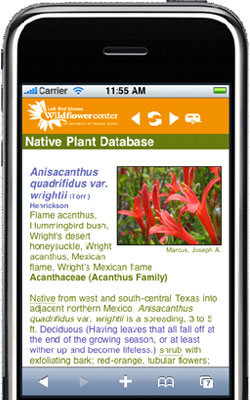
Did you know you can access the Native Plant Information Network with your web-enabled smartphone?
Ask Mr. Smarty Plants
Ask Mr. Smarty Plants is a free service provided by the staff and volunteers at the Lady Bird Johnson Wildflower Center.

rate this answer

Tuesday - July 14, 2009
From: Troy, VA
Region: Mid-Atlantic
Topic: Trees
Title: What is the growth rate of the table mountain pine in zone 6 & 7?
Answered by: Jimmy Mills
QUESTION:
How fast growing is the table mountain pine in Zones 6 and 7 in the Appalachians? What is the growth rate?ANSWER:
The Table Mountain pine Pinus pungens (Table Mountain pine) is endemic to the Appalachians, and occupies xeric sites of Appalachian rocky and shaly mountainous areas from Georgia into Pennsylvania It is frequently found on ridges of gorges that dissect the Blue Ridge Mountains, and is characterized as a slow growing species. I have not found information dealing with its growth rate specifically, but here are two articles that concern its growth, habitat, and response to fire.
This article from the USDA Forest Service estimates the maximum possible age of Table Mountain Pine to be 250 years, and a maximum height of 95 ft and maximum diameter of 37 inches d.b.h. have been reported. In studies of regeneration of trees from fire, they report that seedlings grow well, forming a dense sapling stand that attains its maximum groth rate at about age thirty when the trees are about 7 inches d.b.h., but after that, growth is extremely slow.
This second Forest Service article deals with the distribution and occurrence, its botanical and ecological characteristics, and management considerations.
An additional note of interest; it is the Lonesome Pine in John Fox's 1908 novel "The Trail of the Lonesome Pine", and the song by the same name popularized by Laurel and Hardy.
More Trees Questions
Looking for a good cultivar of Prunus mexicana.
May 27, 2009 - Has anyone come up with a good cultivar of Prunus Mexicana? As in, one selected from the wild? Or a hybrid with a European plum? I'd like one in my yard (I have also wanted a good Purple Leaf Plum, b...
view the full question and answer
Evergreen Privacy Hedge for Long Island
June 29, 2012 - I live on Long Island and want a privacy evergreen hedge partial sun.
view the full question and answer
Native conifer bearing evergreen for noise reduction
April 01, 2008 - I asked the prior question about noise reduction and you gave me several choices. Thank you for that. Of the plants you suggested, the wax myrtle is the tallest and therefore probably best for my 2-st...
view the full question and answer
Oak sap dripping on driveway in Austin
November 06, 2011 - Why would oak sap be dripping on driveway at this time when other oaks the neighbors have are not.
view the full question and answer
Spots on persimmon tree leaves from Dripping Springs TX
July 10, 2013 - We are in rural Hays County Texas off Hamilton Pool Rd Texas. Large persimmon trees are turning yellow, blackish spots on underside of leaves. What do we do?
view the full question and answer
| Support the Wildflower Center by Donating Online or Becoming a Member today. |