Native Plants

Q. Who is Mr. Smarty Plants?
A: There are those who suspect Wildflower Center volunteers are the culpable and capable culprits. Yet, others think staff members play some, albeit small, role. You can torture us with your plant questions, but we will never reveal the Green Guru's secret identity.
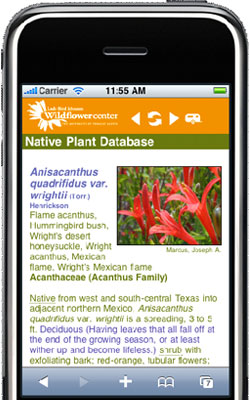
Did you know you can access the Native Plant Information Network with your web-enabled smartphone?

Ask Mr. Smarty Plants
Ask Mr. Smarty Plants is a free service provided by the staff and volunteers at the Lady Bird Johnson Wildflower Center.

rate this answer

Monday - June 22, 2009
From: Austin, TX
Region: Southwest
Topic: Diseases and Disorders, Trees
Title: Why is my Ash drooping?
Answered by: Jimmy Mills
QUESTION:
Last spring, I bought a house in Austin, TX with a large Ash tree in the front yard. It looked fine last year, but has been looking funny since it leafed out this spring. It's as if the leaves are weighing all the branches down. The canopy has dropped noticeably and most of the branches seem to be pointing down. It's still thick and green, not losing any leaves, but it looks like it's melting. To be honest, I'm not sure if it's a Texas Ash, or the "dreaded" Arizona Ash, which I'm told has a limited life span in this area. What might be wrong with my tree, and what can I do about it? I really, really don't want to lose this tree. Thank you.ANSWER:
Since you are in Austin and you said it is a big tree, Mr. Smarty Plants is thinking you have an Arizona Ash Fraxinus velutina (velvet ash). The Texas Ash Fraxinus texensis (Texas ash) is a smaller tree, and it is very colorful in the Fall. Compare the images of the plants: F. velutina ; F. texensis. This will help you determine which Ash you have.
The Arizona Ash produces copious quanities of fruits/seeds beginning in early spring into the summer, and the crop seems heavy this spring. If your tree is covered with seeds, this could be the cause of the drooping limbs. The seeds eventually fall, and the drooping should be reduced. Now Arizona Ash is a dioecious species; so if your tree is a male, there won't be any seeds and this doesn't answer your question.
Another course of action is to have an arborist check on the overall health of your tree. The Texas Chapter of the International Society of Arboriculture can help you contact a certified arborist in Austin.
More Trees Questions
Wanting to grow a Buckley Oak in Amarillo, TX
January 20, 2016 - I live in Amarillo Texas in the Texas Panhandle. I recently became interested in the Buckley Oak and was wondering if it might grow well here and if so, where I might find one that I could purchase a...
view the full question and answer
Problems with a Cercis (Redbud)
August 25, 2014 - Half of my redbud tree is pooped out looking. On two places on the bark are areas where a few layers of bark have pulled back. In these areas there are white growths.
view the full question and answer
At what age does Possumhaw (Ilex decidua) begin to flower in Pflugerville, TX?
January 13, 2011 - At what age does a female possumhaw (Ilex decidua) usually bloom and set fruit? Or is there a way to identify the female other than by the presence of berries? I grew a number from seed and want to ...
view the full question and answer
Injury from non-native Canary Palm from Torrance CA
October 18, 2013 - I got stuck in the eye a yr ago by a Phoenix canariensis. It went through my retina and through the integral chamber and put a stamp on my lense. There was no room for any more err without causing bli...
view the full question and answer
Do Maple trees and Poplars grow well in Amarillo,TX?
May 25, 2010 - Do maple trees and poplars grow well in Amarillo Texas? I love the fall reds, oranges, and yellows. If they don't grow well can you recommend some trees that have the color that will grow well?
view the full question and answer
| Support the Wildflower Center by Donating Online or Becoming a Member today. |