Native Plants

Q. Who is Mr. Smarty Plants?
A: There are those who suspect Wildflower Center volunteers are the culpable and capable culprits. Yet, others think staff members play some, albeit small, role. You can torture us with your plant questions, but we will never reveal the Green Guru's secret identity.

Did you know you can access the Native Plant Information Network with your web-enabled smartphone?

Ask Mr. Smarty Plants
Ask Mr. Smarty Plants is a free service provided by the staff and volunteers at the Lady Bird Johnson Wildflower Center.

rate this answer

Thursday - June 25, 2009
From: Rindge, NH
Region: Northeast
Topic: Shrubs
Title: Shrubs for New Hampshire
Answered by: Nan Hampton
QUESTION:
Will be landscaping next Spring: Do you think using 'Ilex Crenata'-Japanese Holly together with variegated Euonymus (species: fortunei) as shrub hedges in front of our house is a good combo? Do they grow fast? How high and wide? Do they keep their foliage ALL year round? I don't want shrubs that are bare at anytime during the year? Are they easily maintained? Any other possible shrubs you might suggest?ANSWER:
Since the Lady Bird Johnson Wildflower Center's mission is "to increase the sustainable use and conservation of native wildflowers, plants and landscapes," Mr. Smarty Plants would not recommend planting either Ilex crenata (Japanese holly) or Euonymus fortunei (wintercreeper) because they are both non-native plants whose origins are in Asia. Additionally E. fortunei is listed on Tennessee Exotic Pest Plant Council's Invasive Exotic Pest Plants in Tennessee-2004 and Weeds of Wisconsin. Ilex crenata also appears on WeedUS - Database of Plants Invading Natural Areas in the United States and the Georgia Exotic Pest Plant Council list.Here are some New Hampshire evergreen native alternatives for these two species:
Arctostaphylos uva-ursi (kinnikinnick)
Vaccinium vitis-idaea (lingonberry)
Juniperus communis var. depressa (common juniper) and here are photos and information.
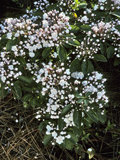
Kalmia angustifolia (sheep laurel)
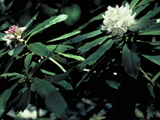
Kalmia latifolia (mountain laurel)
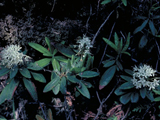
Ledum groenlandicum (bog Labrador tea)
Rhododendron maximum (great laurel)
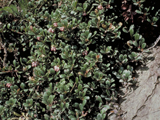
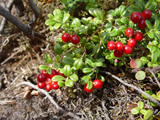
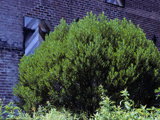
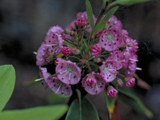
More Shrubs Questions
Companion Plants for Texas Mountain Laurel
March 12, 2015 - I am building a garden from scratch and need help. I want to plant a Texas mountain laurel on each front section of my house in front of a window, and I also want to use Thumbelina Leigh English laven...
view the full question and answer
Planting Texas Mountain Laurel to transplant to Dallas
August 29, 2012 - My daughter would like to incorporate a tree planting ceremony in her wedding in Texas. The seedling would be planted in a pot for a few years and later transplanted in a yard when they buy a home. Wo...
view the full question and answer
Sumac Leaves Turning Red
November 22, 2013 - Hi, Mr. Smarty Plants,
I recently planted a flowering sumac bush. Is it normal for that plant to get fall leaf-color?
About a week after planting it, the temp reached the mid-30s, and after that, I ...
view the full question and answer
Plants that are deer resistant for high desert climate in Utah
January 23, 2008 - We are building in a high desert climate in Dammeron Valley, Utah. We want plants that are both deer resistant and require little watering. Can you advise which plants (shrubs, flowers, cacti) that ...
view the full question and answer
Natural location of Ceanothus impressus in California
May 21, 2006 - Where is Ceanothus impressus 'victoria' native? I need as specific as you can. Thanks much.
view the full question and answer
| Support the Wildflower Center by Donating Online or Becoming a Member today. |