Native Plants

Q. Who is Mr. Smarty Plants?
A: There are those who suspect Wildflower Center volunteers are the culpable and capable culprits. Yet, others think staff members play some, albeit small, role. You can torture us with your plant questions, but we will never reveal the Green Guru's secret identity.

Did you know you can access the Native Plant Information Network with your web-enabled smartphone?

Ask Mr. Smarty Plants
Ask Mr. Smarty Plants is a free service provided by the staff and volunteers at the Lady Bird Johnson Wildflower Center.

rate this answer

Tuesday - June 16, 2009
From: Duluth, GA
Region: Southeast
Topic: Grasses or Grass-like
Title: Replacing grass on steep hill in Georgia
Answered by: Nan Hampton
QUESTION:
I live near Atlanta, Georgia. My yard is a steep hill, which makes mowing VERY challenging. If possible, I would like to remove the grass and plant something hardy that does not require mowing. What plant(s) would be best? Also, when replacing grass, should I turn the soil with a tiller? I'm definitely an inside person, so I know precious little about plants and yard work. Thanks!ANSWER:
Mr. Smarty Plants hates to tell you this, but removing the grass on your steep lawn is going to present you with an immediate NEW problem—erosion! Grasses with their extensive fibrous root systems are ideal plants to prevent erosion on steep slopes. Although tilling is one way to get rid of the tall grass, it will leave you very susceptible to erosion uniess you get something else with extensive roots in the ground to stabilize it quickly. If you really want to get rid of your grass, solarization is a better option. Native American Seed in Junction, Texas has a very good description of how to do this. You can read about other Grass Removal Methods from Sonoma County (California) Master Gardeners.
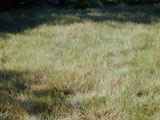
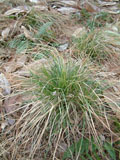
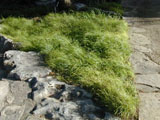
Now for a replacement—have you considered replacing your fast-growing tall grass with a short native grass that needs very little mowing or watering? Bouteloua dactyloides (buffalograss) is a sun-loving grass native to Georgia that has varieties that grow to only 4-inches high. Another possibility is to replace the grasses with grass-like sedges. You can read Sedge Lawns for Every Landscape by John Greenlee to learn more about them. A carefully chosen sedge species has the advantage of having a maximum height of 4 to 10 inches and being evergreen. Here are two good candidates: Carex pensylvanica (Pennsylvania sedge) and Carex texensis (Texas sedge).
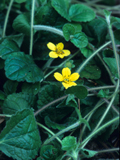
The following are low-growing evergreen plants that would serve well as groundcovers if you replace your grass. You should compare the required growing conditions of each of these to the characteristics of your site.
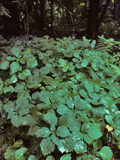
Chrysogonum virginianum (green and gold)
Pachysandra procumbens (Allegheny-spurge)
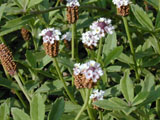
Phyla nodiflora (turkey tangle fogfruit)
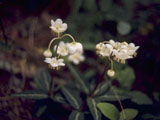
Chimaphila maculata (striped prince's pine)
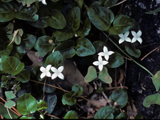
Mitchella repens (partridgeberry)
More Grasses or Grass-like Questions
Sources for native plants from Austin TX
December 19, 2012 - Hello. I am currently planning a Texas native plant garden. Unfortunately, I cannot seem to find the seeds/bulbs/roots/plants for some of the natives at local nurseries: Indian Ricegrass (Achnatherum ...
view the full question and answer
Plantings for a slope from New Carrollton MD
June 27, 2012 - My house (Maryland, near DC) sits at the bottom of a south facing slope. The soil is very heavy clay. The grade is about 1:20 for about 100 feet (with a steeper part at the top). Part of the hill is i...
view the full question and answer
Grass for detention pond in Illinois
October 06, 2008 - Hi, please advise regarding grass for bottom of detention pond. I have pond with drawdown time 4 days, what grass could survive being underwater 4 days, and not die? Thank you.
view the full question and answer
Low plants to cover bank too steep to mow
June 26, 2008 - I have a bank along the road that is too steep to mow. This bank faces east and only gets 2 - 4 hours per day of sunlight. I'd like to try ground cover to prevent erosion, however visibility is a p...
view the full question and answer
Ground cover for burned acreage in Bastrop, Texas
October 31, 2011 - The fire took 2/3 of the trees on my half acre in Bastrop County. It was mostly wild. What do I plant for ground cover? Do I plant native grass seed in fall? I want to keep it native as possible. ...
view the full question and answer
| Support the Wildflower Center by Donating Online or Becoming a Member today. |