Native Plants

Q. Who is Mr. Smarty Plants?
A: There are those who suspect Wildflower Center volunteers are the culpable and capable culprits. Yet, others think staff members play some, albeit small, role. You can torture us with your plant questions, but we will never reveal the Green Guru's secret identity.

Did you know you can access the Native Plant Information Network with your web-enabled smartphone?

Ask Mr. Smarty Plants
Ask Mr. Smarty Plants is a free service provided by the staff and volunteers at the Lady Bird Johnson Wildflower Center.

rate this answer

Saturday - May 30, 2009
From: Buda, TX
Region: Southwest
Topic: Compost and Mulch, Diseases and Disorders, Shrubs
Title: Problems with Green Cloud purple sage in Buda TX
Answered by: Barbara Medford
QUESTION:
I planted the "Green Cloud" variety of purple sage about 3 years ago. Yesterday, I noticed yellowish dots on the underside of the leaves of some plants. Is this harmful? The plants seem to be ok at this time, but I'd like to prevent any problems that might be brewing. I thought about the cotton root rot, but we have been in a drought.....not much water here (however,the area is heavily mulched).ANSWER:
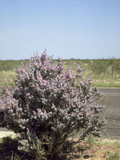
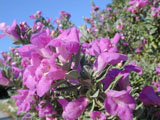
There are 5 plants in our Native Plant Database with the common name "purple sage;" however, only one of them, Leucophyllum frutescens (Texas barometer bush), is native to Texas, so we will assume that it the one you are asking about. The species of this plant usually has silvery green foliage; "Green Cloud" is a selection which has green leaves and pinkish flowers. Pictures of Green Cloud.
We investigated the possibility of cotton root rot, but understand that this plant is pretty resistant to it. Another thing causing yellowing on leaves is chlorosis, the lack of cholorophyll, which is usually the result of the plant roots being unable to access trace elements, especially iron, in the soil. The key to both these problems is the drainage for the plant. Cotton root rot, for instance, is prevalent in calcareous clay loam, where drainage is poor. Chlorosis can be precipitated by too little drainage as well. So, the first thing you want to do is check that water is not standing on the roots of your purple sage. If water in a shallow depression stands there for more than about 30 minutes, your drainage is poor. You need some compost in the dirt in which the sage is planted, or it should be in a raised bed. Pull some of that mulch back, and work some decomposed matter into the soil as much as possible without damaging the roots. Let the lower branches get some air. Try gradually getting the air circulation improved and getting organic material into the soil, and see if that helps.
More Diseases and Disorders Questions
Treating scarred Gum Bumelia from Lampasas TX
June 05, 2013 - We have a very old Gum Bumelia with a scarred open tree trunk. In the past concrete was used to fill the scarred trunk. What is the acceptable method of helping the tree. More concrete or using blac...
view the full question and answer
Leaves on 3 year old maple turning brown in Lebo, KS.
July 16, 2011 - Hello, one of our five Maple trees which is is 3 yrs. old now, we saw a week ago that the leaves started turning brown and dropping. My question is: Will the tree survive this and return healthy next ...
view the full question and answer
Problems with Blackeyed Susans in Philadelphia
May 26, 2009 - For 8 years I successfully grew Black Eyed Susans in a fairly large area in my garden. For the last two years,almost immediately upon pushing through the ground they develop black spots and then appe...
view the full question and answer
Mildew and rot in navel orange tree in California
September 02, 2008 - I have a great navel orange tree that seems to have two problems. One of them looks like powdery mildew and the other is some kind of black rot. I have sprayed it several times to no avail. I live ...
view the full question and answer
Pale leaves and brown tips on Tecoma stans in Austin
November 12, 2008 - I have a Tecoma Stans planted in a large galvanized container in a sunny spot. It has grown very fast in the last few months and flowers regularly, but the leaves are pale and the tips are turning bro...
view the full question and answer
| Support the Wildflower Center by Donating Online or Becoming a Member today. |