Native Plants

Q. Who is Mr. Smarty Plants?
A: There are those who suspect Wildflower Center volunteers are the culpable and capable culprits. Yet, others think staff members play some, albeit small, role. You can torture us with your plant questions, but we will never reveal the Green Guru's secret identity.

Did you know you can access the Native Plant Information Network with your web-enabled smartphone?

Ask Mr. Smarty Plants
Ask Mr. Smarty Plants is a free service provided by the staff and volunteers at the Lady Bird Johnson Wildflower Center.

rate this answer

Sunday - April 26, 2009
From: Westerville, OH
Region: Mid-Atlantic
Topic: Pruning, Shrubs
Title: Care of Northern honeysuckle bush
Answered by: Barbara Medford
QUESTION:
I have a honeysuckle bush, I have had it for about year to two years. I would like to know if I should cut the brown parts off. There are some vines that do not look good, but some of the branches have green growing on them. I just would like to know how to better care for my bush, if I should trim it up or what. Please help, before my husband gets to it.ANSWER:
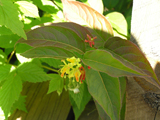
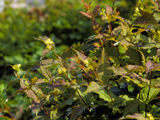
We are assuming that you have Diervilla lonicera (northern bush honeysuckle), which is native to Ohio. It is deciduous, forms thickets by suckerinig, and is short-lived. You can follow the link above and learn more about it, including the fact that it is a low water use plant, and needs shade (less than 2 hours of sun daily) or part shade (2 to 6 hours of sun) to thrive. Without more information about possible insect infestation or other environmental problems, we can't say what is causing the browning of some of the branches. However, most woody plants will benefit from some trimming up. Any vine that is detracting from the appearance by looking brown or straggly can be clipped off, right at the ground, if you wish. Dead ends can easily be pruned off below the dead area. Most woody plants will come back fuller and more vigorous after a good pruning. For further information and pictures, see this Connecticut Botanical Society website Diervilla lonicera.
From the Image Gallery
More Shrubs Questions
Bumelia sending up shoots in Austin
November 28, 2010 - I have a bumelia that is sending up shooters everywhere in my yard. Everywhere!! I started to dig them up, but many come from deep roots and my digging seems to have encouraged the tree to send up m...
view the full question and answer
Plants to grow under a black walnut tree in PA
July 03, 2011 - I want to plant some shrubs and flowers in an area with southern exposure that is dry, sunny, and within the drip line of, and partially under a large black walnut tree. I had been told that native pl...
view the full question and answer
Cupressaceae dying in Suffolk Co.NY
October 20, 2012 - I have noticed that all of my Cupressaceae (& others I see in my area) are dying. They turn yellow, then rust & brown til they are everbrowns. what is going on?
view the full question and answer
Non-berrying possumhaw from Austin
June 05, 2014 - I planted a possumhaw 8 to 10 years ago for the beautiful winter color, it has never set berries. I see tiny white flowers along the branches each spring, and always hope this will be the year, but I...
view the full question and answer
Identification of white flowering bush with lovely scent
May 17, 2015 - Please identify the sweet smelling white flowering bush/tree blooming now,May, in western Massachusetts. The flowers are tiny 4(?) petals in small clusters. The scent is wonderful.
view the full question and answer
| Support the Wildflower Center by Donating Online or Becoming a Member today. |