Native Plants

Q. Who is Mr. Smarty Plants?
A: There are those who suspect Wildflower Center volunteers are the culpable and capable culprits. Yet, others think staff members play some, albeit small, role. You can torture us with your plant questions, but we will never reveal the Green Guru's secret identity.

Did you know you can access the Native Plant Information Network with your web-enabled smartphone?

Ask Mr. Smarty Plants
Ask Mr. Smarty Plants is a free service provided by the staff and volunteers at the Lady Bird Johnson Wildflower Center.

rate this answer

Saturday - January 17, 2009
From: Austin, TX
Region: Southwest
Topic: Privacy Screening
Title: Privacy and noise screen in Austin
Answered by: Barbara Medford
QUESTION:
Mr. Smarty, I purchased a home and notice that my neighbors seem to hang outside their garage on the weekends and thus causing some noise. I need some major privacy from this neighbor and I was thinking of planting 5-6 Leland Cypress trees on my side to hide his view but don't know how far apart to give me privacy. What do you recommend? And can I plant them now in January? Please HELP!ANSWER:
We sympathize with your need for privacy, however, we don't think the Leyland Cypress is the right solution. For openers, it is a cross between Cupressus macrocarpa (Monterey cypress) and Chamaeryparis nootkatensis (Nooktka Cypress). The first is native to only a small area of the northern California coast, and does not prosper when it is away from the cool ocean breezes. The second, according to the USDA Forest Service linked above, is a native to coastal or mountainous, moist regions of North America from Alaska south to Oregon, performing best in areas with high humidity and moist soil conditions. Even though both parents of this hybrid, first created in 1888 in Wales, are natives to North America, it is not regarded as a native plant, itself. This Floridata website Cupressocyparis Leylandii warns that it is a high maintenance, fast growing tree, and can grow to 80 feet, overshadowing everything around it. In windy areas, trees may blow over due to rapid growth. A large tree unless constantly trimmed, it should not be planted too close to structures. So, those characteristics of both parents of the hybrid don't sound much like Austin, do they? In our dry, often windy, environment it would be a struggle to keep it from being damaged, if it could survive at all, and if it did survive, it doesn't appear you really have space on your property for even one, much less a hedge.
At the Lady Bird Johnson Wildflower Center, we promote the use of plants native not only to North America but to the area in which they are being grown. Because they are already adapted to the environment, they will require less fertilizer, water and maintenance. Rather than a tree, we would recommend some native shrubs that will grow fairly quickly, maintain foliage close to the ground, and be dense enough to help buffer you from the sound. We are going to suggest some that are evergreen, attractive year-round, seldom bothered by pests and disease, and effective in toning down noise. In fact, if you have the room, you might plant two rows of the shrubs, the first row with shrubs 6 feet apart, and the second row staggered, with the first one in the row positioned between the first two in the first row, continuing the second row with shrubs six feet apart. If you only have room for one row, plant the shrubs 3 to 4 feet apart. As these grow together into a fairly solid plant wall, that arrangement would give you an added layer of protection. Most of these will also attract birds and provide nesting sites. They are all commercially available; if you have any difficulty finding the one you choose, you can go to our Native Plant Suppliers section, type in your town and state in the "Enter Search Location" box and get a list of native plant nurseries, seed companies and landscape consultants in your general area.
Before we make our list, there are a couple of considerations we want to explain. All these shrubs require a good deal of sun. Planting them between two houses that are close together will probably not allow them the sun to grow as fast and thick as you would like. Also, several are listed as "dioecious," which means that only the females have berries and there must be a male of the same species, blooming at the same time, within 30 to 40 feet, for the berries to develop. If you had a hedge of 12 yaupons, for example, a couple of males in that hedge would assure berries on the females. You can follow the links to each plant webpage and learn about their light and moisture requirements, speed of growth, etc.
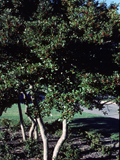
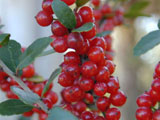
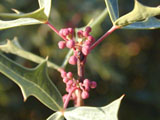
Ilex vomitoria (yaupon) - grows 12 to 25 ft. tall, female plants have bright red berries. Dioecious.
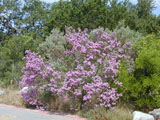
Leucophyllum frutescens (Texas barometer bush) - can reach 8 ft in height, pinky purple flowers can bloom intermittently virtually year round, depending on conditions.
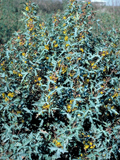
Mahonia trifoliolata (agarita) - 6 to 8 ft. tall, rigid spreading branches can create a thicket, spiny leaves really a barrier.
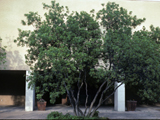
Rhus virens (evergreen sumac) - 8 to 12 feet tall. Dioecious.
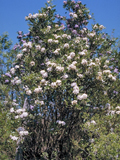
Sophora secundiflora (Texas mountain-laurel) - up to 30 ft. tall. Warning: red seeds are poisonous.
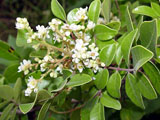
Morella cerifera (wax myrtle) - 6 to 12 ft. tall, fast growing, fragrant foliage, attracts birds. Dioecious.
More Privacy Screening Questions
Looking for a Privacy Barrier Plant for NC
August 21, 2014 - I am trying to determine the best plant for a privacy barrier for my area in NC that has clay soil. I have a 6 foot high fence but need something 12 feet or taller. It has to be something that does no...
view the full question and answer
Privacy screen for Pace Florida
March 10, 2014 - We live in the Florida panhandle and I wondering what we could use as a natural fence line between our property and the neighbor's. I love the look of oleander, but upon research found it to be toxic...
view the full question and answer
Evergreen Privacy Screen for Maryland
November 19, 2012 - I am looking for an evergreen that will suffice to be planted as a privacy screen between my property and my neighbors. Looking to plant a row at the property line.
The lot is shaded most of the d...
view the full question and answer
Fence Shrub for Sugarland, TX
June 08, 2015 - Hello
I live in Sugar Land TX, I am looking for a fast growing shrub to plant along my six foot wood fence for a privacy screen. There is not a lot of room for them to grow in width but there is pl...
view the full question and answer
Privacy screen for Sedona AZ
August 02, 2013 - I live In Sedona Az. A builder just built a house next to my house and the new house is ugly to look at. What plant or tree would grow fast and reach 18 foot in height fast. It can be about 5 to 6 foo...
view the full question and answer
| Support the Wildflower Center by Donating Online or Becoming a Member today. |