Native Plants

Q. Who is Mr. Smarty Plants?
A: There are those who suspect Wildflower Center volunteers are the culpable and capable culprits. Yet, others think staff members play some, albeit small, role. You can torture us with your plant questions, but we will never reveal the Green Guru's secret identity.

Did you know you can access the Native Plant Information Network with your web-enabled smartphone?

Ask Mr. Smarty Plants
Ask Mr. Smarty Plants is a free service provided by the staff and volunteers at the Lady Bird Johnson Wildflower Center.

rate this answer

Monday - November 10, 2008
From: Tucson, AZ
Region: Southwest
Topic: Seed and Plant Sources
Title: Is Cissus trifoliata a food source for wildlife?
Answered by: Barbara Medford
QUESTION:
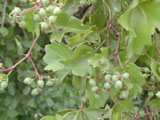
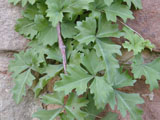
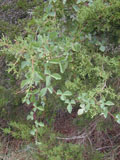
We apparently have Cissus Trifoliata growing around and over our porch.I was thinking about trying to remove it and plant grape vines instead as our desert tortoises will eat grape leaves. My question is whether or not this (native)vine is a food source for wildlife (including tortoises) or if there will be little impact if I remove it from my yard.ANSWER:
Cissus trifoliata (sorrelvine) has somewhat fleshy leaves which may cause skin irritation for some people. The small berries are inedible, and the leaves have a bad odor when crushed. We could not find evidence that it is a significant food source for any wildlife, including the desert tortoise. Since there is the possibility of skin irritation, there might be some chemical component in the plant that is not good for consumption by wildlife, although we don't know this for sure. However, in view of the possibility of irritation and the bad odor, it does not seem worth it to keep it on your porch, if you would prefer to replace it with grapevines, thus providing leaves for your tortoise's dinner.

More Seed and Plant Sources Questions
Bluebonnets for wedding in February
August 04, 2008 - I'm getting married in February 2009. My father passed away when I was younger and thus, won't be there to walk me down the aisle. His favorite flower was bluebonnets and I would like to include t...
view the full question and answer
Smarty Plants on Hesperaloe parviflora
July 11, 2005 - I see these bright pink orange flowers on tall bracts everyday on the way to work. I have been searching for the name so I can buy one. I found a picture on your site at (http://www.wildflower.org/?...
view the full question and answer
Looking for chinaberry trees to buy and plant in Austin
September 15, 2009 - I am looking to buy china berry small trees to plant in Austin , any suggestion where i might be able to buy them
thank you
view the full question and answer
Source for Texas maple keys
October 05, 2004 - I'm looking for a source for native Texas maple keys. Know of any?
view the full question and answer
Smarty Plants for Mission, TX
August 11, 2005 - Last week I visited my uncle who is head of a church in Mission, TX. The
church owns an empty 2 to 3 acre lot, where they hope to build a school
someday. However, that day is at least 10 to 15 years...
view the full question and answer
| Support the Wildflower Center by Donating Online or Becoming a Member today. |