Native Plants

Q. Who is Mr. Smarty Plants?
A: There are those who suspect Wildflower Center volunteers are the culpable and capable culprits. Yet, others think staff members play some, albeit small, role. You can torture us with your plant questions, but we will never reveal the Green Guru's secret identity.
Did you know you can access the Native Plant Information Network with your web-enabled smartphone?
Ask Mr. Smarty Plants
Ask Mr. Smarty Plants is a free service provided by the staff and volunteers at the Lady Bird Johnson Wildflower Center.

rate this answer

Monday - July 28, 2008
From: St Charles, IL
Region: Midwest
Topic: Poisonous Plants, Grasses or Grass-like, Shrubs
Title: Hardy plants for a narrow yard in Illinois
Answered by: Nan Hampton
QUESTION:
I have an area in my yard that is approx 35 feet by 5 feet that is shaded on the east by a 4 ft fence and on the west by the house and above by trees. It slopes off to the neighbors yard (so doesn't retain much water) and the soil is somewhat rocky and compacted. I am looking for ANYTHING that might grow in these conditions. The last problem of this spot: the dogs have the run of this area and so if the plant is short, I 'd like it to be able to withstand a bit of trampling, and if it's bushy, it has to take being chewed on now and then (after establishment of course!--but no yummy toxic varieties). (We can put a small fence around it to keep the dogs out for a few years, eventually I'd like to take it down and have the plants "stand" on their own. Any suggestion you could give me would be helpful. Thanks!ANSWER:
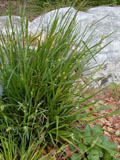
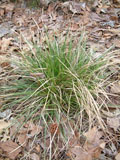
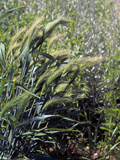
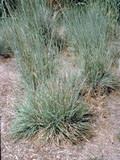
You might consider sedges and/or grasses for groundcover. The sedges all grow to about one foot high. The grasses grow taller, 2 to 3 feet, but are very attractive when they are green and even when they turn brown in the fall:
Carex blanda (common woodland sedge)
Carex granularis granularis (meadow sedge)
Carex pensylvanica (Pennsylvania sedge)
Elymus canadensis (Canada wild rye)
Schizachyrium scoparium (little bluestem)
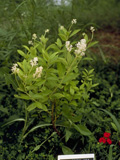
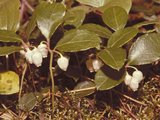
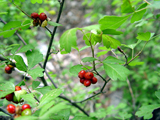
Here are some shrubs that are hardy and grow in rocky or varied soil conditions. They range in size from a few inches high to 10 or more feet.
Ceanothus americanus (New Jersey tea)
Gaultheria procumbens (eastern teaberry)
Physocarpus opulifolius (common ninebark)
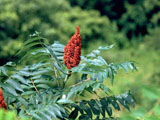
Rhus aromatica (fragrant sumac)
I checked several toxic plant databases (Poisonous Plants of North Carolina, Cornell University Poisonous Plants Informational Database, and University of Pennsylvania Poisonous Plants) and none of the plants recommended above appeared on any of them so your dogs should be safe. They should, however, be kept out of the area until your plants are well-established.
You can see more possibilities for plants to meet your requirements by doing a Combination Search in our Native Plant Database and choosing 'Illinois' from the Select State or Province option and 'Shrub' (or another form) from Habit (general appearance), then 'Part Shade' from Light Requirement and 'Dry' from Soil Moisture.
For nurseries that specialize in native plants in your area please see the suggestions in our National Suppliers Directory.


More Shrubs Questions
Problems on mock orange plant in England
August 20, 2008 - I have a small mock orange plant that is about 3 years old. It is currently in a 12 inch plant pot in full sun. It bloomed beautifully this year but the leaves on both the new and old growth are start...
view the full question and answer
Native plants for morning sun in Pembroke MA
October 07, 2009 - Could you please suggest native groundcover,plants/shrubs/grasses for eastern facing slope which gets morning sun? It is my front yard which slopes down toward driveway so it would be a major focal po...
view the full question and answer
Dwarf Yaupon Holly Cultivar Heights
September 18, 2014 - What is the largest of the dwarf yaupons?
view the full question and answer
Low-maintenance native plants for Arizona
March 12, 2009 - Will you please suggest some Native plants that can be left without care for the summer and survive - other than cactus?
view the full question and answer
Aromatic sumac in Travis County
August 14, 2010 -
This is an answer to article in today's, August 14, newspaper. I assume that aromatic sumac is native to Travis county because I have it all over my property. It turns bright red in the fall adding...
view the full question and answer
| Support the Wildflower Center by Donating Online or Becoming a Member today. |