Native Plants

Q. Who is Mr. Smarty Plants?
A: There are those who suspect Wildflower Center volunteers are the culpable and capable culprits. Yet, others think staff members play some, albeit small, role. You can torture us with your plant questions, but we will never reveal the Green Guru's secret identity.

Did you know you can access the Native Plant Information Network with your web-enabled smartphone?

Ask Mr. Smarty Plants
Ask Mr. Smarty Plants is a free service provided by the staff and volunteers at the Lady Bird Johnson Wildflower Center.

rate this answer

Monday - April 14, 2008
From: Boerne, TX
Region: Southwest
Topic: Compost and Mulch, Watering, Trees
Title: Sudden death of Texas Mountain Laurel
Answered by: Barbara Medford
QUESTION:
Last year, my 15-year-old Mountain Laurel died very suddenly. The leaves began to curl up and turn brown, and it was dead within about 15 days. What happened?ANSWER:
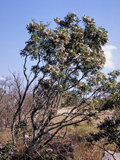
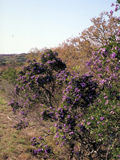
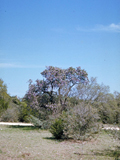
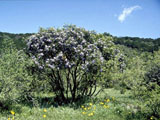
Since you didn't mention any sort of insect disturbance or contamination from spraying nearby with herbicides, we are guessing that your tree died by drowning. Boerne, between San Antonio and Kerrville on US Hwy. 87, should ordinarily be dry enough to satisfy the needs of the Sophora secundiflora (Texas mountain-laurel) for good drainage. However. last year's weather was very unusual in Central Texas, and we had an awful lot of rain. If your Mountain Laurel had survived that many years, it could mean that the drainage where it was planted had not been challenged. If it was under roof drainage, in the path of runoff, or just in a hole with bad drainage, the roots may have stood in water longer that it could survive. Obviously, there's nothing you can do to recover your lost tree; however, if you choose to replace it, be aware of the drainage needs. Don't plant it somewhere that could be in the path of heavy runoff, work some humus (compost, etc.) into the soil, and make sure it's not at the bottom of a slope or a dip in the property. This tree is accustomed to growing on limestone shelves, with rocks for soil, and water a rarity.
More Trees Questions
Precautions regarding pruning live oaks in the Austin area.
October 27, 2015 - Is it still recommended that we clean pruning shears and spray wounds when pruning live oaks in the Austin area?
view the full question and answer
Protecting live oaks when removing jasmine in Austin
December 03, 2010 - Thank you for your answer to my question of eliminating a 25-year-old bed of Asian Jasmine. I have another question. There is a stand of live oak trees in this bed and as we are digging out the jasmi...
view the full question and answer
Fast growing native trees for firewood in New Hampshire
September 25, 2008 - Can you tell me what FAST growing tree is best for a planned crop? We plan to generate new tree crops every year. We want to use this wood for burning in indoor wood stoves and maybe in an outdoor woo...
view the full question and answer
Transplanting redbud from field in Edmond, OK
March 30, 2009 - I want to transplant a small redbud from a field to my yard. The trunk diam is about 1.5" and the tree is about 4' tall. What is the best way to do this? Should I plant it in a pot first?
view the full question and answer
Privacy screen for Sedona AZ
August 02, 2013 - I live In Sedona Az. A builder just built a house next to my house and the new house is ugly to look at. What plant or tree would grow fast and reach 18 foot in height fast. It can be about 5 to 6 foo...
view the full question and answer
| Support the Wildflower Center by Donating Online or Becoming a Member today. |