Native Plants

Q. Who is Mr. Smarty Plants?
A: There are those who suspect Wildflower Center volunteers are the culpable and capable culprits. Yet, others think staff members play some, albeit small, role. You can torture us with your plant questions, but we will never reveal the Green Guru's secret identity.

Did you know you can access the Native Plant Information Network with your web-enabled smartphone?

Ask Mr. Smarty Plants
Ask Mr. Smarty Plants is a free service provided by the staff and volunteers at the Lady Bird Johnson Wildflower Center.

rate this answer

Saturday - March 22, 2008
From: cedar hill, TX
Region: Southwest
Topic: Pruning, Herbs/Forbs
Title: Pruning of native perennial blooming plants
Answered by: Barbara Medford
QUESTION:
Hello - I am still a newbie at using Native Texas plants (but loving them!), and I need pruning assistance. When (and how much) do I prune: hot lips salvia, hummingbird bush (anisthcanthus wrightii), and common yarrow? All of these appear dead (although possibly are still alive) in my yard. The hot lips do have some green to them, but not a great deal.ANSWER:
Welcome to Native Texas gardening! One of the first things you learn here is that you can't fight the way things grow in Texas. Far better to select plants that are native here and have adapted to our weather, soil, etc. We have an excellent set of "How-To Articles" that should help you start to learn your way around. Particularly, in reference to your question, read the article on Gardening Timeline. Each of the plants you've asked about has a webpage that you can click on the plant name to access, and find out more about its habits and needs. Most Texas perennial flowering plants need some cutting back when they have dropped their leaves. Many can actually be cut to the ground, as they are going to come back from the roots, but we like to leave a few 6-inch stalks standing up so we know that's a plant we planted, and not a weed that needs to be yanked. Always clean up around your plants, taking away dropped leaves and stems, to help prevent mildew, disease and insect damage.
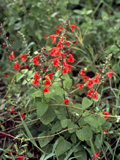
Salvia coccinea (blood sage) This should be periodically trimmed and deadheaded to keep it bushy and in bloom.
Anisacanthus quadrifidus var. wrightii (Wright's desert honeysuckle) (also known as Hummingbird Bush). Cutting this plant back severely in winter will provide more blooms and encourage bushier form.
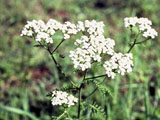
Achillea millefolium (common yarrow)

More Pruning Questions
Trimming back freeze damage from Anacacho orchid in Liberty Hill TX
May 17, 2010 - When is it safe to trim back what I think is dead wood on my Anacacho orchid trees (that were hit hard this past winter)? Is there any harm done if I cut back living wood?
view the full question and answer
Rocky Mountain Juniper Grazed by Deer
April 29, 2013 - I have four Colorado red cedar (Juniperus scopulorum). The deer have eaten from their height down. Now these narrow top to bottom evergreens have only tops left. Will the bottom fill in if I protect t...
view the full question and answer
When and how to prune lavender (Lavandula sp.)
March 20, 2009 - Dear Mr. Smarty Plants
I have a Goodwin Creek Lavender plant that I planted last year. It did very well but my question is about pruining.
It seems that there is some growth coming up now that it...
view the full question and answer
Red oaks that didn't drop leaves in Austin
April 04, 2012 - I have a number of Red Oaks on land that did not drop leaves this past fall. Now these same trees seem to be dead? It seems there's some type of mold/fungus on the trees. Some trees have small patche...
view the full question and answer
Pruning non-native peach in Austin, TX.
June 18, 2015 - I planted two five gallon Texas Star peach trees last February but didn't have the nerve to prune them back to knee height. After having been convinced that this is a good thing to do, I'd like to k...
view the full question and answer
| Support the Wildflower Center by Donating Online or Becoming a Member today. |