Native Plants

Q. Who is Mr. Smarty Plants?
A: There are those who suspect Wildflower Center volunteers are the culpable and capable culprits. Yet, others think staff members play some, albeit small, role. You can torture us with your plant questions, but we will never reveal the Green Guru's secret identity.

Did you know you can access the Native Plant Information Network with your web-enabled smartphone?

Ask Mr. Smarty Plants
Ask Mr. Smarty Plants is a free service provided by the staff and volunteers at the Lady Bird Johnson Wildflower Center.

rate this answer

Friday - January 25, 2008
From: Splendora, TX
Region: Southwest
Topic: Grasses or Grass-like
Title: Native grass for Splendora, Texas.
Answered by: Nan Hampton
QUESTION:
We have a newly built house on a two acre lot in Splendora (zip code 77372). We would like to seed (the best choice) for grass. What about centipede or buffalo grass? The soil is a sand with clay 4 feet underneath. Also, we have "critter holes" that we can't figure out. I know what crawfish "towers" look like (we have a few), but, these others are a mystery. They are up to 2 - 3 inches wide & seem to have a least two entrances. I'm hoping they aren't snake holes!! Any ideas? Thank you!ANSWER:
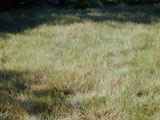
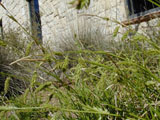
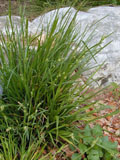
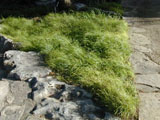
Mr. Smarty Plants recommends Bouteloua dactyloides (buffalograss), but not Eremochloa ophiuroides (centipede grass) since it is not native to North America and what we are all about here at the Lady Bird Johnson Wildflower Center is "...to increase the sustainable use and conservation of native wildflowers, plants and landscapes." Buffalograss does very well in the sun and in partial shade, requires very little water, and doesn't need mowing very often. Please see our article "Native Lawns" for help in establishing a native lawn.You might also consider using one of the sedges (e.g., Carex cherokeensis (Cherokee sedge), Carex blanda (eastern woodland sedge) or Carex texensis (Texas sedge)) in place of grass for your lawn. For more on the advantages of replacing grass with sedges read Sedge Lawns for Every Landscape by John Greenlee.
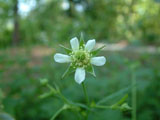
There are several plants that aren't grasses or sedges that will also work as groundcovers; for instance, Calyptocarpus vialis (straggler daisy), Geum canadense (white avens), and Phyla nodiflora (turkey tangle fogfruit).
Now for those critter holes, have you considered that they could be made by moles or gophers? I think this, or some other rodent, is more likely than snakes; but, without seeing a picture of them, I'm afraid that's about the best I can do. You might check with your Montgomery County Extension Office to see if they have any ideas for you.
More Grasses or Grass-like Questions
Lindheimer's Muhly Grass Seeds for Human Use?
July 07, 2016 - Does anyone know if Lindheimer's Muhly seeds were ever used as human food source?
view the full question and answer
Plants for wall behind pool in Huntingdon Beach California
May 11, 2009 - I have a backyard pool and I just removed a messy ivy hedge that grew along the back block wall. The plant was shedding too much leaves. I would like the new plant to hide the fence and grow close en...
view the full question and answer
Problems for non-native St. Augustine grass from Little Rock AR
July 18, 2012 - We sodded St. Augustine grass four weeks ago. For the first three weeks we had no rain and temperatures over 100 degrees. We have watered 20 minutes twice a day since installation. There are brown pat...
view the full question and answer
Plant for deep shade in Pennsylvania
April 09, 2013 - Hi! I am landscaping our house and trying to use only plants that provide seasonal benefit to bees, butterflies, birds etc. not the deer though. My question is that I have a fairly steep slope of abou...
view the full question and answer
Submerged paving under lawn
September 07, 2008 - I had 4 patches of rectangular areas (about 4'x6'or more) in my lawn where the grass is fine in spring but totally dies in summer. I decided to till these bare patches so that grass may grow better...
view the full question and answer
| Support the Wildflower Center by Donating Online or Becoming a Member today. |