Native Plants

Q. Who is Mr. Smarty Plants?
A: There are those who suspect Wildflower Center volunteers are the culpable and capable culprits. Yet, others think staff members play some, albeit small, role. You can torture us with your plant questions, but we will never reveal the Green Guru's secret identity.

Did you know you can access the Native Plant Information Network with your web-enabled smartphone?

Ask Mr. Smarty Plants
Ask Mr. Smarty Plants is a free service provided by the staff and volunteers at the Lady Bird Johnson Wildflower Center.

rate this answer

Thursday - July 19, 2007
From: Watkinsville, GA
Region: Southeast
Topic: Edible Plants
Title: Edibility of fruit of Passiflora incarnata
Answered by: Joe Marcus
QUESTION:
We have Passion flower vines growing, blooming and producing fruit all over our property and the land nearby. They are growing wild. We are near Greensboro, Georgia which is barely in the Northeast part of the state. I love the flowers and I want to know whether the fruit is edible. I have observed it for several years and not yet seen any of the green fruit change color. I looked up some information and found that a variety that grows in Australia has green fruit, but it did not look quite like our plants. Can you tell me how to find out whether our fruit is edible?ANSWER:
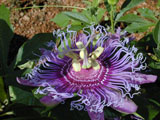
At least two native passionflowers call Georgia home, but by far the most common species there is Passiflora incarnata (purple passionflower), also known colloquially as maypop. Maypop's fruit is about the size and shape (without the fuzz) of a kiwifruit when mature. When ripe, the skin of the fruit wrinkles slightly, changes color to a greenish-yellow to yellow to brownish-yellow and softens. At this point the fruit (technically a berry) is edible. Yours should be ripening soon.
The seed-filled pulp of the fruit is the part that is eaten. The fruits of some individual plants are tastier than those on other plants of the species. Some people do not care for the taste at all. There probably is not an Emily Post-like way of eating maypops, but children just seem to know that you should break them open - they often make an audible pop in the process - and squeeze the contents, seeds and all, into your mouth where you strain and swallow the sweet-tart pulp and spit out the glob of seeds. Dainty no, delicious yes.
You are right that there is surprisingly little information on the Internet about this sweet summer treat. We are sure that as time goes by, more information will be posted online extolling the virtues of this wonderful native fruit.
From the Image Gallery
More Edible Plants Questions
Need information about Pignut (Hoffmannseggia glauca).
November 30, 2009 - I wanted to know a little about Pignut (also called Indian Rush-pea and Hog Potato); botanical name Hoffmannseggia glauca. Is it edible, and at what point does the plant produce a tuber (looks like a ...
view the full question and answer
Native Grasses as a Hay Crop in Beeville, TX
October 22, 2014 - I am looking to cut Hay on about 38 acres just west of Beeville, Texas. I want to convert the land to native grasses, but I still want to have a decent hay crop that I can sell. What is a good set of ...
view the full question and answer
Dog eats Celtis laevigata, sugar hackberry
May 21, 2012 - This is an odd question but I am a biologist and have for years notice an odd behavior in my Golden Retriever. When he gets stomach distress or something makes him nervous like an incoming thunderstor...
view the full question and answer
Wild plum tree failing to bloom from Simonton TX
May 04, 2013 - I have a wild plum tree that has been in the ground for 3 or 4 years and it has not ever flowered. Why? I don't know what kind it is. I dug it up from a friends yard. Her wild plum trees have flowere...
view the full question and answer
How Do Persimmons Breed - Starkville, MS
August 14, 2012 - Thank you for your earlier response about the genders of native persimmon trees. We have two, a much larger one that has borne fruit for years and years and a smaller one that I'd just assumed was m...
view the full question and answer
| Support the Wildflower Center by Donating Online or Becoming a Member today. |