Native Plants

Q. Who is Mr. Smarty Plants?
A: There are those who suspect Wildflower Center volunteers are the culpable and capable culprits. Yet, others think staff members play some, albeit small, role. You can torture us with your plant questions, but we will never reveal the Green Guru's secret identity.

Did you know you can access the Native Plant Information Network with your web-enabled smartphone?

Ask Mr. Smarty Plants
Ask Mr. Smarty Plants is a free service provided by the staff and volunteers at the Lady Bird Johnson Wildflower Center.

rate this answer

Wednesday - June 06, 2007
From: Edinboro, PA
Region: Mid-Atlantic
Topic: Deer Resistant
Title: Control for slugs and snails in Arisaema triphyllum
Answered by: Joe Marcus
QUESTION:
I had a beautiful Jack In The Pulpit growing and something has eaten it. What can I do to help prevent that next year? I live in Northwestern PA.ANSWER:
Slugs or snails are the likely culprits. Jack-in-the-pulpit (Arisaema triphyllum), contains chemical compounds which most herbivores - including deer and rabbits - find unpalatable. Of course, deer are famous for eating plants which common knowledge says they won't eat, but deer typically browse such plants only when other, preferred food sources are scarce and when the normally-distasteful plant is producing new, tender growth with low cellular concentrations of the offending chemical compound. Snails and slugs are not that picky and Jack-in-the-pulpit seems to be a preferred plant for them.
The best way to forestall another slug attack next year is to remove the things in your garden that attract them. Since you will want to keep your Jack-in-the-pulpit plants, you will want to take a different strategy. The most attractive garden elements for snails and slugs are good hiding places. These creatures spend most of their time lurking in moist sheltered spots and do their hunting and feeding during nighttime hours. If you remove or otherwise make unsuitable the places snails like to hide, they will simply go elsewhere.
There are several non-toxic (to humans and other vertebrates) control strategies that you might employ to kill or repel your garden snails. Here is a link to an excellent article from The University of California on snail and slug management. One of the copper-based strategies described in the article, along with removal of hiding places, will likely yield the best results for you.
From the Image Gallery
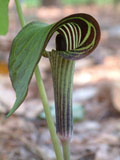
More Deer Resistant Questions
Is it deer or ducks eating plants in Granbury, TX?
May 18, 2009 - I have some salvia and coreopsis that were recently beheaded along with some blooms on Knockout roses. I had just recently put out some Deerscram, but we've had some ducks visiting recently.
Could ...
view the full question and answer
Deer resistant plants for campground in West Virginia
February 24, 2006 - We spend the summers at a campground as permanent campers. We fix up our sites to be a pleasure to spend our time smelling and see the wild life come and perch around the area. We would like to know...
view the full question and answer
Use of Gaura by deer as a food source
March 05, 2006 - I live in North Central Texas and am considering planting some Gaura plants in my backyard. However, we have a large deer population in the area. Are deer generally drawn to Gaura as a food source?
view the full question and answer
Will deer eat bellflowers?
August 10, 2014 - Are deer attracted to the bellflower? Will they eat it?
view the full question and answer
Deer resistant plants for Trinity, TX
March 23, 2013 - I need a list of deer resistant flowers, herbs and plants that would could be planted in Trinity, Texas.
view the full question and answer
| Support the Wildflower Center by Donating Online or Becoming a Member today. |