Native Plants

Q. Who is Mr. Smarty Plants?
A: There are those who suspect Wildflower Center volunteers are the culpable and capable culprits. Yet, others think staff members play some, albeit small, role. You can torture us with your plant questions, but we will never reveal the Green Guru's secret identity.

Did you know you can access the Native Plant Information Network with your web-enabled smartphone?

Ask Mr. Smarty Plants
Ask Mr. Smarty Plants is a free service provided by the staff and volunteers at the Lady Bird Johnson Wildflower Center.

rate this answer

Monday - July 11, 2016
From: Mt. Enterprise, TX
Region: Southwest
Topic: Butterfly Gardens, Wildflowers
Title: Promoting Monarch Habitats in Texas
Answered by: Anne Van Nest
QUESTION:
My parents have a 6 acre pasture in East, TX with native milkweed in it. What are the best times of year to bush hog to promote more milkweeds & do you know of any grants to help manage land for monarch migration?ANSWER:
A good resource to look into for possible assistance is the USDA Natural Resouces Conservation Service Monarch Butterfly Habitat Development Project. The NRCS Monarch Butterfly Habitat Development Project focuses on the Eastern population of the monarch butterfly, which occurs in all states east of the Rocky Mountains. FWS has identified the migratory corridor from Texas to the upper Midwest as a key region for monarch habitat efforts.Monarchs use milkweed as the sole food source of their larva, and also as a source of nectar for adults. There are about 110 species of Asclepias in North America. For this project, which focuses on large-scale habitat enhancement for the eastern population, NRCS is focusing on six species of Asclepias. All are perennials.Three of these species occur in the southern Great Plains (Asclepias asperula, A. oenotheroides and A. viridis) and three in the Midwest (A. syriaca, A. incarnata, and A. tuberosa). In addition to these species, several others are increasingly available in the commercial native seed industry, including A. verticillata, A. purpurascens, and A. sullivantii.
The FWS has identified three species as being the most critical for the monarch recovery in the Southern Plains. They are:
• Spider milkweed (Asclepias asperula): This narrow-leafed species is particularly common to central Texas and is most adapted to shallow calcareous soils common to the Edwards Plateau of central Texas. It also occurs in OK and KS, but to a lesser degree. It occurs primarily on grazed lands but also on areas maintained by periodic mowing and shallow soils that are not grazed. It appears to prefer shallow soils that range from slightly alkaline to calcareous.
• Zizotes milkweed (A. oenotheroides): This wide-leaf species is common in northern Mexico, southern, central and north-central Texas. It also occurs in Oklahoma. Zizotes milkweed is well adapted to deep, neutral to moderately alkaline clays and clay loam soils, and occurs primarily on grazed lands as well as on areas maintained by periodic mowing. Introduced grasses common to southern Texas may be contributing to the decline of this milkweed species.
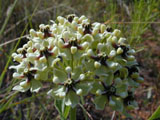
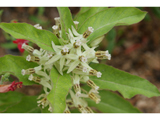
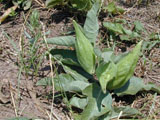
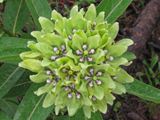
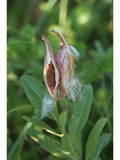
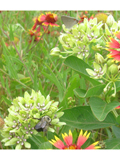
• Green antelope horn (A. viridis): This wide-leaf species is common to central Texas, Oklahoma and Kansas. Because of the larger range, many consider this species to be the key species for first generational monarchs. It occurs almost exclusively on grazed lands and non-agricultural areas periodically mowed, such as roadsides, parks and urban lands. It appears to prefer deep loams and fine sandy loam soils but tolerates deep finer textures soils. This species prefers soils that are slightly acid to slightly alkaline. Unlike A. asperula, it rarely occurs on shallow soils.
Monarchs limit lipid intake during migration and use a “fuel as you go” approach. As they near Mexico, monarchs begin to build lipid reserves needed to overwinter in the cool and damp climate. Failure to build fat reserves would impact survival during the long winter dormancy period. For these reasons, NRCS will concentrate on increasing availability and distribution of fall nectaring habitat in the southern Great Plains subregion. It is important to note that Asclepias species are an excellent source of nectar. Prescribed burning during summer has increased availability of milkweed for the fall migration. Similarly, summer mowing appears to increases availability of milkweed nectaring resources in the fall. NRCS will allocate resources in an attempt to increase availability of fall nectaring plants in the southern Great Plains subregion.
From the Image Gallery

More Butterfly Gardens Questions
What would replace non-native orange tree leaves in butterfly hatchery?
July 17, 2009 - I have a very small orange tree that currently has dozens of caterpillars on it that look like bird droppings. I think I have narrowed them down to a swallowtail butterfly. I would love to let them ma...
view the full question and answer
Effects or insecticide on Monarch butterflies
July 28, 2013 - Thank you for fielding questions about plants!! Our nursery just informed us that their milkweed grower was using imidacloprid in their milkweed production. As a follow up to the question already in...
view the full question and answer
Food for butterflies in Austin
April 21, 2013 - Mr. Smarty Plants, my kids and I are raising Painted Lady butterflies from caterpillars but it's still too cold to release them (oddly cool spring we're having!) If they mate and lay eggs, what loc...
view the full question and answer
Green blooms on Cedar Sage in Lucas TX
September 22, 2010 - I have two Cedar Sage (Salvia roemeriana) one purchased from your plant sale and one from a local nursery planted in part shade in the Dallas area.
They seem to be quite happy and are blooming but ...
view the full question and answer
Growing butterfly weed as a girl scout project
July 30, 2012 - We have a group of girl scouts who want to sell 'crafts' at a farmers market. I am wanting to steer the moms and girls in a different direction. I was wondering if you think that butterfly weed woul...
view the full question and answer
| Support the Wildflower Center by Donating Online or Becoming a Member today. |