Native Plants

Q. Who is Mr. Smarty Plants?
A: There are those who suspect Wildflower Center volunteers are the culpable and capable culprits. Yet, others think staff members play some, albeit small, role. You can torture us with your plant questions, but we will never reveal the Green Guru's secret identity.

Did you know you can access the Native Plant Information Network with your web-enabled smartphone?

Ask Mr. Smarty Plants
Ask Mr. Smarty Plants is a free service provided by the staff and volunteers at the Lady Bird Johnson Wildflower Center.

rate this answer

Friday - November 06, 2015
From: Austin, TX
Region: Southwest
Topic: Meadow Gardens, Propagation, Herbs/Forbs
Title: Improving Bluebonnet seed contact with soil
Answered by: Guy Thompson
QUESTION:
I have a five acre field in Blanco County, much of which is covered by bluebonnets. There are several species of native grasses as well. Would it be beneficial to disk or otherwise disturb the soil every few years? Or would annual mowing provide enough soil disturbance to encourage the bluebonnets to reseed?ANSWER:
We have a good website describing methods for large scale wildflower seed planting. This would be useful to you, since the most important requirement for good germination is getting the seeds into direct contact with the mineral soil. Mowing and raking off existing vegetation prior to planting may be necessary to improve seed/soil contact.
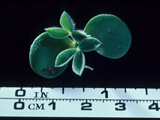
However, I would not recommend following these procedures this year. With all the rain we have had, Lupinus texensis (Texas bluebonnet) seeds are already germinating in Central Texas. I suggest that you walk through your field looking for sprouting Bluebonnet seeds. I attach two photos of Bluebonnet seedlings. In my yard many of them still have only the two seed leaves (the round leaves shown in the first photo). If you see no signs of Bluebonnet seedlings, it should be save to proceed with the soil-loosening steps described in the website.
From the Image Gallery

More Herbs/Forbs Questions
Optimal time for trimming Fall asters
July 04, 2014 - RE: fall asters
What is the latest date in the summer that I can trim my fall asters and still get a good amount of blooms in October?
view the full question and answer
Color year round, welcome to Austin Texas.
December 04, 2011 - I am new to Austin and want to plant colorful flowers for fall and winter that get a "wow" reaction. I have not seen much at the local nurseries. Any and all suggestions are greatly appreciated!
view the full question and answer
Death of Texas Betony and Blackfoot Daisy from Austin
April 18, 2013 - I have one small area that there are two plants - Texas Betony and Blackfoot Daisy withered and died eventually. Same kinds of plants are doing fine close by. It is my front yard close to walk way.I w...
view the full question and answer
South Austin Groundcovers for Oak Shade
March 29, 2013 - Hi! I live in S. Austin now but used to work at the Wildflower Center! My backyard is shady with several oak mots. Do you have any suggestions as to what if any ground cover will grow in all that sha...
view the full question and answer
Native plants for under a pine tree in Vevay IN
June 29, 2009 - At our office we have a very nice garden however, in the front we have a large pine tree. We cannot get anything to take root & live there. Do you have any suggestions for a native shrub or perennia...
view the full question and answer
| Support the Wildflower Center by Donating Online or Becoming a Member today. |