Native Plants

Q. Who is Mr. Smarty Plants?
A: There are those who suspect Wildflower Center volunteers are the culpable and capable culprits. Yet, others think staff members play some, albeit small, role. You can torture us with your plant questions, but we will never reveal the Green Guru's secret identity.
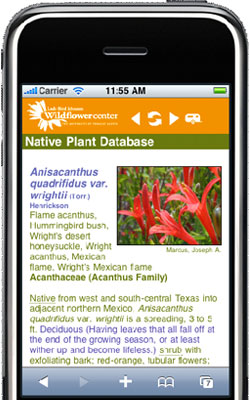
Did you know you can access the Native Plant Information Network with your web-enabled smartphone?

Ask Mr. Smarty Plants
Ask Mr. Smarty Plants is a free service provided by the staff and volunteers at the Lady Bird Johnson Wildflower Center.

rate this answer

Saturday - July 11, 2015
From: Covington, LA
Region: Southeast
Topic: Privacy Screening, Shrubs
Title: Barrier Shrubs for North Carolina
Answered by: Larry Larson
QUESTION:
Need a spiny barrier shrub that will grow in North Carolina shady rain forest (4,000 feet elevation) to deter trespassers wading down a creek from climbing on a private nature path that we constructed 10 ft above the creek. It probably needs to be about 3 ft tall ( or be pruned to 2-3 ft tall) so as to not block the view of the creek from the trail. I placed NO TRESPASSING signs to no avail. The trail is being destroyed, not to mention liability risks. Open to suggestions.ANSWER:
When Mr. Smarty Plants first read your question I thought of some of the championship level spiny plants we have here in Texas. Those would really send those trespassers back towards where they came from! But – They won’t do very well at 4000 ft. in North Carolina.
The plants that more likely should do well are listed in the Recommended Species Collection for North Carolina.
These lists can be sorted for characteristics. When I select Shrubs, this reduces the list to 32 candidates. Further selecting 1-6 feet high gives seven ones that are naturally as short as you would like. Thorny or thicket forming shrubs aren’t some of the characteristics that can be sorted out – but they are often listed in the discussion.
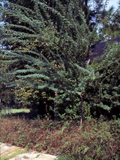
Erythrina herbacea (Coralbean) and Ribes rotundifolium (Appalachian gooseberry seem to meet your request most clearly, they are both thorny and 6 ft. or less in height. From the USDA link showing the native area, the Gooseberry seems better adapted to the mountains.
Other candidates that might find application are
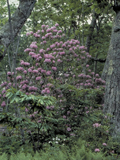
Rhododendron catawbiense (Catawba rosebay), Rhus glabra (Smooth sumac), Rhododendron maximum (Great laurel), and Symphoricarpos orbiculatus (Coralberry). Those struck me as possibilities as they form dense thickets, sometimes even mentioned as on slopes
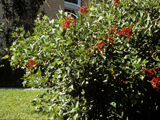
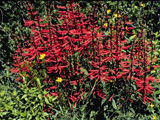
From the Image Gallery
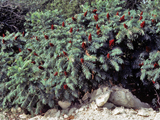
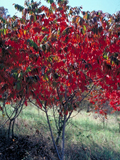
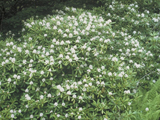
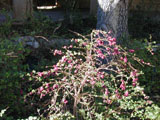
More Privacy Screening Questions
Trees for Privacy Screening in Central Texas
July 11, 2016 - I live in Cedar Park, Texas and have a neighbor who likes to have parties. I need a evergreen tree/hedge that will provide privacy and sound barrier. We have some wax myrtles but they don't work. We ...
view the full question and answer
Vines to Cover Brush Pile in Maryland
April 29, 2013 - We have a large brush pile on our property that we'd intended to burn, but it is big enough now that it would require the help of the fire department! I'm thinking I'd like to cover it with native ...
view the full question and answer
Dog-safe Privacy Screen for Ocala, FL
June 25, 2015 - Am desperately searching for fast growing privacy that would be non toxic to dogs in Ocala, Florida (zone 9 I think). Wanted Leland cypress but due to toxicity it won't work.
view the full question and answer
Screen for utility box in Seabrook TX
February 21, 2011 - Utility box cover: Thinking of using star jasmine on a three sided fence/trellis. Each side 3 ft sq. I can send a picture. Not sure best fence style to use or way to plant. Suggestions? Need cove...
view the full question and answer
Need suggestions for plants for a privacy screen for a pecan orchard in Chappell Hill, TX.
September 21, 2011 - Mr. Smarty Plants,
My family has just begun converting our land in Chappell Hill, TX (Washington County) into a pecan orchard. We had to clear a lot of the overgrowth around the edge of the proper...
view the full question and answer
| Support the Wildflower Center by Donating Online or Becoming a Member today. |