Native Plants
Q. Who is Mr. Smarty Plants?
A: There are those who suspect Wildflower Center volunteers are the culpable and capable culprits. Yet, others think staff members play some, albeit small, role. You can torture us with your plant questions, but we will never reveal the Green Guru's secret identity.
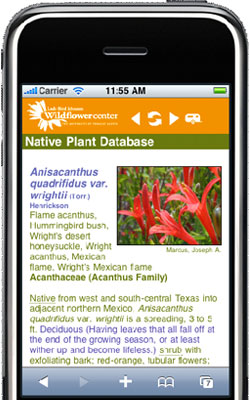
Did you know you can access the Native Plant Information Network with your web-enabled smartphone?

Ask Mr. Smarty Plants
Ask Mr. Smarty Plants is a free service provided by the staff and volunteers at the Lady Bird Johnson Wildflower Center.
rate this answer

Tuesday - December 09, 2014
From: Cushing, TX
Region: Southwest
Topic: Erosion Control, Ferns, Grasses or Grass-like, Herbs/Forbs, Shrubs
Title: Plants to prevent creekside erosion in Nacogdoches County, Texas
Answered by: Nan Hampton
QUESTION:
I am looking for some advice on plants native to Texas that can help prevent erosion. I own a wooded lot with a creek and would like to consolidate the sides of the creek against potential erosion. I'd like to find plants that could fill that purpose keeping in mind that it's a natural-looking environment in the middle of the woods (low light). Someone recommended "button bush" but I'm not sure that's the best choice. Thanks for your advice!ANSWER:
Cephalanthus occidentalis (Common buttonbush) would be an excellent choice for the creekside. It is frequently found along streams and does well in shade and part shade and is native to Nacogdoches County.
Here are some other plants that would fit your criteria that are also native to Nacogdoches County:
Shrubs:
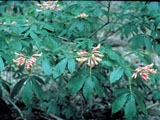
Aesculus pavia (Scarlet buckeye) is another shrub that likes moist soil and grows in part shade.
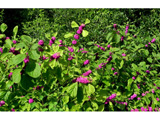
Callicarpa americana (American beautyberry) thrives in moist soils and part shade. It is valuable as a wildlife food plant.
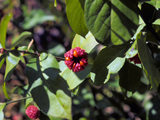
Euonymus americanus (American strawberry-bush) does well in part shade and moist soils.
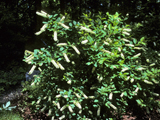
Itea virginica (Virginia sweetspire) an understory shrub that grows well in part shade, moist soil and is noted for its erosion control capabilities.
Grasses: Grasses have extensive fibrous roots that hold the soil well.
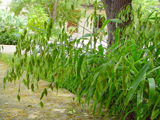
Chasmanthium latifolium (Inland sea oats) is a beautiful grass that likes wet soils and thrives in the shade and part shade.
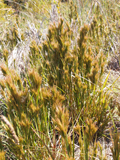
Andropogon glomeratus (Bushy bluestem) is an attractive grass that also loves moist soils, but it needs full sun to thrive.
Ferns: Ferns do well in shade and part shade in moist soils.
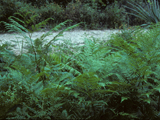
Athyrium filix-femina (Common ladyfern) is a large fern, growing to 2-3 feet high.
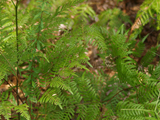
Pteridium aquilinum (Western bracken fern) is also a large fern and grows in dry soils as well as wet soils in shade and part shade.
Herbs:
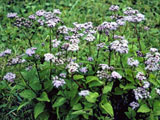
Conoclinium coelestinum (Blue mistflower) grows in sun and part shade and attracts butterflies.
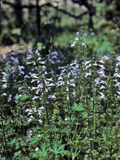
Salvia lyrata (Lyreleaf sage) is evergreen, grows in sun, part shade and shade and tolerates flooding.
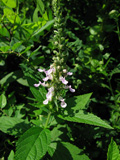
Teucrium canadense (Canada germander) grows in moist soils in part shade and near streams.
From the Image Gallery
More Herbs/Forbs Questions
The Unusual Foliage of Green Dragon
July 16, 2014 - I was hiking last week (July 7-11, 2014) in Hocking County, Ohio and while in a gorge along a river I saw the weirdest plant I've ever seen in my life. It wasn't weird because it had bizarre flowers...
view the full question and answer
Transplant shock in Dakota mock vervain
July 23, 2007 - We just planted some Verbena bipinnatifida in our back yard and when we planted it, it had purple flowers on it but now they've all dried up. We live in central Colorado and thought this plant was fa...
view the full question and answer
Native perennials for Donley County, TX
July 16, 2009 - What are the best perennials to plant in Donley County, TX?
view the full question and answer
Sun tolerant, rabbit-resistant plants in Plano, TX
November 07, 2008 - I live in Plano, Texas and am trying to identify sun tolerant plants for my landscape that are also rabbit resistant. The rabbits have taken over and destroy pansies, marigolds, etc. I am looking fo...
view the full question and answer
Native plants for a littoral zone in Fort Myers, Florida
June 05, 2009 - Dear Mr. Smarty Plants,
What native plants would you recommend for the littoral zone on a pond in Fort Myers Florida?
Damon's Mom
view the full question and answer
| Support the Wildflower Center by Donating Online or Becoming a Member today. |