Native Plants

Q. Who is Mr. Smarty Plants?
A: There are those who suspect Wildflower Center volunteers are the culpable and capable culprits. Yet, others think staff members play some, albeit small, role. You can torture us with your plant questions, but we will never reveal the Green Guru's secret identity.

Did you know you can access the Native Plant Information Network with your web-enabled smartphone?

Ask Mr. Smarty Plants
Ask Mr. Smarty Plants is a free service provided by the staff and volunteers at the Lady Bird Johnson Wildflower Center.

rate this answer

Saturday - August 02, 2014
From: New Haven, MO
Region: Midwest
Topic: Problem Plants, Shade Tolerant, Herbs/Forbs, Trees
Title: Magnolia species are allelopathic
Answered by: Nan Hampton
QUESTION:
Have a healthy Southern Magnolia tree around 8 years old. It seems like everything I plant next to it dies.: Variegated Spirea, Stokes Aster, Hydrangeas. Is there something it secretes like the walnut trees do that kills certain plants? Thanks.ANSWER:
You are absolutely right that magnolias produce chemicals that leech into the soils around it from fallen leaves, twigs and flowers that affect the growth of many other plants. The chemicals are sesquiterpene lactones. Here is a link to a previous question sent to Mr. Smarty Plants explaining allelopathy and magnolias. As well as the allelopathic effects of the magnolia, it is often difficult to find plants that will grown in the dense shade provided by the magnolia canopy. The SF Guide's article, What Flowers Grow under Magnolia Trees, suggests some flowers that will grow there, but they are not all native plants and if native, are not native to Missouri. You can find native plants that are recommended for Missouri on our Recommended page. Using the NARROW YOUR SEARCH option in the sidebar, choose "Herb" from the GENERAL APPEARANCE slot and "Shade" from LIGHT REQUIREMENT to limit the list small plants that grow well in the shade. Here are a few that might be able to resist the allelopathic effects of the magnolia.
Asarum canadense (Canadian wild ginger)
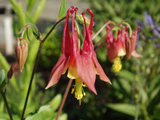
Aquilegia canadensis (Eastern red columbine)
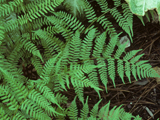
Athyrium filix-femina (Common ladyfern)
Lobelia cardinalis (Cardinal flower)
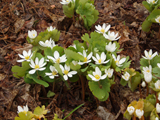
Sanguinaria canadensis (Bloodroot)
If you do the search above, you can find more plants.
The best way to fight those allelopathic effects are to keep the leaves, twigs, etc., from the magnolia picked up from under the tree.
From the Image Gallery


More Herbs/Forbs Questions
Problems with chile pequin from Pflugerville TX
July 19, 2012 - Hello there! I have a question about my chile pequin (Capsicum annuum L.) plant. I purchased it last year from the Wildflower Center Fall Plant Sale. It stayed in a pot until three months ago when I p...
view the full question and answer
Range and adaptability of evening primrose from Tucson AZ
August 28, 2009 - What is the natural range of the evening primrose?
What adaptations does it have to live in the arid Southwest?
view the full question and answer
Penta and licorice plants for Austin
May 04, 2009 - For Austin location
Are you familiar with a small flowering plant called Penta?
How about Licorice?
If yes, could you provide growing conditions.
Thanks
view the full question and answer
Possible mildew on standing cypress
May 29, 2008 - My mother-in-law took some standing cypress seeds from Texas to Virginia several years ago. They have always done very well, but this year they are growing very tall, but the bottom half of the stalk...
view the full question and answer
Planting under Pine Trees in Pocatello ID
April 08, 2014 - Hi I was wondering if you could give me some ideas of what I could plant under and near some pine trees for my area. The trees are huge and so it is also constant shade where I want to plant. Thanks f...
view the full question and answer
| Support the Wildflower Center by Donating Online or Becoming a Member today. |