Native Plants

Q. Who is Mr. Smarty Plants?
A: There are those who suspect Wildflower Center volunteers are the culpable and capable culprits. Yet, others think staff members play some, albeit small, role. You can torture us with your plant questions, but we will never reveal the Green Guru's secret identity.

Did you know you can access the Native Plant Information Network with your web-enabled smartphone?

Ask Mr. Smarty Plants
Ask Mr. Smarty Plants is a free service provided by the staff and volunteers at the Lady Bird Johnson Wildflower Center.

rate this answer

Thursday - August 14, 2014
From: South Haven, MI
Region: Midwest
Topic: Erosion Control
Title: Plants to grow in sandy shade with steep slope
Answered by: Nan Hampton
QUESTION:
I'm a very experienced gardener but I'm completely stumped on this one. We live among the dunes in SW Michigan. Our yard mostly consists of Ammophila breviligulata and Asclepias syriaca bisected by boardwalks. We have had to stabilize the sunny dune facing the lake with more Ammophila breviligulata and it's been very successful. We’ve added a small “traditional” lawn and some perennial gardens so it’s a really nice combination. For the other gardens and lawn we have amended the sand with soil, added drip irrigation, incorporated xeriscaping, and terraced where possible to grow local native plants and this has worked well also. However; there is a back dune area that is slowly changing over to forest - but the dune is steep and exposed to winds so there has been no accumulation of leaves for start a forest floor environment. There is still some minor sand erosion occuring when we have strong rains from the south - which we want to prevent. There are maple and oak trees, black raspberry, (and an occasional attempt by unidentified weeds) growing here. None of the other methods we used in other areas will work in this location. What would you suggest we plant? It’s 100% sand, almost 100% shade after the trees develop in the spring and about a 60% grade. Or maybe I’m crazy to think something could grow here?ANSWER:
You certainlly have a triple whammy there—shade, sand and steep slope. Generally, we recommend grasses to help stop erosion because their extensive fibrous roots help hold the soil in place; however, there are very few grasses that do well in the shade or in sand. The plants I am recommending below I found by selecting Michigan Recommended from the Special Collections page. I used the NARROW YOUR SEARCH option and chose "Shade" under LIGHT REQUIREMENT and "0 – 1" and "1 – 3" under HEIGHT (IN FEET). All the choices below occur in Van Buren and Allegan Counties.
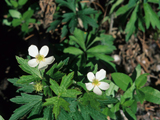
Anemone canadensis (Canadian anemone) needs moisture, but grows well in sand and shade.
Aquilegia canadensis (Eastern red columbine) grows in the shade in sandy well-drained soil.
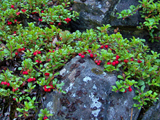
Arctostaphylos uva-ursi (Kinnikinnick) loves sand and will grow in sun, part shade and shade.
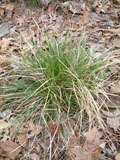
Carex pensylvanica (Pennsylvania sedge) grows in sun, part shade and shade and spreads by rhizomes.
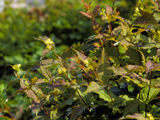
Diervilla lonicera (Northern bush honeysuckle) is a small mound-shaped shrub that likes sandy sites and grows in part shade and shade.
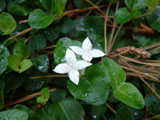
Mitchella repens (Partridgeberry) is a good groundcover for sandy slopes.
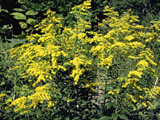
Solidago nemoralis (Gray goldenrod) grows in sun, part shade and shade and in a variety of soils including sandy ones.
You can find more choices by doing the search above yourself. On the species page check GROWING CONDITIONS to find soil type. You can also determine if the plant occurs in your county by scrolling down the species page to ADDITIONAL RESOURCES and clicking on the USDA Plants link. On the USDA page click on Michigan on the map and you will see the Michigan counties where the plant has been reported.
You may want to consider erosion-control blankets to stabilize the steep slope so that seeds have a better chance to germinate and become established. The erosion-control fabric works by slowing the runoff water and allowing sediment to fall out rather than be washed away. Seeds are sown under the erosion-control material and grow up through the matting when they germinate. Underneath the matting the roots of the plants growing through the erosion-control material anchor the soil to stop the erosion. If you use erosion-control blankets made of biodegradable material, they will eventually disappear leaving the plants to control the problem. Seeds can be sown under an erosion control blanket or grass plugs and other plants can be planted by cutting holes through the blanket. This material is available at most nurseries. In the linked article above from the University of Washington there are descriptions of other erosion control materials that can be used. Your slope might also benefit from some of the other methods discussed there.
From the Image Gallery

More Erosion Control Questions
Preventing erosion on a sloping lot
April 16, 2011 - I am trying to find a native plant to use on a sloped area in my back yard to help prevent the slope from eroding away (zone 7- N. Atlanta, GA). I want something evergreen, between 6 to 30 inches tal...
view the full question and answer
Non-native daylilies for steep hill in Manassas VA
April 25, 2013 - Would like to plant steep hill w perennial flowering plants like daylily. The daylily farm said this would work great but not sure if we should lay landscaping fabric and poke through holes to plant ...
view the full question and answer
Riverbank retention in VA
March 26, 2012 - I need some groundcover/bank retention for a Virginia riverbank in mixed sun and shade. I want to plant something native to VA. the area is out of the water but subject to occasional (4-5 times per y...
view the full question and answer
Erosion control plants for steep slope in Austin, TX
April 09, 2007 - I'm interested in finding native plants, either perennials or grasses, that would help control erosion on a fairly steep slope. These plants would be in a park, and volunteers will be watering the pl...
view the full question and answer
Need to stabilize a south facing slope in Henderson, NC
April 30, 2010 - Hi, I have a south facing slope that is heavy clay with rock under it. It gets a lot of sun. I have planted a few bushes and some ground cover, but with all the snow and rain we had this past winter, ...
view the full question and answer
| Support the Wildflower Center by Donating Online or Becoming a Member today. |