Native Plants

Plant Database
Search for native plants by scientific name, common name or family. If you are not sure what you are looking for, try the Combination Search or our Recommended Species lists.
Anderson, Wynn
Yucca elata
Yucca elata (Engelm.) Engelm.
Soaptree Yucca, Soaptree, Soapweed Yucca, Palmilla, Palmella, Amole
Agavaceae (Century-Plant Family)
Synonym(s): Yucca angustissima var. elata, Yucca elata var. elata, Yucca elata var. utahensis, Yucca elata var. verdiensis, Yucca utahensis, Yucca verdiensis
USDA Symbol: yuel
USDA Native Status: L48 (N)
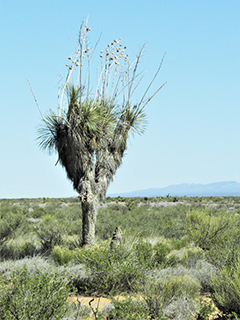
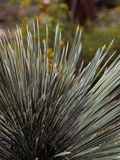
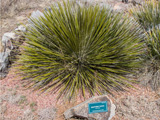
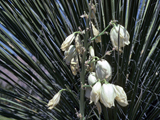
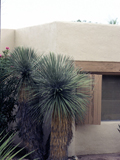
This is a 5-20 ft., tree-like yucca with fine, arching, gray-green to blue-green leaves with white margins. Plants resemble coarse bunchgrass when young, gradually developing several heads on trunk-like stems with age. The flowering stem in 3-7 ft. long with 25-30 side branches covered with clusters of creamy-white, bell-shaped flowers. The brown, woody seed capsule is interesting. Evergreen, palmlike shrub or small tree with single trunk or several clustered trunks; unbranched or with few upright branches and very long, narrow leaves. Growth is extremely slow, about 1" (2.5 cm) in height a year. The local name "Palmilla," Spanish for "small palm," refers to the resemblance of this species to a palm.

Plant Characteristics
Duration: PerennialHabit: Cactus/Succulent
Leaf Retention: Evergreen
Leaf Complexity: Simple
Fruit Type: Capsule
Size Notes: Up to about 20 feet tall in bloom.
Leaf: Green
Bloom Information
Bloom Color: WhiteBloom Time: Apr , May , Jun
Distribution
USA: AZ , NM , NV , TX , UTNative Distribution: S.w. TX to c. & s. AZ; also adjacent Mex.
Native Habitat: Deserts; grasslands; mesas
Growing Conditions
Water Use: LowLight Requirement: Sun
Soil Moisture: Dry
CaCO3 Tolerance: High
Cold Tolerant: yes
Soil Description: Well-drained soils. Gypseous, Sandy, Sandy Loam, Medium Loam.
Conditions Comments: State flower of New Mexico.
Benefit
Use Ornamental: Blooms ornamental, Showy, Accent tree or shrubUse Wildlife: Nectar-moths, Seeds-Small mammals, Browse.
Use Food: Cattle relish the young flower stalks, and chopped trunks and leaves serve as emergency food during droughts. Indians ate the flower buds, flowers, and young flower stalks of this and other yuccas, either raw or boiled.
Use Other: Soapy material in the roots and trunks of this abundant species has been used as a soap substitute. The leaves are a source of coarse fiber and were used by Native Americans in making baskets.
Conspicuous Flowers: yes
Interesting Foliage: yes
Attracts: Butterflies
Larval Host: Yucca giant butterfly.
Propagation
Description: Yuccas will germinate promptly from fresh seed held over winter. Seeds germinate best in 60-70 degree temperatures. Yuccas may also be grown from rhizomes, stem cuttings, or by digging offsets from the side of established plants. Transplant into a wellSeed Collection: Gather capsules as they begin to dry but before they split. Allow to dry, then crush to remove seeds. Overwinter, keep seeds in moist sand in the refrigerator. For longer storage periods, keep in sealed, refrigerated containers.
Commercially Avail: yes
From the National Organizations Directory
According to the species list provided by Affiliate Organizations, this plant is on display at the following locations:Texas Parks and Wildlife Department - Austin, TX
Bibliography
Bibref 298 - Field Guide to Texas Trees (1999) Simpson, B.J.Bibref 355 - Landscaping with Native Plants of Texas and the Southwest (1991) Miller, G. O.
Bibref 308 - Lone Star Field Guide to Wildflowers, Trees, and Shrubs of Texas, Revised Edition (2003) Tull, D. & G.O. Miller
Bibref 995 - Native Landscaping from El Paso to L.A. (2000) Wasowski, S. and A. Wasowski
Bibref 318 - Native Texas Plants: Landscaping Region by Region (2002) Wasowski, S. & A. Wasowski
Bibref 291 - Texas Wildscapes: Gardening for Wildlife (1999) Damude, N. & K.C. Bender
Search More Titles in Bibliography
Additional resources
USDA: Find Yucca elata in USDA PlantsFNA: Find Yucca elata in the Flora of North America (if available)
Google: Search Google for Yucca elata
Metadata
Record Modified: 2021-04-26Research By: TWC Staff