Native Plants

Plant Database
Search for native plants by scientific name, common name or family. If you are not sure what you are looking for, try the Combination Search or our Recommended Species lists.
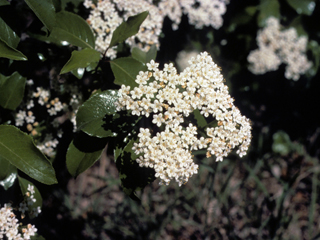
Wasowski, Sally and Andy
Viburnum rufidulum
Viburnum rufidulum Raf.
Rusty Blackhaw Viburnum, Rusty Blackhaw, Southern Blackhaw, Blackhaw, Bluehaw, Downy Viburnum, Southern Nannyberry, Rusty Nannyberry, Nannyberry
Caprifoliaceae (Honeysuckle Family)
Synonym(s): Viburnum prunifolium var. ferrugineum, Viburnum rufidulum var. margarettiae, Viburnum rufotomentosum
USDA Symbol: viru
USDA Native Status: L48 (N)
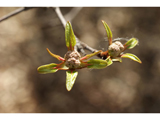
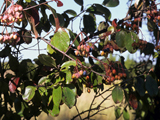
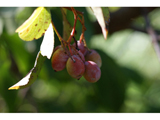
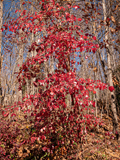
This viburnum is a shrub or tree, usually growing to 18 ft. but sometimes taller with bark separating into dark, rectangular plates. Twigs reddish brown with a thin light gray coating. Leaves in pairs, often on short spurs, the petioles covered with rust colored, branched hairs visible under a l0x hand lens; blades up to 3 1/2 inches long, elliptic to oval or ovate, tip rounded or with a broad point, base rounded or broadly wedge shaped, margins finely serrate, firm textured with a shiny upper surface. Glossy, dark-green, deciduous leaves turn a variety of warm hues in autumn. Flowers white, from 1/4 to 3/8 inch wide, in rounded or flattened clusters up to 4 inches wide, appearing in March and April and noticeable from a distance in early spring. Fruit fleshy, bluish black lightened by a waxy coating, up to 1/2 inch long, slightly longer than wide.
Rusty Blackhaw is distinguished from the more northerly Blackhaw, Viburnum prunifolium, primarily by the reddish-brown hairs on foliage and other parts, as well as by the slightly larger leaves and paler blue fruit. The Latin species name, meaning "reddish," also refers to the hairs. The two species intergrade where their ranges meet.

Plant Characteristics
Duration: PerennialHabit: Tree
Leaf Retention: Deciduous
Leaf Arrangement: Opposite
Leaf Complexity: Simple
Leaf Shape: Elliptic
Fruit Type: Drupe
Size Notes: Up to about 30 feet tall.
Bloom Information
Bloom Color: WhiteBloom Time: Mar , Apr , May
Distribution
USA: AL , AR , FL , GA , IL , IN , KS , KY , LA , MO , MS , NC , OH , OK , SC , TN , TX , VANative Distribution: VA to s. OH, s. IN, s. IL & MO, s., except in mts., to FL & TX
Native Habitat: Thickets, Open woodlands, Stream, river banks. Dry, rocky woods; thickets; stream banks. Open woodlands from East to Central Texas. Well-drained sand, loam, clay.
Growing Conditions
Water Use: LowLight Requirement: Part Shade
Soil Moisture: Dry
Cold Tolerant: yes
Soil Description: Dry soils. Limestone-based, Sandy, Sandy Loam, Medium Loam, Clay Loam, Clay
Conditions Comments: Slow-growing. Hard to propagate. With its waxy leaves, rusty blackhaw presents excellent fall hues of red, lavender, pink, and orange. Tiny clusters of flowers bloom in spring. In Manual of the Vascular Plants of Texas, Correll and Johnston noted that the fruit tastes similar to raisins. Rusty blackhaw is good for understory plantings. Birds appreciate the fruit.
Benefit
Use Ornamental: Showy, Understory tree, Fall conspicuous, AttractiveUse Wildlife: Nectar-bees, Nectar-butterflies, Nectar-insects, Fruit-birds, Fruit-mammals
Interesting Foliage: yes
Attracts: Birds
Deer Resistant: Moderate
Propagation
Propagation Material: SeedsDescription: Viburnums are most often propagated from semi-hardwood cuttings taken in the fall. These should be woody at the base or taken with a heel. Rooting is slow.
Seed Collection: Collect the fruit as soon as it has turned a dark blue-black color. Store seeds with pulp on at 41 degrees.
Seed Treatment: If seeds must be stored, they will need a period of stratification.
Commercially Avail: yes
Find Seed or Plants
View propagation protocol from Native Plants Network.
Mr. Smarty Plants says
Edible Plants for North Georgia
January 10, 2010
We are planning a forest food garden in the hollers of the N GA Mountains.
Which edible fruit, nut, berry, herb and creepers would be best for this reddish, clay-like soil? The food garden is in...
view the full question and answer
Native alternative for Japanese Red Maple in Oklahoma
October 12, 2009
Mr. Smarty Plants, I am looking for a native alternative to a Japanese Red Maple. I would like a small tree that I can put in my front garden that will not pose a security risk my being overgrown and ...
view the full question and answer
Plants for wildlife and trees for shade.
September 29, 2007
We live in Kempner Texas, our land has mostly cedar trees. We would like to make a wildlife habitat on the back side of our property. Can you recommend plants that will grow in shade to partial sun,...
view the full question and answer
Variety of native tall plants for a screen in shady area near Ft. Worth
June 12, 2007
Hello, we live west of Ft Worth. We are looking for tall plants to form a visual screen along a chain link fence we share with a neighbor. We have post oaks there and it is very shady and the ground ...
view the full question and answer
Non-native Sandankwa viburnum (Viburnum suspensum) damaged by freeze
April 16, 2006
We live in Georgetown. My Sandankwa Viburnum seem to have been affected by the late freeze. There are now very few leaves and no flowers/buds. Should I cut the plants back, leave them alone, or giv...
view the full question and answer
National Wetland Indicator Status
| Region: | AGCP | AK | AW | CB | EMP | GP | HI | MW | NCNE | WMVE |
| Status: | UPL | FACU | UPL | FACU | FACU |
From the National Organizations Directory
According to the species list provided by Affiliate Organizations, this plant is on display at the following locations:Fredericksburg Nature Center - Fredericksburg, TX
Lady Bird Johnson Wildflower Center - Austin, TX
Pineywoods Native Plant Center - Nacogdoches, TX
Texas Discovery Gardens - Dallas, TX
Brackenridge Field Laboratory - Austin, TX
Stengl Biological Research Station - Smithville, TX
Texas Parks and Wildlife Department - Austin, TX
NPSOT - Fredericksburg Chapter - Fredericksburg, TX
Texas Master Naturalists - Lost Pines Chapter - Bastrop, TX
NPSOT - Austin Chapter - Austin, TX
Jacob's Well Natural Area - Wimberley, TX
NPSOT - Williamson County Chapter - Georgetown, TX
Mt. Cuba Center - Hockessin, DE
Bibliography
Bibref 298 - Field Guide to Texas Trees (1999) Simpson, B.J.Bibref 355 - Landscaping with Native Plants of Texas and the Southwest (1991) Miller, G. O.
Bibref 293 - Manual of the Vascular Plants of Texas (1979) Correll, D. S. & M. C. Johnston
Bibref 354 - Native & Naturalized Woody Plants of Austin & the Hill Country (1981) Lynch, D.
Bibref 318 - Native Texas Plants: Landscaping Region by Region (2002) Wasowski, S. & A. Wasowski
Bibref 291 - Texas Wildscapes: Gardening for Wildlife (1999) Damude, N. & K.C. Bender
Bibref 297 - Trees of Central Texas (1984) Vines, Robert A.
Bibref 286 - Wildflowers of the Texas Hill Country (1989) Enquist, M.
Search More Titles in Bibliography
Web Reference
Webref 23 - Southwest Environmental Information Network (2009) SEINet - Arizona ChapterResearch Literature
Reslit 2080 - K-IBA improves rooting of Viburnum rufidulum (2007) J. GriffinReslit 2234 - The morphology of the bud and the development of the leaves of Viburnum rufidulum (1937) G. L. Cross
Reslit 2783 - Reclaimed water and Florida natives II (1992) L. M. Robinson, J. R. Parnell
This information was provided by the Florida WIldflower Foundation.
Search More Titles in Research Literature
Additional resources
USDA: Find Viburnum rufidulum in USDA PlantsFNA: Find Viburnum rufidulum in the Flora of North America (if available)
Google: Search Google for Viburnum rufidulum
Metadata
Record Modified: 2023-05-31Research By: LAL