Native Plants

Plant Database
Search for native plants by scientific name, common name or family. If you are not sure what you are looking for, try the Combination Search or our Recommended Species lists.
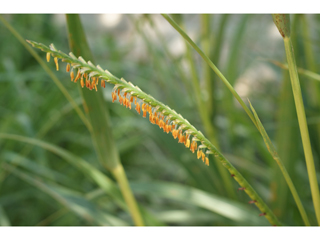
Mathews, Ray
Tripsacum dactyloides
Tripsacum dactyloides (L.) L.
Eastern Gamagrass, Fakahatchee Grass
Poaceae (Grass Family)
Synonym(s): Coix dactyloides, Tripsacum dactyloides var. occidentale
USDA Symbol: trda3
USDA Native Status: L48 (N)
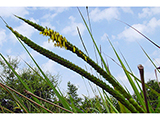
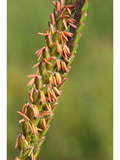
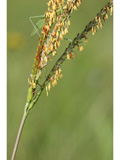
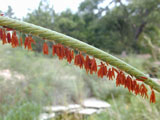
Usually 2-3 ft. in height, can grow 12 ft. tall. It is interesting primarily for its terminal inflorescences which have separate male and female flowers. Stigmas are purple; stamens orange. The plant is a perennial.
Deer eat the hard, yellow seeds of this plant.
Plant Characteristics
Duration: PerennialHabit: Grass/Grass-like
Root Type: Fibrous
Leaf Retention: Evergreen
Leaf Arrangement: Alternate
Leaf Complexity: Simple
Leaf Shape: Linear
Leaf Venation: Parallel
Breeding System: Flowers Unisexual , Monoecious
Fruit Type: Caryopsis
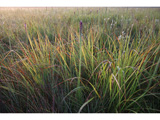
Size Notes: Up to about 12 feet tall, often much shorter.
Leaf: Green
Bloom Information
Bloom Color: BrownBloom Time: Apr , May , Jun , Jul , Aug , Sep
Distribution
USA: AL , AR , CT , DC , DE , FL , GA , IA , IL , IN , KS , KY , LA , MA , MD , MI , MO , MS , NC , NE , NJ , NY , OH , OK , PA , RI , SC , TN , TX , VA , WVNative Distribution: MA to IA & KS, s. to FL, OK & TX, south through Mexico, Central America, and the Caribbean to South America as far as Paraguay in southeastern South America
Native Habitat: Borders of salt marshes; stream banks; mesic, upland, tallgrass prairies, Frequent in scattered parts of the state, more common in the eastern half, rare in Plains Country
Growing Conditions
Water Use: HighLight Requirement: Part Shade
Soil Moisture: Moist
CaCO3 Tolerance: None
Soil Description: Moist soils. Sandy, Sandy Loam, Medium Loam, Clay Loam, Clay, Calcareous, Acid-based
Conditions Comments: Eastern gamagrass is related to corn, and deer gobble up its seeds. This grass grows large and stately; it is a good idea to allocate plenty of room to it. Cut it back in winter, but carefully, the leaf blade edges are sharp!
Benefit
Use Ornamental: Accent, Grows in clumps, Border, Ground cover, Can be mowedUse Wildlife: Deer eat the hard, yellow seeds. Seeds-granivorous birds, Cover, Nesting site, Graze.
Conspicuous Flowers: yes
Interesting Foliage: yes
Attracts: Butterflies
Larval Host: Bunchgrass Skipper
Deer Resistant: Moderate
Butterflies and Moths of North America (BAMONA)
|
Byssus Skipper (Problema byssus)  Larval Host |
Find Seed or Plants
Order seed of this species from Native American Seed and help support the Wildflower Center.
Find seed sources for this species at the Native Seed Network.
View propagation protocol from Native Plants Network.
National Wetland Indicator Status
| Region: | AGCP | AK | AW | CB | EMP | GP | HI | MW | NCNE | WMVE |
| Status: | FAC | FAC | FACW | FAC | FAC | FAC |
From the National Organizations Directory
According to the species list provided by Affiliate Organizations, this plant is on display at the following locations:Lady Bird Johnson Wildflower Center - Austin, TX
Texas Discovery Gardens - Dallas, TX
Nueces River Authority - Uvalde, TX
Texas Parks and Wildlife Department - Austin, TX
NPSOT - Austin Chapter - Austin, TX
Native Seed Network - Corvallis, OR
NPSOT - Williamson County Chapter - Georgetown, TX
Bibliography
Bibref 1186 - Field Guide to Moths of Eastern North America (2005) Covell, C.V., Jr.Bibref 1185 - Field Guide to Western Butterflies (Peterson Field Guides) (1999) Opler, P.A. and A.B. Wright
Bibref 946 - Gardening with Prairie Plants: How to Create Beautiful Native Landscapes (2002) Wasowski, Sally
Bibref 318 - Native Texas Plants: Landscaping Region by Region (2002) Wasowski, S. & A. Wasowski
Bibref 291 - Texas Wildscapes: Gardening for Wildlife (1999) Damude, N. & K.C. Bender
Bibref 1294 - The Midwestern Native Garden: Native Alternatives to Nonnative Flowers and Plants An Illustrated Guide (2011) Adelman, Charlotte and Schwartz, Bernard L.
Search More Titles in Bibliography
Web Reference
Webref 38 - Flora of North America (2019) Missouri Botanical Garden, St. Louis, MO & Harvard University Herbaria, Cambridge, MA.Webref 23 - Southwest Environmental Information Network (2009) SEINet - Arizona Chapter
Research Literature
Reslit 33 - Aspects of the Germination Ecology and Biomass Production of Eastern Gamagrass (Tripsacum dactyloides L.) (1985) R. C. AndersonReslit 749 - A Method to Enhance Germination of Eastern Gamagrass (1994) B. Kindiger
Reslit 1173 - Enhancing germination of eastern gamagrass seed with stratification and gibberellic acid (2004) C. Rogis, L. R. Gibson, A. D. Knapp and R. Horton
Reslit 1203 - High-frequency callus induction and plant regeneration in Tripsacum dactyloides (L.) (2002) R. V. Sairam, C. Wilber, J. Franklin, B. Smith, J....
Reslit 1338 - Seed germination and dormancy in eastern gamagrass (2001) T. L. Springer, C. L. Dewald and G. E. Aiken
Reslit 1339 - How does plant population density affect the forage yield of eastern gamagrass? (2003) T. L. Springer, C. L. Dewald, P. L. Sims and R. L....
Reslit 1389 - Response of eastern gamagrass seed to gibberellic acid buffered below its pKa (2003) X. Tian, A. D. Knapp, L. R. Gibson, R. Struthers, ...
Reslit 1390 - Cupule removal and caryopsis scarification improves germination of eastern gamagrass seed (2002) X. Tian, A. D. Knapp, K. J. Moore, E. C. Brummer a...
Reslit 1688 - Growth and seed yield of three perennial grains within monocultures and mixed stands (1998) J. K. Piper
Reslit 1958 - Ecotypic Variation in Tripsacum dactyloides Evaluated in Texas (1983) T. G. Schliesing and B. E. Dahl
This information was provided by the Florida WIldflower Foundation.
Search More Titles in Research Literature
From the Archive
Wildflower Newsletter 1989 VOL. 6, NO.4 - Spring Climbs Rockies Slowly, Colorado Cooler, Conference of Wildflower and Nati...Additional resources
USDA: Find Tripsacum dactyloides in USDA PlantsFNA: Find Tripsacum dactyloides in the Flora of North America (if available)
Google: Search Google for Tripsacum dactyloides
Metadata
Record Modified: 2023-07-03Research By: TWC Staff, GAP