Native Plants

Plant Database
Search for native plants by scientific name, common name or family. If you are not sure what you are looking for, try the Combination Search or our Recommended Species lists.
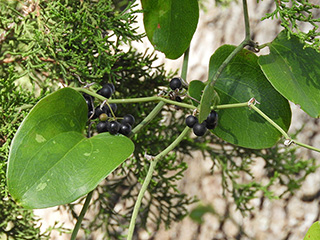
Richardson, Charmaine
Smilax bona-nox
Smilax bona-nox L.
Sawbriar, Saw Greenbriar, Catbriar, Bullbriar, Stretchberry Vine
Smilacaceae (Catbrier Family)
Synonym(s): Smilax bona-nox var. exauriculata, Smilax bona-nox var. hastata, Smilax bona-nox var. hederifolia
USDA Symbol: smbo2
USDA Native Status: L48 (N)
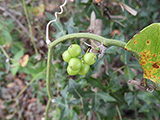
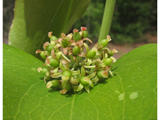
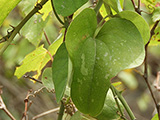
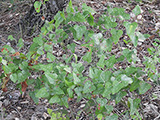
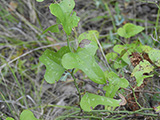
A prickly vine forming dense tangles in shrubby and wooded areas. Stems smooth, green, with stout, sharp prickles on the lower sections. Leaves with tendril-bearing petioles; blades up to 4 1/2 inches long and 4 inches wide, varying from triangular to heart shaped, often with a broad lobe on each side, firm textured and occasionally mottled on the upper surface, persisting into winter. Flowers small, rather inconspicuous, in clusters arising from the axils of the leaves, male and female on different plants, appearing from March to June. Fruit spherical, l/4 inch in diameter, fleshy, black.
Plant Characteristics
Duration: PerennialHabit: Vine
Leaf Retention: Evergreen , Semi-evergreen
Leaf Arrangement: Alternate
Leaf Complexity: Simple
Leaf Shape: Ovate
Breeding System: Flowers Unisexual , Dioecious
Fruit Type: Berry
Size Notes: Can grow into the tops of trees.
Leaf: Green
Bloom Information
Bloom Color: GreenBloom Time: Mar , Apr , May
Distribution
USA: AL , AR , DE , FL , GA , IL , IN , KS , KY , LA , MD , MO , MS , NC , NJ , OK , SC , TN , TX , VAGrowing Conditions
Water Use: MediumLight Requirement: Shade
Soil Moisture: Dry , Moist
CaCO3 Tolerance: Medium
Drought Tolerance: High
Heat Tolerant: yes
Benefit
Use Wildlife: The fruits of saw greenbrier are eaten by wood ducks, ruffed grouse, wild turkeys, fish crows, black bears, opossums, raccoons, squirrels, and many species of songbirds. White-tailed deer browse the foliage. Provides cover for small animals and birds.Use Other: The seeds are animal dispersed and can be carried long distances by birds.
Attracts: Birds
Deer Resistant: No
Mr. Smarty Plants says
Removal of bramble under live oaks and replacing with groundcover
September 26, 2007
We have several large live oaks on the front of our 12 acre property in Hockley, Texas. Under and around each oak is an extensive amount of bramble which we would like to remove so that we can enjoy ...
view the full question and answer
National Wetland Indicator Status
| Region: | AGCP | AK | AW | CB | EMP | GP | HI | MW | NCNE | WMVE |
| Status: | FAC | FACU | FACU | FACU |
From the National Organizations Directory
According to the species list provided by Affiliate Organizations, this plant is on display at the following locations:Lady Bird Johnson Wildflower Center - Austin, TX
Pineywoods Native Plant Center - Nacogdoches, TX
Brackenridge Field Laboratory - Austin, TX
Patsy Glenn Refuge, c/o Wimberley Birding Society - Wimberley, TX
Nueces River Authority - Uvalde, TX
Stengl Biological Research Station - Smithville, TX
Texas Master Naturalists - Lost Pines Chapter - Bastrop, TX
Jacob's Well Natural Area - Wimberley, TX
Wildflower Center Seed Bank
LBJWC-65 Collected 2006-06-21 in Travis County by Lady Bird Johnson Wildflower CenterBibliography
Bibref 293 - Manual of the Vascular Plants of Texas (1979) Correll, D. S. & M. C. JohnstonBibref 354 - Native & Naturalized Woody Plants of Austin & the Hill Country (1981) Lynch, D.
Search More Titles in Bibliography
Additional resources
USDA: Find Smilax bona-nox in USDA PlantsFNA: Find Smilax bona-nox in the Flora of North America (if available)
Google: Search Google for Smilax bona-nox
Metadata
Record Modified: 2023-01-13Research By: TWC Staff