Native Plants

Plant Database
Search for native plants by scientific name, common name or family. If you are not sure what you are looking for, try the Combination Search or our Recommended Species lists.
Loveless, Brenda K.
Quercus phellos
Quercus phellos L.
Willow Oak, Swamp Willow Oak, Pin Oak, Peach Oak
Fagaceae (Beech Family)
Synonym(s):
USDA Symbol: quph
USDA Native Status: L48 (N)
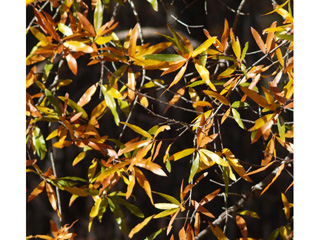
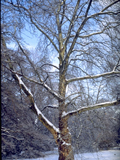
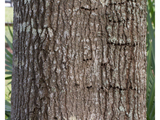
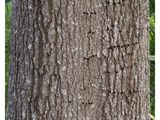
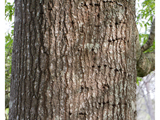
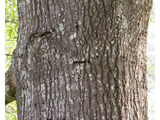
Willow oak, a deciduous tree, can attain 100 ft. but is usually shorter in cultivation. Its straight trunk supports a cone-shaped crown which becomes round at maturity. Long, fine-textured, narrow leaves with tiny awn at apex, resembling the foliage of willows, turn from bright green in summer to yellow or russet in fall. Bark is gray to reddish brown. Nut nearly round, cup shallow.
A popular street and shade tree with fine-textured foliage, widely planted in Washington, D.C., and southward. Its disadvantage, however, is that is becomes too large to be grown around houses. Readily transplanted because of shallow roots. Easily distinguishable from most other oaks by the narrow leaves without lobes or teeth. While superficially the foliage resembles that of willows, it is recognized as an oak by the acorns and the tiny bristle-tip. City squirrels as well as wildlife consume and spread the acorns.
Plant Characteristics
Duration: PerennialHabit: Tree
Leaf Retention: Deciduous
Leaf Arrangement: Alternate
Leaf Complexity: Simple
Leaf Venation: Pinnate
Breeding System: Flowers Unisexual , Monoecious
Inflorescence: Catkin
Fruit Type: Nut
Size Notes: Up to about 100 feet tall.
Leaf: Green
Autumn Foliage: yes
Fruit: Light yellow or greenish brown
Bloom Information
Bloom Color: YellowBloom Time: Mar , Apr , May
Distribution
USA: AL , AR , CT , DC , DE , FL , GA , IL , KY , LA , MD , MO , MS , NC , NJ , NY , OK , PA , SC , TN , TX , VANative Distribution: E. TX to n. FL, n. to s. IL & NJ
Native Habitat: Alluvial soils, moist forests, stream banks and bottomlands.
Growing Conditions
Water Use: HighLight Requirement: Part Shade
Soil Moisture: Moist
CaCO3 Tolerance: None
Cold Tolerant: yes
Soil Description: Moist clay or loamy, slightly acid, soils. Sandy, Sandy Loam, Medium Loam, Clay Loam, Clay, Acid-based
Benefit
Use Ornamental: Fall conspicuous, popular shade tree.Use Wildlife: Fruit-mammals, Fruit-birds, Nesting site, Cover, Substrate-insectivorous birds.
Attracts: Birds , Butterflies
Larval Host: White M hairstreak, Horace's Duskywing.
Butterflies and Moths of North America (BAMONA)
|
White M Hairstreak (Parrhasius m-album) 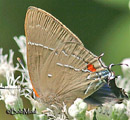 Larval Host |
Propagation
Description: Oaks are most often propagated from seed. Stratify or plant immediately outdoors or in deep containers to accomodate long initial taproot. Many oaks require cold temperatures to initiate shoot development. Protect outdoor beds with wire meshSeed Collection: Best quality acorns are picked or shaken from the tree. Collect when color has changed to brown. Best if sown immediately as acorns lose viability quickly in storage. Short-term storage in moist, shaded saw dust or sand. Acorns to be sown immediately can be soaked in hot water for 15 min. to prevent weevil infestation. Stored seed should be fumigated with methyl bromide.
Seed Treatment: Stratify 30-60 days at 41 degrees.
Commercially Avail: yes
Maintenance: Prevent complete soil dryness, May be pruned 12 mo. out of the year, Prune to maintain shape, Fertilize 3 times a year with lawn fertilizer 3:1:2 ratio
National Wetland Indicator Status
| Region: | AGCP | AK | AW | CB | EMP | GP | HI | MW | NCNE | WMVE |
| Status: | FACW | FAC | FACW | FACW | FACW |
From the National Organizations Directory
According to the species list provided by Affiliate Organizations, this plant is on display at the following locations:Pineywoods Native Plant Center - Nacogdoches, TX
Crosby Arboretum - Picayune, MS
Texas Parks and Wildlife Department - Austin, TX
Georgia Native Plant Society - Atlanta, GA
Longwood Gardens - Kennett Square, PA
Mt. Cuba Center - Hockessin, DE
Wellspring Organic Farm and Education Center - West Bend, WI
Bibliography
Bibref 766 - Dale Groom's Texas Gardening Guide (2002) Groom, D.Bibref 298 - Field Guide to Texas Trees (1999) Simpson, B.J.
Bibref 1620 - Gardening with Native Plants of the South (Reprint Edition) (2009) Wasowski, S. with A. Wasowski
Bibref 355 - Landscaping with Native Plants of Texas and the Southwest (1991) Miller, G. O.
Bibref 841 - Native Alternatives to Invasive Plants (2006) Burrell, C. C.
Bibref 318 - Native Texas Plants: Landscaping Region by Region (2002) Wasowski, S. & A. Wasowski
Bibref 291 - Texas Wildscapes: Gardening for Wildlife (1999) Damude, N. & K.C. Bender
Search More Titles in Bibliography
Additional resources
USDA: Find Quercus phellos in USDA PlantsFNA: Find Quercus phellos in the Flora of North America (if available)
Google: Search Google for Quercus phellos
Metadata
Record Modified: 2015-11-05Research By: TWC Staff