Native Plants

Plant Database
Search for native plants by scientific name, common name or family. If you are not sure what you are looking for, try the Combination Search or our Recommended Species lists.
Wasowski, Sally and Andy
Prunus caroliniana
Prunus caroliniana Aiton
Carolina Cherry-laurel, Cherry-laurel, Laurel Cherry, Carolina Laurel Cherry
Rosaceae (Rose Family)
Synonym(s): Laurocerasus caroliniana
USDA Symbol: prca
USDA Native Status: L48 (N)
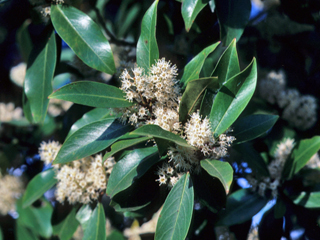
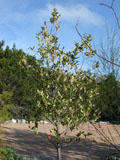
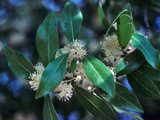
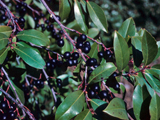
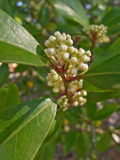
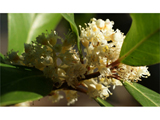
With a natural range extending from southern North Carolina west to east Texas, Carolina Laurel Cherry is a dense shrub or small tree, 15-40 ft. tall, with a pyramidal to oval outline. Leaves are firm, smooth, evergreen, narrowly elliptic, tapered to a pointed tip and equally tapered to the base. Margins are smooth on reproductive trees, with narrow, pointed teeth on saplings and root sprouts. Upper surface is dark green and shiny, the lower surface lighter and duller. The leaves have a taste suggestive of almond flavoring and are poisonous when eaten. Flowers are white to cream, about 3/16 inch wide, in showy elongate clusters among the leaves, opening from February to April. Fruit is fleshy, but with a thin pulp, black, 1/2 inch long by 3/8 inch wide, egg shaped with a small tip, and persistent through winter.
A handsome, evergreen, ornamental and large hedge plant in southeastern North America, often escaping from cultivation. The greatest use of Carolina Cherry-laurel is for providing a nearly carefree, dark green visual screen. Birds consume the dry fruit.
Plant Characteristics
Duration: PerennialHabit: Tree
Leaf Retention: Evergreen
Leaf Arrangement: Alternate
Leaf Complexity: Simple
Leaf Shape: Elliptic
Leaf Venation: Pinnate
Leaf Pubescence: Glabrous
Leaf Margin: Entire
Leaf Apex: Acute
Leaf Texture: Smooth
Breeding System: Flowers Unisexual , Monoecious
Inflorescence: Raceme
Fruit Type: Drupe
Size Notes: Up to about 40 feet tall, often much shorter.
Leaf: Deep green.
Flower: Flowers in 2 inch spikes.
Fruit: Black, Blue 1-1.3 cm.
Bloom Information
Bloom Color: WhiteBloom Time: Feb , Mar , Apr
Distribution
USA: AL , AR , FL , GA , LA , MS , NC , SC , TXNative Distribution: Coastal Plain of s.e. NC to FL Panhandle, w. to e. TX; naturalized elsewhere
Native Habitat: Low woods; maritime forests; fields; thickets
Growing Conditions
Water Use: MediumLight Requirement: Sun , Part Shade
Soil Moisture: Moist
Cold Tolerant: yes
Soil Description: Moist, deep, loamy, well-drained soils. Clay Loam, Medium Loam, Sandy Loam, Sandy
Conditions Comments: Likes the moist, well-drained soils of its natural range. Prolonged saturation can cause root rot, particularly in clay soils. Shallow, nutrient-poor, rocky soils can cause chlorosis and heat stress.
Benefit
Use Ornamental: A showy, attractive, fast growing, evergreen screening tree or hedge, popular in residential landscaping in the mid-20th century.Use Wildlife: Berries attract birds. Flowers attract bees and other insects.
Warning: The seeds, twigs, and leaves of all Prunus species contain hydrocyanic acid and should never be eaten. Leaves of Prunus caroliniana are particularly high in this toxin. Sensitivity to a toxin varies with a person’s age, weight, physical condition, and individual susceptibility. Children are most vulnerable because of their curiosity and small size. Toxicity can vary in a plant according to season, the plant’s different parts, and its stage of growth; and plants can absorb toxic substances, such as herbicides, pesticides, and pollutants from the water, air, and soil.
Conspicuous Flowers: yes
Interesting Foliage: yes
Attracts: Birds
Nectar Source: yes
Deer Resistant: High
Value to Beneficial Insects
Special Value to Native BeesThis information was provided by the Pollinator Program at The Xerces Society for Invertebrate Conservation.
Propagation
Propagation Material: Seeds , Semi-hardwood Cuttings , Softwood CuttingsDescription: Prunus species may be rooted from dormant hardwood, softwood, semi-hardwood, or root cuttings. Semi-hardwood and softwood cuttings taken in summer root easiest. Germination of most seeds requires cold stratification.
Seed Collection: Collect fruit when it is filled out, firm, and its ripe color. Clean seeds from pulp and briefly air dry. (Seeds to be sown immediately in fall do not need drying.) Storage viability is maintained at 31-41 degrees.
Seed Treatment: For spring sowing, stratify seeds in moist sand for 30-60 days in a greenhouse, then cold stratify (36-41 degrees) for 60-90 days. Plant well before high temperatures.
Commercially Avail: yes
Maintenance: Cherry laurels do not like being severely pruned and will resist being trained into an angled hedge.
Mr. Smarty Plants says
Tree for sound block near Houston
April 24, 2010
I live in Pearland, just south of Houston and am looking for a tree that I can plant along my fenceline between my neighbor and me that will block noise. We have a pool and entertain a lot, but they a...
view the full question and answer
Eucalyptus tree for Spring, Texas
October 31, 2008
I've heard eucalyptus trees do not lose their leaves in the winter and grow considerably tall. I want to replace a decaying pine tree with a eucalyptus tree. Do you recommend that for the Spring, T...
view the full question and answer
Native evergreen for privacy screen
May 15, 2008
I want to incorporate a tree in my landscaping near my house (10-15 feet) for privacy, what are the best trees that don't shed their leaves and have nice flowers and their roots wont destroy my found...
view the full question and answer
Fast growing native hedges for Sachse, TX
March 30, 2007
I just bought a house in Sachse, Tx and want to plant a privacy hedge. It will be about 220' long and I want it to grow to at least 10'-12' high. I also want it to be fast growing and be evergree...
view the full question and answer
Alternatives to non-Texas native pin cherry for Texas
February 28, 2006
Dear Ms. Smarty Plants,
I learned that the fire cherry/ pin cherry is a very hardy tree, and that it is very drought resistant. I live in zone 7, on black land, which becomes very dry in the summer. ...
view the full question and answer
National Wetland Indicator Status
| Region: | AGCP | AK | AW | CB | EMP | GP | HI | MW | NCNE | WMVE |
| Status: | FACU | FACU | FACU | FACU | FACU |
From the National Organizations Directory
According to the species list provided by Affiliate Organizations, this plant is on display at the following locations:Pineywoods Native Plant Center - Nacogdoches, TX
Texas Discovery Gardens - Dallas, TX
Brackenridge Field Laboratory - Austin, TX
Texas Parks and Wildlife Department - Austin, TX
NPSOT - Austin Chapter - Austin, TX
NPSOT - Williamson County Chapter - Georgetown, TX
Wellspring Organic Farm and Education Center - West Bend, WI
Bibliography
Bibref 298 - Field Guide to Texas Trees (1999) Simpson, B.J.Bibref 481 - How to Grow Native Plants of Texas and the Southwest: Revised and Updated Edition (2001) Nokes, J.
Bibref 355 - Landscaping with Native Plants of Texas and the Southwest (1991) Miller, G. O.
Bibref 293 - Manual of the Vascular Plants of Texas (1979) Correll, D. S. & M. C. Johnston
Bibref 354 - Native & Naturalized Woody Plants of Austin & the Hill Country (1981) Lynch, D.
Bibref 841 - Native Alternatives to Invasive Plants (2006) Burrell, C. C.
Bibref 318 - Native Texas Plants: Landscaping Region by Region (2002) Wasowski, S. & A. Wasowski
Bibref 291 - Texas Wildscapes: Gardening for Wildlife (1999) Damude, N. & K.C. Bender
Search More Titles in Bibliography
Web Reference
Webref 57 - Atlas of Florida Plants (2020) Institute for Systematic BotanyWebref 3 - Flora of North America (2014) Missouri Botanical Garden, St. Louis, MO & Harvard University Herbaria, Cambridge, MA.
Webref 23 - Southwest Environmental Information Network (2009) SEINet - Arizona Chapter
Additional resources
USDA: Find Prunus caroliniana in USDA PlantsFNA: Find Prunus caroliniana in the Flora of North America (if available)
Google: Search Google for Prunus caroliniana
Metadata
Record Modified: 2023-05-10Research By: TWC Staff, GDG