Native Plants

Plant Database
Search for native plants by scientific name, common name or family. If you are not sure what you are looking for, try the Combination Search or our Recommended Species lists.
Reveal, James L.
Pinus edulis
Pinus edulis Engelm.
Colorado Pinyon Pine, Colorado Pinyon, Pinyon Pine, Pinyon, Two-needle Pine, Two-needle Pinyon, Two-leaf Pinyon, Nut Pine, Pino Dulce
Pinaceae (Pine Family)
Synonym(s): Pinus cembroides var. edulis
USDA Symbol: pied
USDA Native Status: L48 (N)
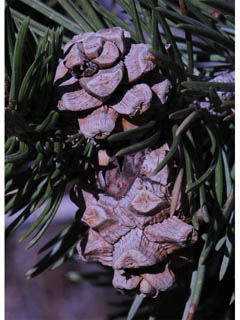
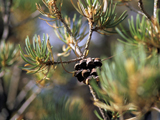
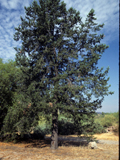
Two-needle pine or pinyon pine is a 10-30 ft., sometimes taller, picturesque, gnarled evergreen with a compact, globose crown. Curving, dark-green needles occur in twos.
The edible seeds, known as pinyon nuts, Indian nuts, pine nuts, and pinones (Spanish), are a wild, commercial nut crop. Eaten raw, roasted, and in candies, they were once a staple food of southwestern Indians. Pinyon ranks first among the native nut trees of the United States that are not also cultivated. Every autumn, local residents, especially Navajo Indians and Spanish-Americans, harvest quantities for the local and gourmet markets. However, most of these oily seeds are promptly devoured by pinyon jays, wild turkeys, woodrats or "packrats," bears, deer, and other wildlife. Small pinyons are popular Christmas trees. This species is the most common tree on the south rim of Grand Canyon National Park.
The species name "edulis" describes the edible large seeds.
Plant Characteristics
Duration: PerennialHabit: Tree
Leaf Retention: Evergreen
Leaf Arrangement: Fascicled
Leaf Complexity: Simple
Leaf Shape: Linear
Breeding System: Flowers Unisexual , Monoecious
Fruit Type: Cone
Size Notes: Up to about 65 feet tall, with a rounded or pyramidal shape. The trunk is short and the lower branches often wide spreading.
Leaf: Green
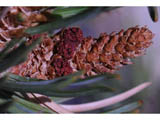
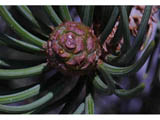
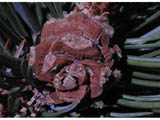
Fruit: Scales thick and fleshy when green, reddish brown later 1 - 1 1/2 inches long, slender, in clusters of 2-3, mostly threes
Bloom Information
Bloom Color: YellowBloom Time: Apr , May
Distribution
USA: AZ , CA , CO , NM , OK , TX , UT , WYNative Distribution: W. OK & TX, w. through the foothills of the western mts. to s.w. WY, south to Coahuila and San Luis Potosi in northern Mexico
Native Habitat: Rocky mesas; dry, mountain slopes
Growing Conditions
Water Use: LowLight Requirement: Part Shade
Soil Moisture: Dry
CaCO3 Tolerance: Low
Cold Tolerant: yes
Soil Description: Dry, rocky soils. Sandy, Sandy Loam, Medium Loam, Clay Loam, Clay
Conditions Comments: This good accent tree is drought- and cold-tolerant. It is very slow-growing and is usually found at elevations of 4,000-7,000 feet.
Propagation
Propagation Material: SeedsDescription: Sow fresh, untreated seed in late fall.
Seed Collection: Collect cones from vigorous trees in late summer and fall just before they completely open to drop seeds. Spread cones on racks to dry so they will release seeds. Cones may be shaken to release seeds. Store at a moisture content of 5-10 % fresh weight.
Commercially Avail: yes
Maintenance: Prune to maintain shape, Remove dead growth, Prevent complete soil dryness, Fertilize 3 times a year with lawn fertilizer 3:1:2 ratio
Find Seed or Plants
View propagation protocol from Native Plants Network.
From the National Organizations Directory
According to the species list provided by Affiliate Organizations, this plant is on display at the following locations:Santa Barbara Botanic Garden - Santa Barbara, CA
Sibley Nature Center - Midland, TX
Texas Parks and Wildlife Department - Austin, TX
Bibliography
Bibref 766 - Dale Groom's Texas Gardening Guide (2002) Groom, D.Bibref 298 - Field Guide to Texas Trees (1999) Simpson, B.J.
Bibref 946 - Gardening with Prairie Plants: How to Create Beautiful Native Landscapes (2002) Wasowski, Sally
Bibref 355 - Landscaping with Native Plants of Texas and the Southwest (1991) Miller, G. O.
Bibref 318 - Native Texas Plants: Landscaping Region by Region (2002) Wasowski, S. & A. Wasowski
Bibref 291 - Texas Wildscapes: Gardening for Wildlife (1999) Damude, N. & K.C. Bender
Bibref 297 - Trees of Central Texas (1984) Vines, Robert A.
Search More Titles in Bibliography
Web Reference
Webref 3 - Flora of North America (2014) Missouri Botanical Garden, St. Louis, MO & Harvard University Herbaria, Cambridge, MA.Additional resources
USDA: Find Pinus edulis in USDA PlantsFNA: Find Pinus edulis in the Flora of North America (if available)
Google: Search Google for Pinus edulis
Metadata
Record Modified: 2022-09-23Research By: TWC Staff