Native Plants

Plant Database
Search for native plants by scientific name, common name or family. If you are not sure what you are looking for, try the Combination Search or our Recommended Species lists.
Wasowski, Sally and Andy
Passiflora incarnata
Passiflora incarnata L.
Maypop, Purple Passionflower, Purple Passion Vine, Apricot Vine
Passifloraceae (Passion-Flower Family)
Synonym(s):
USDA Symbol: pain6
USDA Native Status: L48 (N)
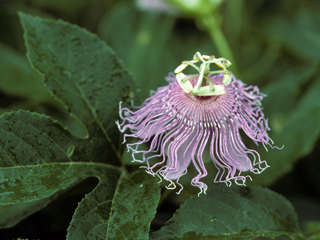
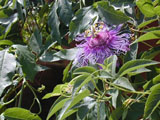
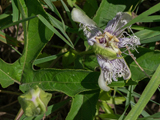
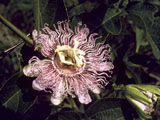
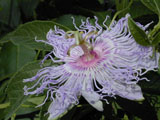
Purple Passion-flower is an herbaceous vine, up to 25 ft. long, that climbs with axillary tendrils or sprawls along the ground. Intricate, 3 in., lavender flower are short-stalked from leaf axils. The petals and sepals subtend a fringe of wavy or crimped, hair-like segments. The pistil and stamens are also showy. Three-lobed, deciduous leaves are dark-green above and whitish below. The fruit is a large, orange-yellow berry with edible pulp. Like some other passion vines, Maypop spreads by root suckers.
This unusual flower is widely distributed in the Southeast, especially from Florida to Texas. The plants were given the name Passionflower or Passion Vine because the floral parts were once said to represent aspects of the Christian crucifixion story, sometimes referred to as the Passion. The 10 petal-like parts represents the disciples of Jesus, excluding Peter and Judas; the 5 stamens the wounds Jesus received; the knob-like stigmas the nails; the fringe the crown of thorns. The name Maypop comes from the hollow, yellow fruits that pop loudly when crushed. Yellow Passion Flower (P. lutea), a small yellow-flowered species, occurs from southeast Pennsylvania to Florida, west to Texas and Oklahoma, and north to Missouri, Illinois, and West Virginia.

Plant Characteristics
Duration: PerennialHabit: Vine
Leaf Retention: Deciduous
Fruit Type: Berry
Size Notes: Climber, up to about 25 feet long.
Fruit: Yellow
Bloom Information
Bloom Color: Pink , Blue , PurpleBloom Time: Mar , Apr , May , Jun , Jul , Aug , Sep , Oct , Nov
Distribution
USA: AL , AR , DC , DE , FL , GA , IL , IN , KS , KY , LA , MD , MO , MS , NC , OH , OK , PA , SC , TN , TX , VA , WVNative Distribution: DE to MO, s. to e. TX & FL, also in Bermuda, introduced farther n. in U.S. Zones 7 to 10.
Native Habitat: Roadsides, Prairies, Plains, Meadows, Pastures, Savannas, Woodland edges and opening, Streams, Riverbanks
Growing Conditions
Water Use: Low , MediumLight Requirement: Sun , Part Shade
Soil Moisture: Dry , Moist
Cold Tolerant: yes
Heat Tolerant: yes
Soil Description: Rich, non-saline clays, loams, sands.
Benefit
Use Ornamental: Showy, Blooms ornamental, Ground cover, Arbor, Twines on fences & other plants, Climbs walls & columnsUse Wildlife: Fruit-birds.
Use Food: Fruits consumed by indigenous people.
Use Medicinal: Amerindians poulticed root for boils, cuts, earaches and inflammation. (Foster & Duke) Tea used to sooth nerves; Inca brewed tonic; crushed leaves in poultices on cuts and bruises. (1 teaspoon dried leaves per cup of boiling water, steep 10 or 15 min) for insomnia, 1 cup at bedtime, as tonic up to 3 cups/day. (Castleman)
Conspicuous Flowers: yes
Attracts: Butterflies
Larval Host: Gulf Fritillary, Zebra Longwing, Crimson-patch longwing, Red-banded hairstreak, Julia butterfly, Mexican butterfly.
Nectar Source: yes
Deer Resistant: Moderate
Butterflies and Moths of North America (BAMONA)
|
Gulf Fritillary (Agraulis vanillae) 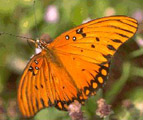 Larval Host |
Variegated Fritillary (Euptoieta claudia)  Larval Host |
Banded Hairstreak (Satyrium calanus)  Larval Host |
Red-banded Hairstreak (Calycopis cecrops) 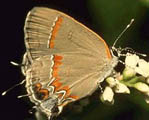 Larval Host |
Propagation
Description: Propagate by seed or cuttings. When sown immediately or stored, seed germination is low. Direct sowing outdoors is recommended. 6-8 in. stem cuttings should be taken early in the season. Once passion flower is established, numerous suckers will appearSeed Collection: Leathery berries develop during a 2-3 month period after flowering. Check seeds when the berry is soft and yellowish. Mature seeds are brown. Seeds should be cleaned soon (remove the sticky aril fomr seeds) and stored in moist sphagnum sealed, refrigerated containers.
Commercially Avail: yes
Maintenance: To encourage bushiness, pinch the plants back during their first growing season.
Mr. Smarty Plants says
Perennial vine for full sun, Denton, TX
March 19, 2010
I would like to grow a perennial vine that would tolerate full sun during the day. A flowering or non-flowering is fine. I do NOT want anything that is poisonous, i.e. Carolina jasmine, since this w...
view the full question and answer
Edible Plants for North Georgia
January 10, 2010
We are planning a forest food garden in the hollers of the N GA Mountains.
Which edible fruit, nut, berry, herb and creepers would be best for this reddish, clay-like soil? The food garden is in...
view the full question and answer
From the National Organizations Directory
According to the species list provided by Affiliate Organizations, this plant is on display at the following locations:Naval Air Station Kingsville - Kingsville, TX
Lady Bird Johnson Wildflower Center - Austin, TX
Texas Discovery Gardens - Dallas, TX
Texas Parks and Wildlife Department - Austin, TX
NPSOT - Fredericksburg Chapter - Fredericksburg, TX
NPSOT - Austin Chapter - Austin, TX
NPSOT - Williamson County Chapter - Georgetown, TX
Mt. Cuba Center - Hockessin, DE
Bibliography
Bibref 417 - Field Guide to Medicinal Plants and Herbs of Eastern and Central North America (2000) Foster, S. & J. A. DukeBibref 1186 - Field Guide to Moths of Eastern North America (2005) Covell, C.V., Jr.
Bibref 1185 - Field Guide to Western Butterflies (Peterson Field Guides) (1999) Opler, P.A. and A.B. Wright
Bibref 1620 - Gardening with Native Plants of the South (Reprint Edition) (2009) Wasowski, S. with A. Wasowski
Bibref 355 - Landscaping with Native Plants of Texas and the Southwest (1991) Miller, G. O.
Bibref 765 - McMillen's Texas Gardening: Wildflowers (1998) Howard, D.
Bibref 841 - Native Alternatives to Invasive Plants (2006) Burrell, C. C.
Bibref 318 - Native Texas Plants: Landscaping Region by Region (2002) Wasowski, S. & A. Wasowski
Bibref 281 - Shinners & Mahler's Illustrated Flora of North Central Texas (1999) Diggs, G. M.; B. L. Lipscomb; B. O'Kennon; W. F...
Bibref 248 - Texas Wildflowers: A Field Guide (1984) Loughmiller, C. & L. Loughmiller
Bibref 291 - Texas Wildscapes: Gardening for Wildlife (1999) Damude, N. & K.C. Bender
Bibref 1294 - The Midwestern Native Garden: Native Alternatives to Nonnative Flowers and Plants An Illustrated Guide (2011) Adelman, Charlotte and Schwartz, Bernard L.
Bibref 1208 - The New Healing Herbs (1995) Michael Castleman
Bibref 1243 - The Southeastern Indians (1976) Hudson, Charles
Bibref 328 - Wildflowers of Texas (2003) Ajilvsgi, Geyata.
Search More Titles in Bibliography
Web Reference
Webref 3 - Flora of North America (2014) Missouri Botanical Garden, St. Louis, MO & Harvard University Herbaria, Cambridge, MA.Webref 23 - Southwest Environmental Information Network (2009) SEINet - Arizona Chapter
Research Literature
Reslit 908 - Field performance and phenotypic variation of Passiflora incarnata L. in New York State (1998) C. M. McGuireReslit 909 - Passiflora incarnata (Passifloraceae): A new fruit crop (1999) C. M. McGuire
Reslit 921 - Germination of stored and scarified seeds of Passiflora caerulea L. (Passifloraceae) (2009) G. M. Mendiondo and M. T. A. Garcia
Reslit 1377 - Analysis of the spatial genetic structure of Passiflora incarnata in recently disturbed sites (2005) R. T. Tague and S. A. Fore
Reslit 1636 - Trophic interactions involving Herpetogramma phaeopteralis (Lepidoptera : Pyralidae) and Passiflora incarnata (Passifloraceae) (2008) A. Sourakov
Reslit 2051 - Allelopathic plants: 18. Passion fruit (Passiflora spp.) (2008) T. D. Khanh, T. D. Xuan, L. H. Linh and I. M. Chun...
Reslit 2182 - Andromonoecy and Variation in Phenotypic Gender of Passiflora incarnata (Passifloraceae) (1988) P. G. May and E. E. Spears
Reslit 2193 - Effect of Defoliation on Gender Expression and Fruit-Set in Passiflora incarnata (1988) E. E. Spears and P. G. May
Reslit 2260 - Reproductive biology and herbicidal sensitivity of maypop passionflower (Passiflora incarnata) (1985) G. Wehtje, R. B. Reed and R. R. Dute
Reslit 2399 - Ants, Extrafloral Nectaries and Herbivory on the Passion Vine, Passiflora incarnata (1983) D. K. McLain
This information was provided by the Florida WIldflower Foundation.
Search More Titles in Research Literature
From the Archive
Wildflower Newsletter 1993 VOL. 10, NO.4 - How to Hire a Garden Designer, Director's Report, Wild Collected or Propagated P...Additional resources
USDA: Find Passiflora incarnata in USDA PlantsFNA: Find Passiflora incarnata in the Flora of North America (if available)
Google: Search Google for Passiflora incarnata
Metadata
Record Modified: 2023-04-26Research By: DIEHL, WFS