Native Plants

Plant Database
Search for native plants by scientific name, common name or family. If you are not sure what you are looking for, try the Combination Search or our Recommended Species lists.
Vick, Albert F. W.
Fraxinus americana
Fraxinus americana L.
White Ash, American Ash, Cane Ash, Smallseed White Ash, Biltmore White Ash, Biltmore Ash
Oleaceae (Olive Family)
Synonym(s): Fraxinus americana var. biltmoreana, Fraxinus americana var. crassifolia, Fraxinus americana var. curtissii, Fraxinus americana var. juglandifolia, Fraxinus americana var. microcarpa, Fraxinus biltmoreana
USDA Symbol: fram2
USDA Native Status: L48 (N), HI (I), CAN (N)
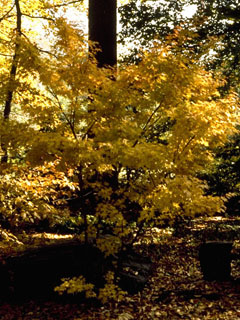
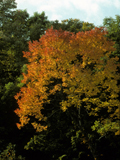
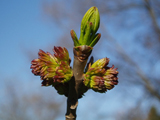
Large tree with straight trunk and dense, conical or rounded crown of foliage with whitish lower surfaces. White ash is a 75-120 ft., large-canopied, deciduous tree with dense branching, pinnate leaves, and early fall color. Leaves turn yellow, then change to purple in autumn.
The wood of White Ash is particularly suited for making baseball bats, tennis racquets, hockey sticks, polo mallets, oars, and playground equipment. A variation with hairs covering twigs, leafstalks, and underleaf surfaces has been called Biltmore Ash.

Plant Characteristics
Duration: PerennialHabit: Tree
Leaf Retention: Deciduous
Breeding System: Flowers Unisexual , Monoecious
Fruit Type: Samara
Size Notes: Up to about 120 feet tall.
Leaf: Green
Autumn Foliage: yes
Fruit: Green
Bloom Information
Bloom Color: Yellow , PurpleBloom Time: Apr , May
Distribution
USA: AL , AR , CO , CT , DC , DE , FL , GA , HI , IA , IL , IN , KS , KY , LA , MA , MD , ME , MI , MN , MO , MS , NC , NE , NH , NJ , NY , OH , OK , PA , RI , SC , TN , TX , VA , VT , WI , WVCanada: NB , NS , ON , PE , QC
Native Distribution: N.S. to s.e. MN & e. NE, s. to n. FL & e. TX
Native Habitat: Rich, upland or lowland woods; well-drained stream banks; pastures
Growing Conditions
Water Use: HighLight Requirement: Sun , Part Shade , Shade
Soil Moisture: Dry , Moist
Soil pH: Acidic (pH<6.8)
CaCO3 Tolerance: Medium
Cold Tolerant: yes
Soil Description: Deep, mesic soils. Sandy, Sandy Loam, Medium Loam, Clay Loam, Clay.
Conditions Comments: White ash has a medium growth rate. It is not as adaptable as green ash, but is considered superior as an ornamental. Susceptible, like many ashes, to a wide variety of disease and insect pests; these usually are not a problem to vigorously growing trees. Seedlings will tolerate quite a bit of shade, but if a full crown is desired, a generous amount of sun will be necessary as the tree matures. Prune in fall.
Benefit
Use Ornamental: Shade tree, Fall conspicuousUse Wildlife: Winged seeds attract song and game birds. Cover, Nesting site, Seeds-granivorous birds, Browse.
Use Other: Some tribes used the bark to produce a yellow dye. (Kershaw)
Ash leaf juice has been recommended for soothing mosquito bites and bee stings. (Kershaw)
Attracts: Birds , Butterflies
Larval Host: Eastern Tiger Swallowtail, Hickory Hairstreak (Satyrium caryaevorum), Mourning Cloak, Red-spotted Purple, Viceroy & Tiger Swallowtail
Butterflies and Moths of North America (BAMONA)
|
Canadian sphinx (Sphinx canadensis)  Larval Host |
Eastern Tiger Swallowtail (Papilio glaucus) 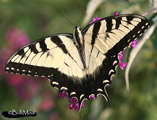 Larval Host |
Hickory Hairstreak (Satyrium caryaevorus)  Larval Host |
Mourning Cloak (Nymphalis antiopa) 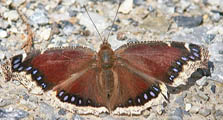 Larval Host |
|
Viceroy (Limenitis archippus) 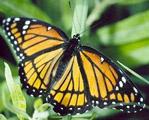 Larval Host |
Propagation
Propagation Material: SeedsDescription: Seeds may be sown outdoors after collection or stored and stratified then sown in spring.
Seed Treatment: Stratify in moist sand or perlite for 30-60 days at 41 degrees. Some references suggest preceding this treatment with an equal period of warm stratification.
Commercially Avail: yes
Find Seed or Plants
View propagation protocol from Native Plants Network.
Mr. Smarty Plants says
Diagnosis of problems with Texas ash
June 07, 2006
Our 15 year old Texas ash has less leaf production this year. It also has a small amount of algae on the trunk, and some of the branches have small white spots on it. Also, a few of the branches close...
view the full question and answer
National Wetland Indicator Status
| Region: | AGCP | AK | AW | CB | EMP | GP | HI | MW | NCNE | WMVE |
| Status: | FACU | FACU | FACU | FACU | FACU | FACU | FACU | FACU |
From the National Organizations Directory
According to the species list provided by Affiliate Organizations, this plant is on display at the following locations:Pineywoods Native Plant Center - Nacogdoches, TX
Texas Parks and Wildlife Department - Austin, TX
Longwood Gardens - Kennett Square, PA
Mt. Cuba Center - Hockessin, DE
Bibliography
Bibref 1186 - Field Guide to Moths of Eastern North America (2005) Covell, C.V., Jr.Bibref 298 - Field Guide to Texas Trees (1999) Simpson, B.J.
Bibref 1185 - Field Guide to Western Butterflies (Peterson Field Guides) (1999) Opler, P.A. and A.B. Wright
Bibref 1620 - Gardening with Native Plants of the South (Reprint Edition) (2009) Wasowski, S. with A. Wasowski
Bibref 355 - Landscaping with Native Plants of Texas and the Southwest (1991) Miller, G. O.
Bibref 291 - Texas Wildscapes: Gardening for Wildlife (1999) Damude, N. & K.C. Bender
Search More Titles in Bibliography
Additional resources
USDA: Find Fraxinus americana in USDA PlantsFNA: Find Fraxinus americana in the Flora of North America (if available)
Google: Search Google for Fraxinus americana
Metadata
Record Modified: 2015-11-12Research By: TWC Staff