Native Plants

Plant Database
Search for native plants by scientific name, common name or family. If you are not sure what you are looking for, try the Combination Search or our Recommended Species lists.
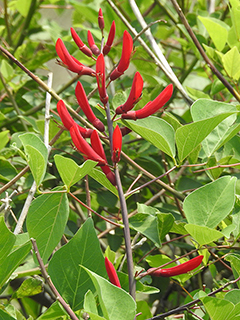
Pyle, Lynn
Erythrina herbacea
Erythrina herbacea L.
Coralbean, Cherokee Bean, Red Cardinal
Fabaceae (Pea Family)
Synonym(s): Erythrina arborea
USDA Symbol: erhe4
USDA Native Status: L48 (N)
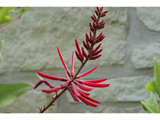
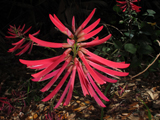
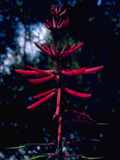
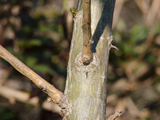
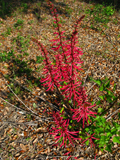
Coralbean is a low, glossy-leaved, thorny shrub to 6 ft., or taller, with many herbaceous, annual stems arising from the woody lower stem and perennial root. The long-petioled, leaflets are distinctively arrowhead-shaped. Leaves are alternate, scattered along the stem, 3 leaflets forming the leaf, which is often prickly beneath. The leaves are 3-5 inches long and 3 1/2-4 inches wide. Leaves fall in winter and before they reappear in spring, upright spikes of showy, tubular flowers adorn the bare branches. The scarlet-red flowers, 12 inches long in spike-like clusters, on the upper portion of the stem. There are 5 united sepals and 5 petals 1 1/2-2 inches long, with the upper petal wrapped around the other 4. These are followed by a persisent legume pod containing several bright red beans. The pod is blackish, constricted between the seeds, and up to 8 1/2 inches long. The seeds are firmly attached to the pod by a sturdy 1/8-inch-long thread and will remain in place for months.
This unusual tropical tree extends its range northward as a shrub or perennial herb, but is killed back to the ground each winter. Planted for the showy flowers and seeds, although the brittle branches are subject to damage by windstorms. In Mexico, the toxic seeds have been used for poisoning rats and fish. Although novelties and necklaces can be made from the seeds, they should be kept away from children.
Plant Characteristics
Duration: PerennialHabit: Shrub
Leaf Retention: Deciduous
Leaf Arrangement: Alternate
Fruit Type: Legume
Size Notes: Up to about 6 feet tall in climates where it dies back each year. Up to about 25 feet tall in climates where it does not die back each year.
Bloom Information
Bloom Color: RedBloom Time: Mar , Apr , May , Jun
Distribution
USA: AL , AR , FL , GA , LA , MS , NC , SC , TXNative Distribution: Coastal plain from s.e. NC to TX and Tamaulipas
Native Habitat: From North Central to South Texas and ranges to coastal states along the Gulf of Mexico. Well-drained sand, loam, clay. Open, sandy woods & clearings of the coastal plains
Growing Conditions
Water Use: MediumLight Requirement: Sun , Part Shade
Soil Moisture: Dry
Cold Tolerant: yes
Soil Description: Sandy soils. Sandy, Sandy Loam, Medium Loam, Clay Loam, Clay, Acid-based, Calcareous
Conditions Comments: Coralbean is opulent with scarlet blooms that resemble numerous crescent moons. Trim dead stem tips after new growth emerges in spring when frost damage becomes evident. Be careful of spines on the stems. The top often freezes back in winter but return with vigor in the spring from underground, tuberous root stumps. The seed pods split open to reveal bright red seeds, providing visual interest long after flowering. The seeds are highly toxic if ingested.
Benefit
Use Ornamental: Attractive, Blooms ornamental, Fruits ornamentalUse Wildlife: Nectar-hummingbirds
Warning: Seeds are poisonous to humans if eaten. Sensitivity to a toxin varies with a person’s age, weight, physical condition, and individual susceptibility. Children are most vulnerable because of their curiosity and small size. Toxicity can vary in a plant according to season, the plant’s different parts, and its stage of growth; and plants can absorb toxic substances, such as herbicides, pesticides, and pollutants from the water, air, and soil.
Conspicuous Flowers: yes
Interesting Foliage: yes
Attracts: Hummingbirds
Propagation
Propagation Material: SeedsDescription: Very easily propagated from scarified seed, semi-hardwood cuttings and root division.
Seed Collection: Collect seeds in late summer through early fall. Fumigate and store in sealed containers at room temperature.
Seed Treatment: Scarification
Commercially Avail: yes
Mr. Smarty Plants says
Shrub for part shade for hedge in Holly Ridge NC
April 07, 2010
We live in Coastal NC. We would like a type of shrub for the front of our home which is partial shade, similar style to a boxwood or trainable hedge. What NC native would compare?
view the full question and answer
Evergreen native shrubs for poor drainage area in Cedar Hill, TX
March 21, 2008
Hi! I have one (big!) bed in on the front of my house. Due to the way the house/motorcourt is built, that area (when it rains as much as it did last year!) doesn't drain well. I now have to replac...
view the full question and answer
From the National Organizations Directory
According to the species list provided by Affiliate Organizations, this plant is on display at the following locations:Lady Bird Johnson Wildflower Center - Austin, TX
NPSOT - Native Plant Society of Texas - Fredericksburg, TX
Crosby Arboretum - Picayune, MS
Texas Parks and Wildlife Department - Austin, TX
NPSOT - Austin Chapter - Austin, TX
National Butterfly Center - Mission, TX
Mt. Cuba Center - Hockessin, DE
Wildflower Center Seed Bank
LBJWC-1209 Collected 2008-09-27 in Nueces County by Lady Bird Johnson Wildflower CenterBibliography
Bibref 765 - McMillen's Texas Gardening: Wildflowers (1998) Howard, D.Bibref 841 - Native Alternatives to Invasive Plants (2006) Burrell, C. C.
Bibref 318 - Native Texas Plants: Landscaping Region by Region (2002) Wasowski, S. & A. Wasowski
Bibref 248 - Texas Wildflowers: A Field Guide (1984) Loughmiller, C. & L. Loughmiller
Bibref 291 - Texas Wildscapes: Gardening for Wildlife (1999) Damude, N. & K.C. Bender
Search More Titles in Bibliography
Web Reference
Webref 1 - Texas Native Shrubs (2002) Texas A&M University Agriculture Program and Leslie Finical, Dallas ArboretumResearch Literature
Reslit 1378 - Antibacterial Constituents from the Roots of Erythrina herbacea against Methicillin-resistant Staphylococcus aureus (2010) H. Tanaka, M. Sudo, T. Kawamura, M. Sato, R. Yamag...Reslit 1803 - First report of soybean rust caused by Phakopsora pachyrhizi on Erythrina herbacea (Coral bean) (2008) A. J. Gevens, N. Nequi, A. Vitoreli, J. J. Marois,...
Reslit 2233 - Axial Rotation of Erythrina herbacea Leaflets (1984) T. J. Herbert
This information was provided by the Florida WIldflower Foundation.
Search More Titles in Research Literature
Additional resources
USDA: Find Erythrina herbacea in USDA PlantsFNA: Find Erythrina herbacea in the Flora of North America (if available)
Google: Search Google for Erythrina herbacea
Metadata
Record Modified: 2022-10-18Research By: TWC Staff