Native Plants

Plant Database
Search for native plants by scientific name, common name or family. If you are not sure what you are looking for, try the Combination Search or our Recommended Species lists.
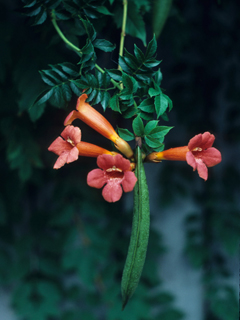
Wasowski, Sally and Andy
Campsis radicans
Campsis radicans (L.) Seem. ex Bureau
Trumpet Creeper, Trumpet Vine, Common Trumpet Creeper, Cow Vine, Foxglove Vine, Hellvine, Devil's Shoestring
Bignoniaceae (Trumpet-Creeper Family)
Synonym(s): Bignonia radicans, Tecoma radicans
USDA Symbol: cara2
USDA Native Status: L48 (N), CAN (N)
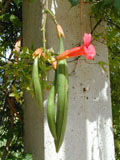
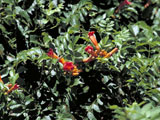
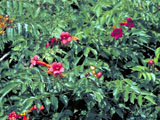
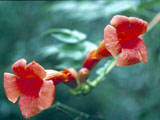
A high-climbing, aggressively colonizing woody vine to 35 ft., climbing or scrambling over everything in its path by aerial rootlets. The pinnately compound leaves up to 12 inches long, with typically 3 to 6 pairs of leaflets and a single terminal one. Leaflets dark green on the upper surface, lighter on the lower, broadly to narrowly ovate, with coarse teeth, an elongate tip, and a rounded to wedge shaped base, the blade extending along the petiolule (leaflet stem) to its base. Flowers showy, waxy, broadly trumpet shaped, up to 3 1/2 inches long, orange to reddish orange and occasionally yellow, clustered at the ends of branches, appearing throughout the summer. Fruit a capsule up to 7 inches long with two dehiscent suture ridges running lengthwise, tapering more gradually to the base than to the tip, and roughly round in cross section.
Native to eastern North America as far north as Ohio and South Dakota, this vine is often cultivated for its attractive, reddish orange flowers and can escape cultivation, sometimes colonizing so densely it seems a nuisance, particularly in the southeast, where its aggressive habit have earned it the names Hellvine and Devil's Shoestring. Its rapid colonization by suckers and layering makes it useful for erosion control, however, and its magnificent flowers never fail to attract Ruby-throated Hummingbirds within its range. Adapted to eastern forests, Trumpet creeper grows tall with support. It climbs by means of aerial rootlets, which, like English Ivy, can damage wood, stone, and brick. To keep it in check, plant it near concrete or an area that you can mow; mowing down the suckers will discourage them. Fairly drought tolerant within its range. Blooms most in full sun.

Plant Characteristics
Duration: PerennialHabit: Vine
Leaf Retention: Deciduous
Leaf Arrangement: Opposite
Leaf Complexity: Pinnate
Leaf Shape: Elliptic , Lanceolate , Obovate , Ovate
Leaf Venation: Pinnate
Leaf Margin: Dentate
Breeding System: Flowers Bisexual
Inflorescence: Cyme , Panicle
Fruit Type: Capsule
Size Notes: Stems up to about 35 feet long.
Leaf: Imparipinnate, typically with 3 to 5 pairs of lateral leaflets.
Autumn Foliage: yes
Flower: Flowers in terminal panicles of 3-flowered dichasial cymes.
Fruit: Fruit when mature, a brown capsule, 5 to 7 inches in length.
Bloom Information
Bloom Color: Red , Orange , YellowBloom Time: Jun , Jul , Aug , Sep
Bloom Notes: Usually reddish orange. Yellow cultivars have been produced.
Distribution
USA: AL , AR , CO , CT , DC , DE , FL , GA , IA , IL , IN , KS , KY , LA , MA , MD , MI , MO , MS , NC , ND , NE , NH , NJ , NY , OH , OK , PA , RI , SC , SD , TN , TX , UT , VA , WI , WVCanada: ON
Native Distribution: Eastern North America from Indiana, Ohio and New Jersey down to Florida and eastern Texas and north to South Dakota.
Native Habitat: In trees of moist woods or along fence rows in old fields.
Growing Conditions
Water Use: LowLight Requirement: Sun
Soil Moisture: Dry , Moist
Soil pH: Circumneutral (pH 6.8-7.2)
CaCO3 Tolerance: High
Drought Tolerance: High
Cold Tolerant: yes
Heat Tolerant: yes
Soil Description: Various well-drained soils. Sandy, Sandy Loam, Medium Loam, Clay Loam, Clay, Limestone-based, Caliche type
Conditions Comments: Blooms most in full sun.
Benefit
Use Ornamental: The plant is frequently cultivated because of its large clusters of attractive, bright red flowers. Several cultivars have been developed, including yellow-flowered varieties and a cross with the Asian species, Campsis grandiflora, which has broader flowers but is less hardy than our native species.Use Wildlife: Pollinated by hummingbirds and long tongued bees.
Warning: The sap of this plant can cause skin irritation on contact.
Conspicuous Flowers: yes
Interesting Foliage: yes
Attracts: Hummingbirds
Larval Host: Trumpet Vine Sphinx Moth (Paratraea plebeja)
Nectar Source: yes
Deer Resistant: Moderate
Butterflies and Moths of North America (BAMONA)
|
Plebeian sphinx (Paratrea plebeja) 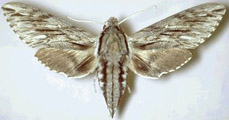 Larval Host |
Propagation
Propagation Material: Root Cuttings , Seeds , Semi-hardwood CuttingsDescription: Take 3-4 inch, new growth semi-hardwood cuttings from May through October. Root cuttings of strong parts of current season's root growth also used, but require more treatment.
Seed Collection: Gather ripe capsules when they turn brown but before they dry and split open (between 2-3 months after flowering). Remove seeds from pod, air dry, and store in sealed, refrigerated containers.
Seed Treatment: Stratify 30-60 days at 41-50 degrees.
Commercially Avail: yes
Maintenance: To keep lush during droughts, water deeply on occasion. Mow to keep it from expanding beyond defined areas. Cut back branches to two buds in the winter to encourage bushier growth and more blooms.
Find Seed or Plants
View propagation protocol from Native Plants Network.
Mr. Smarty Plants says
Toxicity and invasiveness of Scarlet Wisteria
May 04, 2007
I recently purchased seeds for Scarlet Wisteria (Chinese rattlebox tree). I spoke to a neighbor about this and she warned me not to plant them as they were poisonous to hummingbirds. Can you clarify...
view the full question and answer
National Wetland Indicator Status
| Region: | AGCP | AK | AW | CB | EMP | GP | HI | MW | NCNE | WMVE |
| Status: | FAC | FACU | FAC | FACU | FACU | FAC | FACU |
From the National Organizations Directory
According to the species list provided by Affiliate Organizations, this plant is on display at the following locations:Lady Bird Johnson Wildflower Center - Austin, TX
Sibley Nature Center - Midland, TX
Delaware Nature Society - Hockessin, DE
Brackenridge Field Laboratory - Austin, TX
Texas Parks and Wildlife Department - Austin, TX
NPSOT - Fredericksburg Chapter - Fredericksburg, TX
NPSOT - Williamson County Chapter - Georgetown, TX
Bibliography
Bibref 1255 - Bringing Nature Home: How You Can Sustain Wildlife with Native Plants (2009) Tallamy, Douglas W.Bibref 1186 - Field Guide to Moths of Eastern North America (2005) Covell, C.V., Jr.
Bibref 1185 - Field Guide to Western Butterflies (Peterson Field Guides) (1999) Opler, P.A. and A.B. Wright
Bibref 481 - How to Grow Native Plants of Texas and the Southwest: Revised and Updated Edition (2001) Nokes, J.
Bibref 355 - Landscaping with Native Plants of Texas and the Southwest (1991) Miller, G. O.
Bibref 354 - Native & Naturalized Woody Plants of Austin & the Hill Country (1981) Lynch, D.
Bibref 841 - Native Alternatives to Invasive Plants (2006) Burrell, C. C.
Bibref 318 - Native Texas Plants: Landscaping Region by Region (2002) Wasowski, S. & A. Wasowski
Bibref 248 - Texas Wildflowers: A Field Guide (1984) Loughmiller, C. & L. Loughmiller
Bibref 291 - Texas Wildscapes: Gardening for Wildlife (1999) Damude, N. & K.C. Bender
Bibref 1294 - The Midwestern Native Garden: Native Alternatives to Nonnative Flowers and Plants An Illustrated Guide (2011) Adelman, Charlotte and Schwartz, Bernard L.
Search More Titles in Bibliography
Research Literature
Reslit 237 - Factors affecting Campsis radicans seed germination and seedling emergence (2000) D. Chachalis and K. N. ReddyReslit 238 - Pelargonic acid and rainfall effects on glyphosate activity in trumpetcreeper (Campsis radicans) (2004) D. Chachalis and K. N. Reddy
Reslit 239 - Factors affecting sprouting and glyphosate translocation in rootstocks of redvine(Brunnichia ovata) and trumpetcreeper (Campsis radicans) (2005) D. Chachalis and K. N. Reddy
Reslit 240 - Characterization of leaf surface, wax composition, and control of redvine and trumpetcreeper with glyphosate (2001) D. Chachalis, K. N. Reddy and C. D. Elmore
Reslit 154 - Redvine (Brunnichia ovata) and trumpetcreeper (Campsis radicans) controlled under field conditions by a synergistic interaction of the bioherbicide, Myrothecium verrucaria, with glyphosate (2008) C. D. Boyette, R. E. Hoagland, M. A. Weaver and K....
Reslit 155 - Glyphosate and bioherbicide interaction for controlling kudzu (Pueraria lobata), redvine (Brunnichia ovata), and trumpetcreeper (Campsis radicans) (2006) C. D. Boyette, K. N. Reddy and R. E. Hoagland
Reslit 156 - Evaluation of postemergence herbicide combinations for long-term trumpetcreeper (Campsis radicans) control in corn (Zea mays) (2003) K. W. Bradley, E. S. Hagood and P. H. Davis
Reslit 157 - Trumpetcreeper (Campsis radicans) control in double-crop glyphosate-resistant soybean with glyphosate and conventional herbicide systems (2004) K. W. Bradley, E. S. Hagood and P. H. Davis
Reslit 404 - Degree of adaption of lianas (Parthenocissus quinquefolia (L.), Campsis radicans (L.)) to the environmental conditions of towns (2005) G. N. Ergaschewa and W. Drauschke
Reslit 386 - Emergence and growth of trumpetcreeper (Campsis radicans) as affected by rootstock size and planting depth (2004) J. T. Edwards and L. R. Oliver
This information was provided by the Florida WIldflower Foundation.
Search More Titles in Research Literature
From the Archive
Wildflower Newsletter 1996 VOL. 13, NO.3 - Hummingbird Gardening, Blooms Beget Butterflies, Butterflies and Hummingbirds Fo...Additional resources
USDA: Find Campsis radicans in USDA PlantsFNA: Find Campsis radicans in the Flora of North America (if available)
Google: Search Google for Campsis radicans
Metadata
Record Modified: 2022-10-18Research By: TWC Staff, GDG