Native Plants

Plant Database
Search for native plants by scientific name, common name or family. If you are not sure what you are looking for, try the Combination Search or our Recommended Species lists.
Loughmiller, Campbell and Lynn
Aesculus pavia
Aesculus pavia L.
Red Buckeye, Scarlet Buckeye , Firecracker Plant
Hippocastanaceae (Horse-Chestnut Family)
Synonym(s):
USDA Symbol: aepa
USDA Native Status: L48 (N), CAN (I)
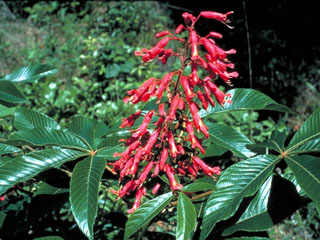
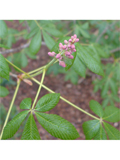
Native from North Carolina south to Florida, west to central Texas, and as far north as Illinois, Aesculus pavia is a handsome shrub or small tree with showy thyrses (often called panicles) of deep red or yellow, campanulate flowers in early spring. The flower clusters are 6-10 inches long, and the individual flowers are 1-1 1/2 inches long. The stamens are rarely much longer than the top petals, usually shorter. The leaves are made up of 5 leaflets joined at a central point on a stem as long as the leaf. They are fine-toothed, glossy dark green above and whitish beneath. The leaves usually drop by the end of summer.
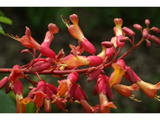
Two varieties are recognized. Aesculus pavia var. pavia has red flowers and is found throughout the range of the species except the western Edwards Plateau in central Texas, where variety flavescens occurs. Variety flavescens has pale to vivid, yellow flowers and is found naturally in only a few counties in central Texas. Where the ranges of the two varieties overlap, hybridization occurs, producing flowers in various combinations of yellow and red.
It is normal for this plant to drop its leaves by the end of summer, so try to place it where it will be highly visible in the early spring but less noticeable after it drops its leaves. The seeds and young shoots are poisonous if ingested, and indigenous people crushed these parts and put them in water to stupefy fish for easier capture. Soap may be obtained from the roots and a black dye from the wood. The species name, pavia, is in honor of Peter Paaw, a 16th century Dutch botanist.

Plant Characteristics
Duration: PerennialHabit: Shrub , Tree
Root Type: Tap
Leaf Retention: Deciduous
Leaf Arrangement: Opposite
Leaf Complexity: Palmate
Leaf Shape: Elliptic
Leaf Venation: Pinnate
Leaf Pubescence: Glabrous , Tomentose
Leaf Margin: Crenate , Serrate
Leaf Apex: Acuminate
Breeding System: Flowers Unisexual , Monoecious
Inflorescence: Thyrse
Fruit Type: Capsule
Size Notes: 10-40 feet, Texas specimens usually on the short end of that range, with those in central Texas commonly no more than 15 feet.
Leaf: Opposite, palmately compound, with 5, rarely 7, leaflets; leaflets elliptic to ovate, pointed at the tip, tapering to the base, toothed, green and smooth on the upper surface, paler and finely hairy on the lower surface, up to 6 inches long, up to 3 inches wide.
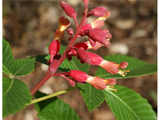
Flower: Numerous, red, in large, loosely-flowered clusters nearly 1 foot long.
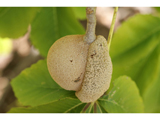
Fruit: Capsules spherical, up to 2 inches across, light brown, not prickly, containing 1 or 2 light reddish brown seeds.
Bloom Information
Bloom Color: Red , YellowBloom Time: Mar , Apr , May
Bloom Notes: Red-flowered plants are variety pavia, found from North Carolina, Florida, and Illinois to the eastern part of the Edwards Plateau in central Texas. Yellow-flowered plants are variety flavescens, found in the western Edwards Plateau of central Texas. Natural hybridization produces two-toned flowers where their ranges meet.
Distribution
USA: AL , AR , FL , GA , IL , KY , LA , MO , MS , NC , OK , SC , TN , TX , VA , WVNative Distribution: Southeastern North America. North Carolina south to northern Florida, west to central Texas, and north to southern Illinois; to 1500 ft (457 m).
Native Habitat: Common in woods, along streams, in thickets, and on rocky hills.
Growing Conditions
Water Use: Medium , HighLight Requirement: Part Shade
Soil Moisture: Moist
Soil pH: Acidic (pH<6.8) , Circumneutral (pH 6.8-7.2)
CaCO3 Tolerance: Medium
Drought Tolerance: Medium
Soil Description: Deep, well-drained sand, loam, clay, limestone. Variety pavia prefers more acidic, often sandy soils than variety flavescens, which is found in rocky limestone soils within its range.
Conditions Comments: Do not over-water. Too much water can lead to leaf spot diseases. Does best if protected from afternoon sun.
Benefit
Use Ornamental: Planted as a handsome ornamental for the showy red flowers, suggesting firecrackers.Use Wildlife: Flowers attract hummingbirds and bees. Nuts consumed by squirrels.
Use Medicinal: Pioneers made home remedies from the bitter bark.
Use Other: American Indians threw powdered seeds and crushed branches of this and other buckeyes into pools of water to stupefy fish. The fish then rose to the surface and were easily caught. Pioneers used the gummy roots as a soap substitute and the wood to produce a black dye.
Warning: Seeds and young shoots are poisonous to humans if eaten. Sensitivity to a toxin varies with a person’s age, weight, physical condition, and individual susceptibility. Children are most vulnerable because of their curiosity and small size. Toxicity can vary in a plant according to season, the plant’s different parts, and its stage of growth; and plants can absorb toxic substances, such as herbicides, pesticides, and pollutants from the water, air, and soil.
Conspicuous Flowers: yes
Interesting Foliage: yes
Attracts: Hummingbirds
Deer Resistant: Moderate
Propagation
Propagation Material: Root Cuttings , SeedsDescription: Sow untreated seeds promptly in loose, rich, well-drained soil.
Seed Collection: Collect when firm and brown.
Seed Treatment: None required. Immediate planting is necessary because seeds degenerate quickly due to high fat content.
Commercially Avail: yes
Maintenance: Soak-water during droughts to delay leaf loss.
Mr. Smarty Plants says
How to propagate Texas red buckeye (Aesculus sp.) from seeds
May 01, 2007
I have a Texas Red Buckeye that is doing very well. How do I propagate from the seeds that come off of that tree? Thanks,
view the full question and answer
National Wetland Indicator Status
| Region: | AGCP | AK | AW | CB | EMP | GP | HI | MW | NCNE | WMVE |
| Status: | FACU | FAC | FAC | FAC |
From the National Organizations Directory
According to the species list provided by Affiliate Organizations, this plant is on display at the following locations:Lady Bird Johnson Wildflower Center - Austin, TX
Pineywoods Native Plant Center - Nacogdoches, TX
Delaware Nature Society - Hockessin, DE
Crosby Arboretum - Picayune, MS
Texas Parks and Wildlife Department - Austin, TX
NPSOT - Fredericksburg Chapter - Fredericksburg, TX
Georgia Native Plant Society - Atlanta, GA
NPSOT - Austin Chapter - Austin, TX
Jacob's Well Natural Area - Wimberley, TX
NPSOT - Williamson County Chapter - Georgetown, TX
Mt. Cuba Center - Hockessin, DE
Bibliography
Bibref 298 - Field Guide to Texas Trees (1999) Simpson, B.J.Bibref 1620 - Gardening with Native Plants of the South (Reprint Edition) (2009) Wasowski, S. with A. Wasowski
Bibref 481 - How to Grow Native Plants of Texas and the Southwest: Revised and Updated Edition (2001) Nokes, J.
Bibref 841 - Native Alternatives to Invasive Plants (2006) Burrell, C. C.
Bibref 318 - Native Texas Plants: Landscaping Region by Region (2002) Wasowski, S. & A. Wasowski
Bibref 281 - Shinners & Mahler's Illustrated Flora of North Central Texas (1999) Diggs, G. M.; B. L. Lipscomb; B. O'Kennon; W. F...
Bibref 297 - Trees of Central Texas (1984) Vines, Robert A.
Search More Titles in Bibliography
Additional resources
USDA: Find Aesculus pavia in USDA PlantsFNA: Find Aesculus pavia in the Flora of North America (if available)
Google: Search Google for Aesculus pavia
Metadata
Record Modified: 2022-03-21Research By: TWC Staff, MWJ, GDG