Native Plants

Plant Database
Search for native plants by scientific name, common name or family. If you are not sure what you are looking for, try the Combination Search or our Recommended Species lists.
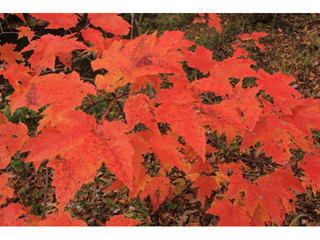
Cressler, Alan
Acer rubrum
Acer rubrum L.
Red Maple, Scarlet Maple, Soft Maple
Aceraceae (Maple Family)
Synonym(s):
USDA Symbol: acru
USDA Native Status: L48 (N), CAN (N)
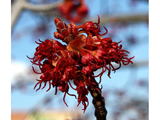
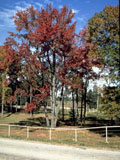
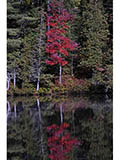
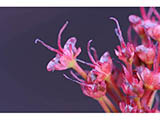
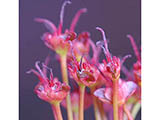
Medium to large tree with narrow or rounded, compact crown and red flowers, fruit, leafstalks, and autumn foliage. This popular ornamental tree grows 40-60 ft. in cultivation, occasionally reaching 100 ft. in the wild. Leaves vary from 3- to 5-lobed, with lobes separated by V-shaped angles. Male trees have notable pinkish red flowers in early spring, and females display decorative red samaras soon after. Young, vigorous trees have smooth, silvery gray bark which provides winter interest. Roots in a dense, fibrous network, often preventing other plants from growing near its trunk. Fall foliage is quite variable, ranging from the brilliant red for which the species is known, to yellow or greenish-yellow. Three varieties are commonly recognized: Variety rubrum has 5-lobed leaves that are smooth or hairy only along the midvein on the underside. Variety drummondii, known as Drummond Maple, Drummond Red Maple, or Swamp Maple, has 3- to 5-lobed leaves that are hairy over their entire lower surface. It tends to prefer moist, swampy sites. Variety trilobum, Trident Maple or Trident Red Maple, has similarly hairy but always 3-lobed leaves, the lower 2 lobes of which are somewhat compressed. Its leaves are more likely to turn yellow in the fall than those of the other varieties. It prefers drier sites than variety drummondii.
Red Maple is a handsome shade tree, named for its often red autumn leaf display. It has the greatest north-south distribution of all tree species along the East Coast, ranging from eastern Canada south to Florida and west to east Texas. Infrequent in forest; mostly found as understory. Very tolerant of most soils, but prefers slightly acid, moist conditions; tolerant of ozone and intermediately tolerant of sulphur dioxide. Not particularly urban tolerant, although planted in ever-increasing numbers in cities (Dirr 1998). Red maple is less reliably symmetrical than the hard maples.
Plant Characteristics
Duration: PerennialHabit: Tree
Root Type: Fibrous
Leaf Retention: Deciduous
Leaf Arrangement: Opposite
Leaf Complexity: Palmate
Leaf Venation: Palmate
Leaf Pubescence: Glabrous , Hirsute
Leaf Margin: Serrate
Leaf Base: Cordate , Rounded
Leaf Texture: Smooth
Breeding System: Flowers Unisexual , Dioecious
Fruit Type: Samara
Size Notes: Up to about 100 feet tall.
Leaf: Green, turning red or yellow in fall
Autumn Foliage: yes
Flower: Flowers 2 mm long
Fruit: Red, Brown 1 to 1.5 inches
Bloom Information
Bloom Color: Red , YellowBloom Time: Mar , Apr
Bloom Notes: Male trees have decorative blooms
Distribution
USA: AL , AR , CT , DC , DE , FL , GA , IA , IL , IN , KY , LA , MA , MD , ME , MI , MN , MO , MS , NC , NH , NJ , NY , OH , OK , PA , RI , SC , TN , TX , VA , VT , WI , WVCanada: NB , NL , NS , ON , PE , QC
Native Distribution: Nf. to s. Ont., s. to FL & e. TX
Native Habitat: Moist soils along stream banks; moist to drier woodlands
Growing Conditions
Water Use: HighLight Requirement: Sun , Part Shade
Soil Moisture: Moist
Soil pH: Acidic (pH<6.8) , Circumneutral (pH 6.8-7.2)
CaCO3 Tolerance: High
Drought Tolerance: Low
Cold Tolerant: yes
Heat Tolerant: yes
Soil Description: Moist, slightly acidic soils.
Conditions Comments: Though usually found in moist woodlands and wet swamps, also found in drier Post Oak woods.
Benefit
Use Ornamental: A popular landscaping tree for its colorful fall foliage, smoky red male flowers in spring, and red samaras on female trees.Use Wildlife: Browsed by deer and moose. Also used by squirrels and a variety of birds (Wasowski and Wasowski 1994). Maples are widely used by inchworms (Geometridae) and relied on by the Rosy Maple Moth (Dryocampa rubicunda), the Oval-based Prominent (Peridea basitriens), the Retarded Dagger Moth (Acronicta retardata), the Orange-humped Maple Worm (Symmerista leucitys), the Maple Looper (Parallelia bistriaris), and the Baltimore Bomolocha (Bomolocha baltimoralis) (Tallamy 2009).
Use Other: Pioneers made ink and cinnamon-brown and black dyes from a bark extract.
Warning: Leaves and bark poisonous to livestock.
Conspicuous Flowers: yes
Interesting Foliage: yes
Attracts: Birds
Larval Host: Cecropia Moth (Hyalophora cecropia) specifically favors Red Maple. Several other moths lay their eggs on maples generally.
Deer Resistant: No
Value to Beneficial Insects
Special Value to Native BeesSpecial Value to Honey Bees
This information was provided by the Pollinator Program at The Xerces Society for Invertebrate Conservation.
Butterflies and Moths of North America (BAMONA)
|
Rosy maple moth (Dryocampa rubicunda)  Larval Host |
Propagation
Propagation Material: SeedsDescription: Seeds mature in early summer and will germinate without pretreatment although treatment will hasten and unify germination. Softwood cuttings root readily with hormone.
Seed Collection: As soon as samaras turn yellowish or reddish brown and the seeds inside are firm, filled out, and dark brown. Best to gather from the tree as seeds that have already dropped lose viability quickly and are easily infested. Seed is usually not extracted from the samara. Keep in cold, moist storage.
Seed Treatment: Stratify 60-75 days at 41 degrees or use a cold water soak for 2-5 days.
Commercially Avail: yes
Find Seed or Plants
View propagation protocol from Native Plants Network.
Mr. Smarty Plants says
Attracting butterflies in Tennessee
July 03, 2009
What flowers and plants do the caterpillars in Tennessee eat? And do you know what butterflies live in Tipton Co. Tennessee?
view the full question and answer
Are black walnut and sugar maple poisonous to alpacas
June 09, 2008
I have alpacas and wonder if black walnut or sugar maple are poisonous to them.
view the full question and answer
National Wetland Indicator Status
| Region: | AGCP | AK | AW | CB | EMP | GP | HI | MW | NCNE | WMVE |
| Status: | FAC | FAC | FAC | FAC | FAC | FAC |
From the National Organizations Directory
According to the species list provided by Affiliate Organizations, this plant is on display at the following locations:Pineywoods Native Plant Center - Nacogdoches, TX
Delaware Nature Society - Hockessin, DE
Crosby Arboretum - Picayune, MS
Georgia Native Plant Society - Atlanta, GA
Natural Biodiversity - Johnstown, PA
First United Methodist Church of Jefferson City - Jefferson City, TN
Mt. Cuba Center - Hockessin, DE
Bibliography
Bibref 1255 - Bringing Nature Home: How You Can Sustain Wildlife with Native Plants (2009) Tallamy, Douglas W.Bibref 1186 - Field Guide to Moths of Eastern North America (2005) Covell, C.V., Jr.
Bibref 298 - Field Guide to Texas Trees (1999) Simpson, B.J.
Bibref 1185 - Field Guide to Western Butterflies (Peterson Field Guides) (1999) Opler, P.A. and A.B. Wright
Bibref 1620 - Gardening with Native Plants of the South (Reprint Edition) (2009) Wasowski, S. with A. Wasowski
Bibref 481 - How to Grow Native Plants of Texas and the Southwest: Revised and Updated Edition (2001) Nokes, J.
Bibref 980 - Manual of Woody Landscape Plants: Their Identification, Ornamental Characteristics, Culture, Propagation and Uses (1998) Dirr, M. A.
Bibref 841 - Native Alternatives to Invasive Plants (2006) Burrell, C. C.
Bibref 318 - Native Texas Plants: Landscaping Region by Region (2002) Wasowski, S. & A. Wasowski
Bibref 281 - Shinners & Mahler's Illustrated Flora of North Central Texas (1999) Diggs, G. M.; B. L. Lipscomb; B. O'Kennon; W. F...
Search More Titles in Bibliography
Additional resources
USDA: Find Acer rubrum in USDA PlantsFNA: Find Acer rubrum in the Flora of North America (if available)
Google: Search Google for Acer rubrum
Metadata
Record Modified: 2022-09-15Research By: TWC Staff, GDG