Native Plants

Plant Database
Search for native plants by scientific name, common name or family. If you are not sure what you are looking for, try the Combination Search or our Recommended Species lists.
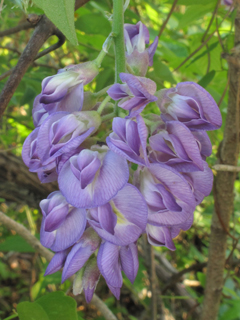
Cressler, Alan
Wisteria frutescens
Wisteria frutescens (L.) Poir.
American Wisteria, Texas Wisteria, Kentucky Wisteria
Fabaceae (Pea Family)
Synonym(s): Kraunhia frutescens, Kraunhia macrostachya, Wisteria frutescens var. macrostachya, Wisteria macrostachya
USDA Symbol: WIFR
USDA Native Status: L48 (N)
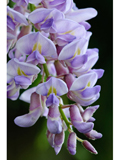
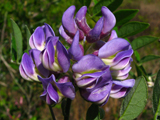
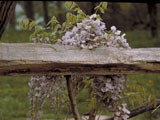
American wisteria is a high-climbing woody, deciduous vine, 25-30 ft. long. Shiny, dark-green, pinnately compound leaves bear 9-15 leaflets which are opposite on the leaf stem, with 1 leaflet at the tip. The flowers are in large, drooping clusters 6-9 inches long that appear after the plant has leafed out, a difference from the popular Asian species. The blooms only appear on new wood. Individual flowers are nearly 1 inch long and are lilac or bluish purple and quite fragrant. A brown, bean-like pod persists until winter. This species is less aggressive than the similar Asian species.
American wisteria is often used as an ornamental planting and has probably escaped from cultivation in many locations. In Texas, the 'Dam B' cultivar has blue flowers in racemes and flowers late May to June and sporadically throughout the summer and fall. A cultivar called 'Nivea' has white flowers.
Plant Characteristics
Duration: PerennialHabit: Vine
Leaf Retention: Deciduous
Leaf Arrangement: Alternate
Inflorescence: Raceme
Fruit Type: Legume
Size Notes: 25-30 feet.
Leaf: Green
Flower: Flowers in 4 to 6 inch flower clusters
Fruit: Brown 2 to 4 inch pod
Bloom Information
Bloom Color: White , Pink , Blue , Purple , VioletBloom Time: May , Jun
Bloom Notes: Usually lavender blue in color, but occasionally white. Blooms only on new wood.
Distribution
USA: AL , AR , CT , DE , FL , GA , IA , IL , IN , KY , LA , MA , MD , MI , MO , MS , NC , NJ , NY , OH , OK , PA , RI , SC , TN , TX , VA , WVNative Distribution: Eastern US as far west as east Texas, Zones 5 to 8
Native Habitat: Moist or wet woods; river banks; upland thickets
Growing Conditions
Water Use: MediumLight Requirement: Sun , Part Shade , Shade
Soil Moisture: Moist
Soil pH: Acidic (pH<6.8) , Circumneutral (pH 6.8-7.2)
CaCO3 Tolerance: Low
Drought Tolerance: Medium
Soil Description: Rich, moist to mesic, neutral to slightly acid soils. Sandy, Sandy Loam, Medium Loam, Clay Loam, Clay.
Conditions Comments: Prefers a good loamy soil in a sunny south or southwest facing position, sheltered from cold winds and from early morning sun on frosty mornings. Plants can become chlorotic on alkaline soils. Prefers a rich soil, but some gardeners feel too rich a soil results in too much leaf growth. Tolerates seasonal flooding.
Benefit
Use Ornamental: A lovely, aromatic Wisteria native to eastern North American that is less aggressive and less damaging to buildings than the Asian species, but has equally lovely flowers. Can be trained on arbors, walls, and columns.Conspicuous Flowers: yes
Fragrant Flowers: yes
Attracts: Butterflies
Larval Host: Marine Blue, Zarucco Duskywing, and skippers
Nectar Source: yes
Deer Resistant: High
Butterflies and Moths of North America (BAMONA)
|
Marine Blue (Leptotes marina)  Larval Host |
Propagation
Propagation Material: Seeds , Softwood CuttingsDescription: Cuttings best, because can take years to bloom from seed.
Commercially Avail: yes
Mr. Smarty Plants says
Vines for shade in North-Central Georgia
August 07, 2009
I am looking for something to hide a 6' wood fence that will grow in almost full shade. I have an area approx 2 feet wide to plant in. Since the fence and planting areas are stepped -- about 8 feet f...
view the full question and answer
National Wetland Indicator Status
| Region: | AGCP | AK | AW | CB | EMP | GP | HI | MW | NCNE | WMVE |
| Status: | FACW | FACW | FACW | FACW | FACW |
From the National Organizations Directory
According to the species list provided by Affiliate Organizations, this plant is on display at the following locations:Lady Bird Johnson Wildflower Center - Austin, TX
Texas Discovery Gardens - Dallas, TX
Delaware Nature Society - Hockessin, DE
NPSOT - Native Plant Society of Texas - Fredericksburg, TX
Crosby Arboretum - Picayune, MS
Texas Parks and Wildlife Department - Austin, TX
Georgia Native Plant Society - Atlanta, GA
NPSOT - Austin Chapter - Austin, TX
NPSOT - Williamson County Chapter - Georgetown, TX
Mt. Cuba Center - Hockessin, DE
Bibliography
Bibref 1186 - Field Guide to Moths of Eastern North America (2005) Covell, C.V., Jr.Bibref 1185 - Field Guide to Western Butterflies (Peterson Field Guides) (1999) Opler, P.A. and A.B. Wright
Bibref 1620 - Gardening with Native Plants of the South (Reprint Edition) (2009) Wasowski, S. with A. Wasowski
Bibref 841 - Native Alternatives to Invasive Plants (2006) Burrell, C. C.
Bibref 318 - Native Texas Plants: Landscaping Region by Region (2002) Wasowski, S. & A. Wasowski
Bibref 248 - Texas Wildflowers: A Field Guide (1984) Loughmiller, C. & L. Loughmiller
Bibref 1294 - The Midwestern Native Garden: Native Alternatives to Nonnative Flowers and Plants An Illustrated Guide (2011) Adelman, Charlotte and Schwartz, Bernard L.
Search More Titles in Bibliography
Additional resources
USDA: Find Wisteria frutescens in USDA PlantsFNA: Find Wisteria frutescens in the Flora of North America (if available)
Google: Search Google for Wisteria frutescens
Metadata
Record Modified: 2014-06-26Research By: NPC, GAP