Native Plants

Plant Database
Search for native plants by scientific name, common name or family. If you are not sure what you are looking for, try the Combination Search or our Recommended Species lists.
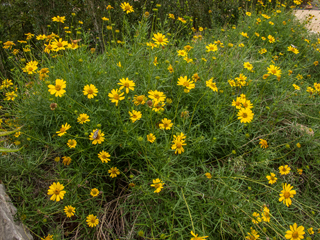
Brundage, Stephanie
Viguiera stenoloba
Viguiera stenoloba S.F. Blake
Skeleton-leaf Goldeneye, Resinbush
Asteraceae (Aster Family)
Synonym(s): Heliomeris tenuifolia, Viguiera stenoloba var. chihuahuensis, Viguiera stenoloba var. stenoloba
USDA Symbol: VIST
USDA Native Status: L48 (N)
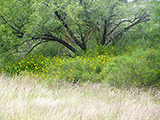
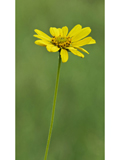
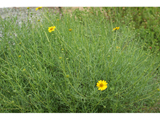
Resinbush or skeleton-leaf goldeneye, a much-branched shrub with a rounded top, grows 2-4 ft. in height. Prolific, daisy-like, yellow-orange flowers bloom singly atop leafless stalks. The dark-green, narrow leaves are persistent.
This extremely drought-tolerant plant makes an excellent tall ground cover or small flowering shrub.
Plant Characteristics
Duration: PerennialHabit: Shrub
Size Notes: Up to about 4 feet tall.
Fruit: Fruit is a cypsela (pl. cypselae). Though technically incorrect, the fruit is often referred to as an achene.
Bloom Information
Bloom Color: YellowBloom Time: Jun , Jul , Aug , Sep , Oct
Distribution
USA: NM , TXNative Distribution: South and west TX & NM, s. to Zacatecas in Mex.
Native Habitat: Dry, rocky sites. Locally abundant in desert or sub-desert areas in the Trans-Pecos and Rio Grande Plains, infrequent in western part of Edwards Plateau. Well-drained sand, loam, clay, caliche, limestone.
Growing Conditions
Water Use: LowLight Requirement: Sun , Part Shade
Soil Moisture: Dry
Cold Tolerant: yes
Heat Tolerant: yes
Soil Description: Dry, rocky soils. Limestone-based, Sandy, Sandy Loam, Medium Loam, Clay Loam, Clay, Caliche type
Conditions Comments: This is an exceptionally drought-tolerant plant. Cut the spent flowers to keep it tidy and to promote more blooming. Skeleton-leaf goldeneye must have good drainage.
Benefit
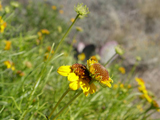
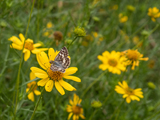
Use Ornamental: Desert landscape, Blooms ornamental, Winter-hardy, Long-blooming, Rocky hillside. An excellent tall ground cover or small flowering shrub.Use Wildlife: Nectar-bees, Nectar-butterflies, Nectar-moths, Nectar-insects, Browse, Seeds-granivorous birds, Cover, Nesting site
Conspicuous Flowers: yes
Attracts: Butterflies
Nectar Source: yes
Deer Resistant: High
Propagation
Propagation Material: SeedsDescription: Most effectively propagated by softwood tip cuttings. Take cuttings on bright-green new growth only, late spring. Tips with buds will not do as well. Propagate by seed by broadcasting in late fall or winter.
Seed Collection: Gather achenes as they turn brown and begin to shatter.
Seed Treatment: Air-dry before storing in sealed, refrigerated containers.
Commercially Avail: yes
Maintenance: Cut back the plant periodically to encourage bushy growth. Extremely drought tolerant.
Mr. Smarty Plants says
Finding Viguiera dentata seeds or plants.
November 09, 2009
I'm trying to locate seeds or plants of Viguiera Dentata, but have been unsuccessful. With the poliferation of these beautiful flowers this fall, I don't understand why I can't locate them. Do you ...
view the full question and answer
From the National Organizations Directory
According to the species list provided by Affiliate Organizations, this plant is on display at the following locations:Naval Air Station Kingsville - Kingsville, TX
Lady Bird Johnson Wildflower Center - Austin, TX
Sibley Nature Center - Midland, TX
NPSOT - Native Plant Society of Texas - Fredericksburg, TX
Texas Parks and Wildlife Department - Austin, TX
NPSOT - Fredericksburg Chapter - Fredericksburg, TX
NPSOT - Austin Chapter - Austin, TX
National Butterfly Center - Mission, TX
NPSOT - Williamson County Chapter - Georgetown, TX
Bibliography
Bibref 355 - Landscaping with Native Plants of Texas and the Southwest (1991) Miller, G. O.Bibref 995 - Native Landscaping from El Paso to L.A. (2000) Wasowski, S. and A. Wasowski
Bibref 318 - Native Texas Plants: Landscaping Region by Region (2002) Wasowski, S. & A. Wasowski
Bibref 291 - Texas Wildscapes: Gardening for Wildlife (1999) Damude, N. & K.C. Bender
Search More Titles in Bibliography
Additional resources
USDA: Find Viguiera stenoloba in USDA PlantsFNA: Find Viguiera stenoloba in the Flora of North America (if available)
Google: Search Google for Viguiera stenoloba
Metadata
Record Modified: 2018-01-12Research By: TWC Staff, GAP