Native Plants

Plant Database
Search for native plants by scientific name, common name or family. If you are not sure what you are looking for, try the Combination Search or our Recommended Species lists.
Vick, Albert F. W.
Rhus copallinum
Rhus copallinum L.
Winged Sumac, Shining Sumac, Flameleaf Sumac, Mountain Sumac, Dwarf Sumac, Wing-rib Sumac, Black Sumac, Upland Sumac
Anacardiaceae (Sumac Family)
Synonym(s): Rhus copallina
USDA Symbol: RHCO
USDA Native Status: L48 (N), CAN (N)
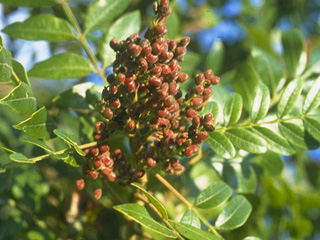
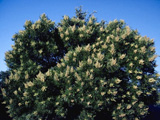
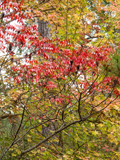
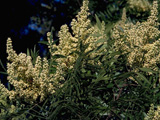
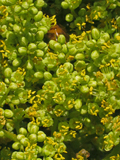
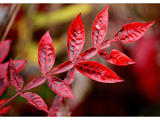
Winged sumac is a large, deciduous shrub or small tree, 20-35 ft. tall, with short, crooked trunks and open branching. Glossy, dark-green, pinnately compound leaves turn reddish-purple in the fall. Yellowish-green flowers are succeeded by drooping, pubescent, pyramidal fruit clusters which turn dull red and persist through winter. It is easily distinguishable from other sumacs by the winged leaf axis and watery sap. Often forms thickets.
Plant Characteristics
Duration: PerennialHabit: Shrub
Leaf Retention: Deciduous
Leaf Arrangement: Alternate
Leaf Complexity: Pinnate
Leaf Shape: Lanceolate
Leaf Margin: Entire
Breeding System: Flowers Unisexual
Inflorescence: Panicle
Fruit Type: Drupe
Size Notes: Up to about 35 feet tall.
Leaf: Green
Autumn Foliage: yes
Flower: Individual plants normally have only male or female flower, not both. Some plants may have both, some male flowers have non-functional pistils and some female flowers have non-functional stamens.
Fruit: Dark red. 1/8 inch long.
Bloom Information
Bloom Color: Yellow , GreenBloom Time: Jul , Aug
Distribution
USA: AL , AR , CT , DC , DE , FL , GA , IA , IL , IN , KS , KY , LA , MA , MD , ME , MI , MO , MS , NC , NE , NH , NJ , NY , OH , OK , PA , RI , SC , TN , TX , VA , VT , WI , WVNative Distribution: S. ME to s. MI & MO, s. to FL & e. TX
Native Habitat: Dry hillsides; open woods; prairies; thickets Found in scrub on limestone outcrops and rocky slopes, prairies, plains, and in sandy woodlands
Growing Conditions
Water Use: LowLight Requirement: Sun
Soil Moisture: Dry
CaCO3 Tolerance: Low
Soil Description: Rocky, poor soils.
Conditions Comments: Shining sumac is a very ornamental sumac. Because of its large, spreading habit, is not suited to small areas. Native sumacs are important wildlife plants, providing winter food for many upland gamebirds, songbirds, and large and small mammals. They are fast growing, generally pest and disease-free, and drought-tolerant. Colonies are often single-sexed, formed from a single, suckering parent. Only female plants produce berries, which are not as showy as those of R. typhina and R. glabra.
Benefit
Use Ornamental: Winged Sumac is sometimes planted as an ornamental for its shiny leaves and showy fruit.Use Wildlife: Winter food for many upland gamebirds, songbirds, and large and small mammals. Wildlife eat the fruit, and deer also browse the twigs.
Use Food: The sour fruit can be nibbled or made into a drink like lemonade.
Attracts: Birds
Value to Beneficial Insects
Special Value to Native BeesSpecial Value to Honey Bees
Provides Nesting Materials/Structure for Native Bees
Supports Conservation Biological Control
This information was provided by the Pollinator Program at The Xerces Society for Invertebrate Conservation.
Propagation
Description: Plant scarified seed 1/3-3/4 in. deep. Easily transplanted by division of colony. Semi-hardwood cutting taken in summer or fall will root.Seed Treatment: Acid scarification for one to two hours
Commercially Avail: yes
Find Seed or Plants
View propagation protocol from Native Plants Network.
Mr. Smarty Plants says
Plant identfication
October 21, 2009
Hi...Can you please identfy the tall, evergreen shrub with purple plum-colored foliage that I have noticed in winter locally?...Hope so, need he color! THX
view the full question and answer
National Wetland Indicator Status
| Region: | AGCP | AK | AW | CB | EMP | GP | HI | MW | NCNE | WMVE |
| Status: | UPL | FACU | UPL | UPL | UPL |
From the National Organizations Directory
According to the species list provided by Affiliate Organizations, this plant is on display at the following locations:Crosby Arboretum - Picayune, MS
Stengl Biological Research Station - Smithville, TX
Texas Parks and Wildlife Department - Austin, TX
Mt. Cuba Center - Hockessin, DE
Bibliography
Bibref 298 - Field Guide to Texas Trees (1999) Simpson, B.J.Bibref 1620 - Gardening with Native Plants of the South (Reprint Edition) (2009) Wasowski, S. with A. Wasowski
Bibref 946 - Gardening with Prairie Plants: How to Create Beautiful Native Landscapes (2002) Wasowski, Sally
Bibref 841 - Native Alternatives to Invasive Plants (2006) Burrell, C. C.
Bibref 318 - Native Texas Plants: Landscaping Region by Region (2002) Wasowski, S. & A. Wasowski
Search More Titles in Bibliography
From the Archive
Wildflower Newsletter 1985 VOL. 2, NO.3 - Greenhouse Assists Research, Wild color on the Hills, Director's Report, Clearin...Wildflower Newsletter 1989 VOL. 6, NO.5 - Educator\\\'s Native Plants Poster Perfected, Pass a Law, Protect a Tree, Resear...
Additional resources
USDA: Find Rhus copallinum in USDA PlantsFNA: Find Rhus copallinum in the Flora of North America (if available)
Google: Search Google for Rhus copallinum
Metadata
Record Modified: 2015-11-05Research By: TWC Staff