Native Plants

Plant Database
Search for native plants by scientific name, common name or family. If you are not sure what you are looking for, try the Combination Search or our Recommended Species lists.
Flaigg, Norman G.
Quercus laceyi
Quercus laceyi Small
Lacey Oak, Texas Blue Oak, Canyon Oak, Smoky Oak, Rock Oak
Fagaceae (Beech Family)
Synonym(s): Quercus glaucoides
USDA Symbol: QULA
USDA Native Status: L48 (N)
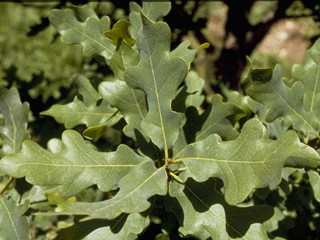
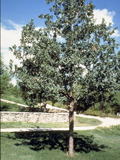
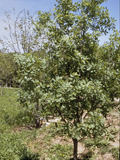
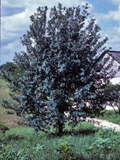
Lacey oak is a medium-sized tree on good sites or a shrub on poor sites. Branches are erect and spreading and there can be multiple trunks. Leaves are deciduous, thick and oblong with a few shallow lobes. Foliage is peach-colored in spring and fall; dark-blue or grayish-green in summer. Summer foliage takes on a smokey appearance.
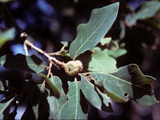
A small to medium tree, which grows up to 60 feet (18.3 mm). BARK: light gray with shallow furrows and scaly ridges. TWIGS and BUDS: young twigs are gray and pubescent, mature limbs become smooth and reddish-brown; smooth, brown ovoid buds. LEAVES: petiole varies from 1⁄8 - 1⁄2 inch (3 - 13 mm) long; leaf blade is obovate or elliptical, 1 1⁄2 - 3 1⁄2 inches (38 - 89 mm) long, 1 1⁄8 - 2 1⁄2 inches (29 - 63 mm) wide, margin of the leaf is entire or with shallow lobes, trees growing on moist sites may have leaves with deep lobes that resemble white oak (Q. alba), secondary veins often end in a tooth, apex rounded; smooth, green above, juvenile leaves have a white pubescence beneath, mature leaves become smooth beneath.
Named for Howard Lacey, who first collected specimens on his property near Kerrville, Texas. Lacey oak is increasingly popular in central Texas as an oak wilt-resistant alternative to or replacement for the commonly used but oak wilt-prone Escarpment Live Oak (Quercus fusiformis) and local red oaks (Quercus buckleyi and Quercus shumardii). It also provides habitat for wildlife and is sometimes used for fuel. The largest known Lacey oak grows in Blanco County, Texas.
Plant Characteristics
Duration: PerennialHabit: Tree
Root Type: Tap
Leaf Retention: Deciduous
Leaf Arrangement: Alternate
Leaf Complexity: Simple
Leaf Shape: Ovate
Leaf Venation: Pinnate
Leaf Margin: Lobed
Breeding System: Flowers Unisexual , Monoecious
Inflorescence: Catkin
Fruit Type: Nut
Size Notes: Up to about 60 feet tall.
Leaf: Leaves green above, juvenile leaves have a white pubescence beneath, mature leaves become smooth beneath.
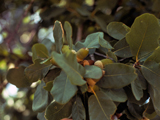
Fruit: Acorns annual; 1 - 3 acorns on a short peduncle up to 3⁄8 inch (10 mm) in length, saucer- shaped cup with pubescent scales, covers up to 1⁄3 of the nut; oblong or barrel-shaped nut, usually blunt at both ends, up to 3⁄4 inch (19 mm) long.
Bloom Information
Bloom Color: YellowBloom Time: Mar , Apr , May
Distribution
USA: TXNative Distribution: Restricted to southern and southwestern parts of the Edwards Plateau in Texas and in the Mexican states of Coahuila, Durango, Nuevo Leon, and Tamaulipas.
Native Habitat: Often found associated with limestone outcrops, woodland, and riparian zones with mixed stands of ash, basswood and other oaks, a component of the pine-juniper-madrone-oak forest type of northern Mexico at elevations between 6,000 - 8,200 feet (1,830 - 2,500 m).
Growing Conditions
Light Requirement: Part ShadeSoil Moisture: Dry
Soil Description: Limestone or rocky soils.
Conditions Comments: Lacey's oak is a medium-sized tree on good sites or a shrub on poor sites. Branches are erect and spreading and there can be multiple trunks. Leaves are deciduous, thick and oblong with a few shallow lobes. Foliage is peach-colored in spring and fall; dark-blue or grayish-green in summer. Summer foliage takes on a smokey appearance.
Benefit
Use Wildlife: Provides food and cover for deer, small mammals, and birds.Interesting Foliage: yes
Attracts: Birds
Deer Resistant: No
Propagation
Description: Oaks are most often propagated from seed. No pretreatment is necessary. Plant immediately – outdoors or in deep containers to accomodate long initial taproot. Many oaks require cold temperatures to initiate shoot development. Protect outdoor beds withSeed Collection: Best quality acorns are picked or shaken from the tree. Collect when color has changed to brown. Best if sown immediately as acorns lose viability quickly in storage. Short-term storage in moist, shaded saw dust or sand. Acorns to be sown immediately can be soaked in hot water for 15 min. to prevent weevil infestation. Stored seed should be fumigated with methyl bromide.
Commercially Avail: yes
From the National Organizations Directory
According to the species list provided by Affiliate Organizations, this plant is on display at the following locations:NPSOT - Native Plant Society of Texas - Fredericksburg, TX
Texas Parks and Wildlife Department - Austin, TX
NPSOT - Fredericksburg Chapter - Fredericksburg, TX
NPSOT - Austin Chapter - Austin, TX
NPSOT - Williamson County Chapter - Georgetown, TX
Bibliography
Bibref 1134 - Field Guide to Native Oak Species of Eastern North America (2003) Stein, John D. and Denise BinionBibref 298 - Field Guide to Texas Trees (1999) Simpson, B.J.
Bibref 841 - Native Alternatives to Invasive Plants (2006) Burrell, C. C.
Bibref 318 - Native Texas Plants: Landscaping Region by Region (2002) Wasowski, S. & A. Wasowski
Search More Titles in Bibliography
Additional resources
USDA: Find Quercus laceyi in USDA PlantsFNA: Find Quercus laceyi in the Flora of North America (if available)
Google: Search Google for Quercus laceyi
Metadata
Record Modified: 2015-11-18Research By: TWC Staff