Native Plants

Plant Database
Search for native plants by scientific name, common name or family. If you are not sure what you are looking for, try the Combination Search or our Recommended Species lists.
Lytle, Melody
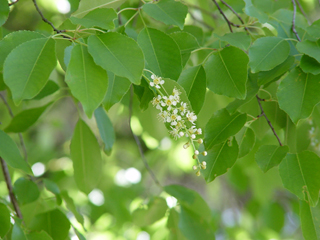
Prunus serotina var. eximia
Prunus serotina Ehrh. var. eximia (Small) Little
Escarpment Black Cherry, Edwards Plateau Black Cherry, Escarpment Cherry
Rosaceae (Rose Family)
Synonym(s): Prunus serotina ssp. eximia
USDA Symbol: PRSEE
USDA Native Status: L48 (N)
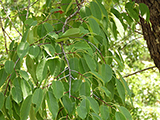
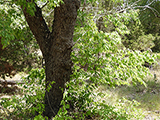
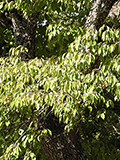
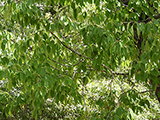
Escarpment Black Cherry is a distinct and isolated geographic variety of Black Cherry (Prunus serotina) found only in the calcareous soils of central Texas. It is distinguished physiologically from other P. serotina varieties by almost or entirely hairless leaves with more coarsely toothed margins, longer petioles, and, at up to 50 ft tall, a height intermediate between the larger Eastern Black Cherry (P. serotina var. serotina) and the smaller Southwestern varieties, virens and rufula.
Like the other varieties, it is prized for its attractive trunk and branches, showy spring blooms and summer fruits, and vivid yellow fall foliage. It is found primarily in wooded Hill Country canyons, slopes, and floodplains, in association with Ashe Juniper (Juniperus ashei), Escarpment Live Oak (Quercus fusiformis), Honey Mesquite (Prosopis glandulosa), Post Oak (Quercus stellata), and other woody plants. It requires full sun. Though the cherries are edible, the rest of the plant is poisonous if eaten, including the seeds.
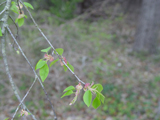
Plant Characteristics
Duration: PerennialHabit: Tree
Leaf Retention: Deciduous
Leaf Arrangement: Alternate
Leaf Complexity: Simple
Leaf Shape: Lanceolate
Leaf Venation: Pinnate
Leaf Pubescence: Glabrous
Leaf Margin: Dentate
Leaf Apex: Acuminate
Leaf Base: Cuneate
Leaf Texture: Smooth
Breeding System: Flowers Unisexual , Monoecious
Inflorescence: Raceme
Fruit Type: Drupe
Size Notes: 45-50 ft tall at most
Leaf: green, darker above, lighter below
Autumn Foliage: yes
Flower: Flowers 7-10 mm wide in 6-15 cm long racemes
Fruit: Dark red to purple-black 7-10 mm in diameter
Bloom Information
Bloom Color: WhiteBloom Time: Mar , Apr
Bloom Notes: Blooms right after leaves emerge
Distribution
USA: TXNative Distribution: Central Texas only, from Burnet and Williamson counties in the north to Comal and Medina counties in the south, west to Kimble and Kinney counties.
Native Habitat: Woodlands, canyons, floodplains, and lower riparian slopes, usually in moist, well-drained soil; on the Edwards Plateau in Juniper-Live Oak woods, Live Oak-Mesquite woods, and Post Oak woods.
Growing Conditions
Water Use: Low , MediumLight Requirement: Sun , Part Shade
Soil Moisture: Moist
Soil pH: Alkaline (pH>7.2)
CaCO3 Tolerance: High
Drought Tolerance: Medium
Cold Tolerant: yes
Heat Tolerant: yes
Soil Description: Rich, moist but well-drained, calcareous soils.
Conditions Comments: Escarpment black cherry is known for the beauty and quality of its wood. The green leaves turn to yellow in the fall. It is easy to grow and will reward you with dangling, lace-like blossoms in the spring. Wildlife eat the fruits. Prefers moister sites and more of a mineral, well drained soil.
Benefit
Use Ornamental: A showy tree with handsome trunk and branches, attractive foliage, especially in fall, and ornamental blooms and fruit. Easy to grow.Use Wildlife: Fruit consumed by numerous birds and mammals.
Use Food: Cherries eaten raw (must be pitted) and used in jellies, jams, pies, and as a flavoring extract in drinks and syrups.
Use Medicinal: Inner bark used in cough syrups, sedatives, and tonics.
Use Other: Wood prized for furniture making and other things because of its lustrous, dark red tint.
Warning: All parts of Prunus species except the fruits contain poisonous substances and should never be eaten. The bark, leaves, and seeds of this species are especially toxic. POISONOUS PARTS: Wilted leaves, twigs (stems), seeds. Highly toxic to humans and herbivorous mammals. May be fatal if ingested. Symptoms include gasping, weakness, excitement, pupil dilation, spasms, convulsions, coma, respiratory failure. Toxic Principle: Cyanogenic glycoside, amygdalin, prussic acid. (Poisonous Plants of N.C.)
Conspicuous Flowers: yes
Interesting Foliage: yes
Fragrant Foliage: yes
Attracts: Birds , Butterflies
Larval Host: Eastern Tiger Swallowtail, viceroys, Columbia Silkmoth, Promethea moths, Small-eyed Sphinx Moth, Wild Cherry Sphinx Moth, Banded Tussock Moth, Spotted Apatelodes
Nectar Source: yes
Deer Resistant: No
Value to Beneficial Insects
Special Value to Native BeesThis information was provided by the Pollinator Program at The Xerces Society for Invertebrate Conservation.
Propagation
Propagation Material: Hardwood Cuttings , Root Cuttings , Seeds , Semi-hardwood Cuttings , Softwood CuttingsDescription: Requires a period of after-ripening followed by a period of warm stratification followed by a period of cold stratification. Cuttings that work best are summer semi-hardwood.
Seed Collection: Collect fruit when it is filled out, firm, and its ripe color. Clean seeds from pulp and briefly air dry. (Seeds to be sown immediately in fall do not need drying.) Storage viability is maintained at 31-41 degrees.
Seed Treatment: For spring sowing, after-ripen for a period, then stratify seeds in moist sand for two weeks in a greenhouse, then cold stratify (36-41 degrees) for 60-90 days. Use a light mineral medium for seedlings. Plant well before high temperatures.
Commercially Avail: yes
Maintenance: May go drought-deciduous in summer, so water some during dry spells to prevent this. Keep fallen leaves, twigs, and branches picked up if you have herbivorous animals, as all parts except the fruit are highly toxic.
Mr. Smarty Plants says
Invasive, non-native Paulownia
May 03, 2006
Hi. We would like to plant a fast growing tree that will provide shade for our house. What do you think of the Paulownia tree (Empress Tree) as a possibility for the Austin area? If this is not a g...
view the full question and answer
From the National Organizations Directory
According to the species list provided by Affiliate Organizations, this plant is on display at the following locations:Lady Bird Johnson Wildflower Center - Austin, TX
Texas Parks and Wildlife Department - Austin, TX
NPSOT - Austin Chapter - Austin, TX
NPSOT - Williamson County Chapter - Georgetown, TX
Bibliography
Bibref 298 - Field Guide to Texas Trees (1999) Simpson, B.J.Bibref 946 - Gardening with Prairie Plants: How to Create Beautiful Native Landscapes (2002) Wasowski, Sally
Bibref 481 - How to Grow Native Plants of Texas and the Southwest: Revised and Updated Edition (2001) Nokes, J.
Bibref 293 - Manual of the Vascular Plants of Texas (1979) Correll, D. S. & M. C. Johnston
Bibref 663 - Poisonous Plants of North Carolina (1994) Vondracek, W. ; L. Van Asch
Bibref 281 - Shinners & Mahler's Illustrated Flora of North Central Texas (1999) Diggs, G. M.; B. L. Lipscomb; B. O'Kennon; W. F...
Bibref 297 - Trees of Central Texas (1984) Vines, Robert A.
Bibref 286 - Wildflowers of the Texas Hill Country (1989) Enquist, M.
Search More Titles in Bibliography
Additional resources
USDA: Find Prunus serotina var. eximia in USDA PlantsFNA: Find Prunus serotina var. eximia in the Flora of North America (if available)
Google: Search Google for Prunus serotina var. eximia
Metadata
Record Modified: 2015-11-06Research By: TWC Staff, GDG