Native Plants

Plant Database
Search for native plants by scientific name, common name or family. If you are not sure what you are looking for, try the Combination Search or our Recommended Species lists.
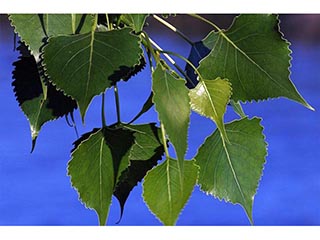
Reveal, James L.
Populus deltoides ssp. monilifera
Populus deltoides W. Bartram ex Marshall ssp. monilifera (Aiton) Eckenwalder
Plains Cottonwood, Great Plains Cottonwood, Texas Cottonwood, Northern Cottonwood
Salicaceae (Willow Family)
Synonym(s): Monilistus monilifera, Populus besseyana, Populus deltoides var. occidentalis, Populus monilifera, Populus occidentalis, Populus sargentii, Populus sargentii var. texana, Populus texana
USDA Symbol: PODEM
USDA Native Status: L48 (N), CAN (N)
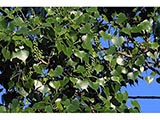
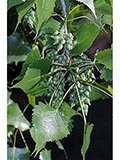
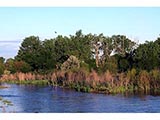
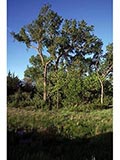
Plains Cottonwood is a western subspecies of Eastern Cottonwood (Populus deltoides) that has slightly smaller leaves that are often broader than long and more coarsely toothed.
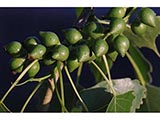
The Plains Cottonwood is a member of the willow family (family Salicaceae) which consists of deciduous, often aromatic trees and shrubs. About 350 species in the genera willow (Salix) and poplar (Populus); nearly worldwide, mostly in north temperate and arctic regions. 35 native and 5 naturalized tree species and about 60 native shrub species in North America. The large genus of willows (Salix), characteristic of wet soils, includes shrubs and mostly small trees, often with several stems or trunks from base and forming thickets. Leaves are narrow and commonly long-pointed and finely toothed, with distinct odor when crushed, turning yellow in autumn; leafstalks are very short with paired and often large stipules. Bark is gray or brown, smooth or becoming rough, scaly or furrowed, bitter, and aromatic. The slender or wiry twigs are tough, flexible, often shedding or easily detached at forks. The many tiny yellowish or greenish flowers usually appear in early spring before leaves; male and female are on separate plants, many crowded in mostly erect catkins. Each flower is above a hairy scale and has a glandlike disc, without calyx or corolla. Male flowers have 1-2 (sometimes to 12) stamens; female have a narrow pointed pistil. The many conical 1-celled long-pointed capsules along a slender stalk, are mostly light brown and mature in late spring or early summer, splitting into 2 parts. The numerous tiny seeds have tufts of white cottony hairs.
Plant Characteristics
Duration: PerennialHabit: Tree
Leaf Retention: Deciduous
Leaf Arrangement: Alternate
Leaf Complexity: Simple
Breeding System: Flowers Unisexual , Monoecious
Fruit Type: Capsule
Size Notes: Up to about 130 feet tall.
Leaf: Green
Bloom Information
Bloom Color: YellowBloom Time: Mar , Apr , May , Jun
Distribution
USA: CO , IA , IL , IN , KS , MI , MN , MO , MT , ND , NE , NM , OH , OK , PA , SD , TX , WI , WYCanada: AB , MB , ON , SK
Native Habitat: Stream/river banks, Roadsides
Growing Conditions
Water Use: HighLight Requirement: Part Shade
Soil Moisture: Dry
CaCO3 Tolerance: Medium
Soil Description: Sandy, Sandy Loam
From the National Organizations Directory
According to the species list provided by Affiliate Organizations, this plant is on display at the following locations:Texas Parks and Wildlife Department - Austin, TX
NPSOT - Austin Chapter - Austin, TX
Bibliography
Bibref 298 - Field Guide to Texas Trees (1999) Simpson, B.J.Bibref 291 - Texas Wildscapes: Gardening for Wildlife (1999) Damude, N. & K.C. Bender
Bibref 297 - Trees of Central Texas (1984) Vines, Robert A.
Search More Titles in Bibliography
Web Reference
Webref 3 - Flora of North America (2014) Missouri Botanical Garden, St. Louis, MO & Harvard University Herbaria, Cambridge, MA.Additional resources
USDA: Find Populus deltoides ssp. monilifera in USDA PlantsFNA: Find Populus deltoides ssp. monilifera in the Flora of North America (if available)
Google: Search Google for Populus deltoides ssp. monilifera
Metadata
Record Modified: 2022-09-23Research By: TWC Staff