Native Plants

Plant Database
Search for native plants by scientific name, common name or family. If you are not sure what you are looking for, try the Combination Search or our Recommended Species lists.
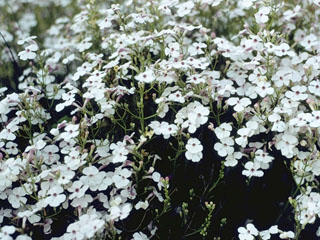
Bransford, W.D. and Dolphia
Penstemon ambiguus
Penstemon ambiguus Torr.
Pink Plains Penstemon, Pink Plains Beardtongue, Gilia Penstemon, Gilia Beardtongue, Sand Penstemon, Sand Beardtongue
Scrophulariaceae (Figwort Family)
Synonym(s):
USDA Symbol: PEAM
USDA Native Status: L48 (N)
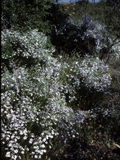
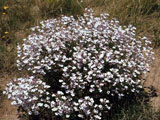
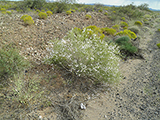
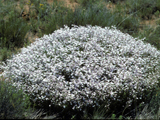
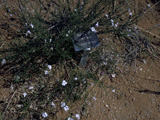
Pink Plains Beardtongue or Sand Penstemon is a mounded, fine-stemmed, shrub-like perennial, 1-3 ft. tall. In bloom, billows of whitish-pink, tubular flowers with pansy-like faces cover the plant. Masses of pinkish-white flowers bloom atop upright stems. Flowering increases with age as the woody base produces more stems. Leaves are thread-like in width, some persisting year-round.
Pink Plains Penstemon blooms most heavily in May, then continues until Oct., depending on moisture. The plant will tolerate extreme heat and drought conditions.
Plant Characteristics
Duration: PerennialHabit: Herb
Leaf Retention: Evergreen
Fruit Type: Capsule
Size Notes: Up to about 3 feet tall.
Flower: Flower 1 inch
Bloom Information
Bloom Color: White , PinkBloom Time: May , Jun , Jul , Aug , Sep , Oct
Distribution
USA: AZ , CO , KS , NM , NV , OK , TX , UT , WYNative Distribution: KS & CO to s. UT & NV, s. to w. TX, e. NM, & Chihuahua in n. Mex.
Native Habitat: Sandy plains, hills & mesas
Growing Conditions
Water Use: LowLight Requirement: Part Shade
Soil Moisture: Dry
Soil Description: Sandy, Sandy Loam
Conditions Comments: Sand penstemon blooms most heavily in May, then continues until Oct., depending on moisture. The plant will tolerate extreme heat and drought conditions.
Benefit
Use Ornamental: Showy, Long-blooming, Blooms ornamental, Perennial gardenUse Wildlife: Cover, Nectar-insects
Warning: This plant contains substances that can cause painful irritation of the mouth and throat if ingested. Sensitivity to a toxin varies with a person’s age, weight, physical condition, and individual susceptibility. Children are most vulnerable because of their curiosity and small size. Toxicity can vary in a plant according to season, the plant’s different parts, and its stage of growth; and plants can absorb toxic substances, such as herbicides, pesticides, and pollutants from the water, air, and soil.
Conspicuous Flowers: yes
Value to Beneficial Insects
Special Value to Native BeesThis information was provided by the Pollinator Program at The Xerces Society for Invertebrate Conservation.
Propagation
Propagation Material: SeedsDescription: Plants may be progagated by root division or seed sown in cool soil – spring or early fall.
Seed Treatment: Germination is best with cold-moist stratification.
Commercially Avail: yes
From the National Organizations Directory
According to the species list provided by Affiliate Organizations, this plant is on display at the following locations:Tohono Chul Park, Inc. - Tucson, AZ
Texas Parks and Wildlife Department - Austin, TX
Bibliography
Bibref 355 - Landscaping with Native Plants of Texas and the Southwest (1991) Miller, G. O.Bibref 995 - Native Landscaping from El Paso to L.A. (2000) Wasowski, S. and A. Wasowski
Bibref 318 - Native Texas Plants: Landscaping Region by Region (2002) Wasowski, S. & A. Wasowski
Bibref 291 - Texas Wildscapes: Gardening for Wildlife (1999) Damude, N. & K.C. Bender
Bibref 328 - Wildflowers of Texas (2003) Ajilvsgi, Geyata.
Search More Titles in Bibliography
Web Reference
Webref 38 - Flora of North America (2019) Missouri Botanical Garden, St. Louis, MO & Harvard University Herbaria, Cambridge, MA.Webref 23 - Southwest Environmental Information Network (2009) SEINet - Arizona Chapter
Additional resources
USDA: Find Penstemon ambiguus in USDA PlantsFNA: Find Penstemon ambiguus in the Flora of North America (if available)
Google: Search Google for Penstemon ambiguus
Metadata
Record Modified: 2023-02-21Research By: TWC Staff