Native Plants

Plant Database
Search for native plants by scientific name, common name or family. If you are not sure what you are looking for, try the Combination Search or our Recommended Species lists.
Marcus, Joseph A.
Malpighia glabra
Malpighia glabra L.
Barbados Cherry, Wild Crapemyrtle, Acerola, Manzanita
Malpighiaceae (Barbados Cherry Family)
Synonym(s):
USDA Symbol: MAGL6
USDA Native Status: L48 (N), VI (N?)
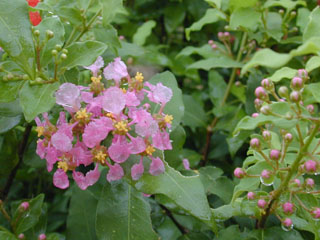
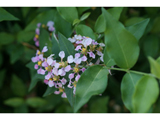
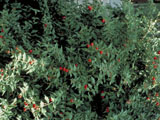
Barbados Cherry develops into a thick, rounded canopy of fairly delicate foliage . Small pink flowers appear periodically from April to October and are followed about one month later by bright red, tart-tasting, 1-inch fruits which are high in vitamin C.



Plant Characteristics
Duration: PerennialHabit: Shrub
Fruit Type: Drupe
Size Notes: Usually shrubby, up to about 9 feet. Sometimes a small tree up to about 18 feet.
Bloom Information
Bloom Color: PinkBloom Time: Jan , Feb , Mar , Apr , Sep , Oct , Nov , Dec
Distribution
USA: TXNative Distribution: From south Texas south through Mexico, Central America, and the Caribbean to South America as far as Peru and Brazil.
Native Habitat: Thickets, brushland (matorral), and palm groves
Growing Conditions
Water Use: MediumLight Requirement: Part Shade
Soil Moisture: Dry
Soil Description: Sandy, Sandy Loam, Medium Loam, Clay Loam, Clay, Limestone. Well-drained.
Conditions Comments: Half of the winters in the Austin area are mild enough for Barbados cherry to keep its leaves. It is useful as a dense screening hedge that may be left soft, sheared, or as a specimen. Birds quickly gobble up its bright, edible fruit and adult butterflies feed on the nectar. Standard tall and dwarf spreading varieties exist.
Benefit
Use Ornamental: Blooms ornamental, Fruits ornamental, Attractive, Hedges, Accent tree or shrub, Patio pot plant, Ground cover, Mass plantingUse Wildlife: Nectar-insects, Fruit-birds, Fruit-mammals, Browse.
Use Food: Fruit, referred to as acerola cherries, eaten and used for juice throughout the world's tropics and increasingly in temperate areas as well. Very high in Vitamin C.
Conspicuous Flowers: yes
Attracts: Birds , Butterflies
Nectar Source: yes
Deer Resistant: No
Butterflies and Moths of North America (BAMONA)
|
Brown-banded Skipper (Timochares ruptifasciata) 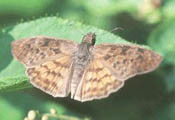 Larval Host |
White-patched Skipper (Chiomara georgina) 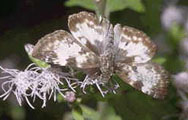 Larval Host |
Florida Duskywing (Ephyriades brunnea) 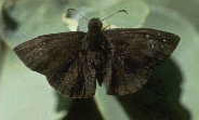 Larval Host |
Cassius Blue (Leptotes cassius) 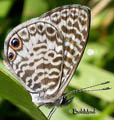 Larval Host |
Propagation
Propagation Material: Softwood CuttingsDescription: New growth comes in summer usually. Take tip cuttings on new growth. Roots easily. Blooming triggered by drop in temperature.
From the National Organizations Directory
According to the species list provided by Affiliate Organizations, this plant is on display at the following locations:Naval Air Station Kingsville - Kingsville, TX
Lady Bird Johnson Wildflower Center - Austin, TX
NPSOT - Native Plant Society of Texas - Fredericksburg, TX
Texas Parks and Wildlife Department - Austin, TX
NPSOT - Austin Chapter - Austin, TX
National Butterfly Center - Mission, TX
NPSOT - Williamson County Chapter - Georgetown, TX
Bibliography
Bibref 1186 - Field Guide to Moths of Eastern North America (2005) Covell, C.V., Jr.Bibref 1185 - Field Guide to Western Butterflies (Peterson Field Guides) (1999) Opler, P.A. and A.B. Wright
Bibref 841 - Native Alternatives to Invasive Plants (2006) Burrell, C. C.
Bibref 318 - Native Texas Plants: Landscaping Region by Region (2002) Wasowski, S. & A. Wasowski
Bibref 291 - Texas Wildscapes: Gardening for Wildlife (1999) Damude, N. & K.C. Bender
Search More Titles in Bibliography
Web Reference
Webref 38 - Flora of North America (2019) Missouri Botanical Garden, St. Louis, MO & Harvard University Herbaria, Cambridge, MA.Webref 23 - Southwest Environmental Information Network (2009) SEINet - Arizona Chapter
Additional resources
USDA: Find Malpighia glabra in USDA PlantsFNA: Find Malpighia glabra in the Flora of North America (if available)
Google: Search Google for Malpighia glabra
Metadata
Record Modified: 2023-04-13Research By: TWC Staff, LAL