Native Plants

Plant Database
Search for native plants by scientific name, common name or family. If you are not sure what you are looking for, try the Combination Search or our Recommended Species lists.
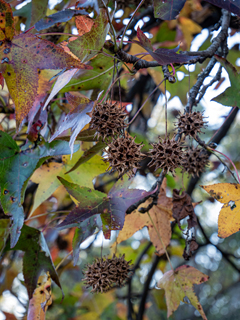
Brundage, Stephanie
Liquidambar styraciflua
Liquidambar styraciflua L.
Sweetgum, American Sweetgum, Red Gum, White Gum, Star-leaved Gum, Starleaf Gum, Alligator Tree, Satin Walnut, Bilsted, Liquidambar
Hamamelidaceae (Witch-Hazel Family)
Synonym(s):
USDA Symbol: LIST2
USDA Native Status: L48 (N)
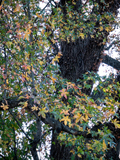
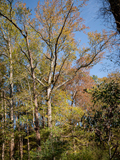
A large, open-crowned tree, sweet-gum grows 75 ft. tall in cultivation and up to 130 ft. in the wild. Large, aromatic tree with straight trunk and conical crown that becomes round and spreading. Young trees are distinctly conical in form. The long, straight trunk is occasionally buttressed and bears strong, ascending branches. Glossy green, deciduous leaves have five deep lobes making a star shape. Fall foliage is purple and red, and will become colorful even without cold temperatures. The fruit is a globular, horny, woody ball, 1 in. in diameter, which hangs on a long stem and persists through January.
An important timber tree, Sweetgum is second in production only to oaks among hardwoods. It is a leading furniture wood, used for cabinetwork, veneer, plywood, pulpwood, barrels, and boxes. In pioneer days, a gum was obtained from the trunks by peeling the bark and scraping off the resinlike solid. This gum was used medicinally as well as for chewing gum.Commercial storax, a fragrant resin used in perfumes and medicines, is from the related Oriental Sweetgum (Liquidambar orientalis Mill.) of western Asia.

Plant Characteristics
Duration: PerennialHabit: Tree
Leaf Retention: Deciduous
Leaf Arrangement: Alternate
Leaf Complexity: Simple
Breeding System: Flowers Unisexual , Monoecious
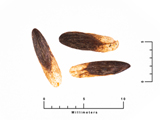
Fruit Type: Capsule
Size Notes: Up to about 130 feet tall.
Leaf: Green
Autumn Foliage: yes
Fruit: Brown
Bloom Information
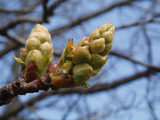
Bloom Color: White , GreenBloom Time: Mar , Apr , May
Distribution
USA: AL , AR , CT , DC , DE , FL , GA , IL , IN , KY , LA , MA , MD , MO , MS , NC , NJ , NY , OH , OK , PA , RI , SC , TN , TX , VA , WVNative Distribution: S. CT to s. IN, s. IL & s.e. MO, s. to s. FL, s.e. TX & s.e. OK; also n.e. Mex. south to Nicaragua
Native Habitat: Low, rich, moist woods; coastal plains
Growing Conditions
Water Use: HighLight Requirement: Part Shade
Soil Moisture: Moist
Soil pH: Acidic (pH<6.8)
CaCO3 Tolerance: Low
Cold Tolerant: yes
Soil Description: Deep, moist, alluvial loams. Sandy, Sandy Loam, Medium Loam, Clay Loam, Acid-based.
Conditions Comments: Sweet gum can become aggressive in moist, sandy soils. It is not drought-tolerant and does not do well is polluted areas or small areas which limit root development. It grows rapidly and is long-lived, adapting to a variety of sites. It is susceptible to iron chlorosis in soil which is too basic. Plant only in spring as roots take 3-4 months to recover from the shock of transplanting. Fruits do not readily decompose and and can jam reel mowers.
Benefit
Use Ornamental: Fast growing, Attractive, Long-living, Fall conspicuous, Shade treeUse Wildlife: Seed balls attract several bird species. Nesting site, Cover, Fruit-birds, Fruit-mammals
Use Medicinal: Comanches used unknown species as contraception. Used to suppress menstrual flow by Assiniboins. (Kindscher) Tea made from leaves used to wash wounds, decoctim of roots from sweet gum and pennywort applied directly to wounds, balsam from sweet gum bark is an astringent. (Weiner)
Attracts: Birds
Propagation
Propagation Material: SeedsDescription: Seeds exhibit only a shallow dormancy and can be planted fresh or stratified. Leafy cuttings taken with a heel can be rooted in summer under mist.
Seed Collection: Collect mature fruiting heads before they have completely dried. Spread out the heads until they release the seeds (5-10 days at 68 degrees). Air dry and store in sealed containers at 35 degrees.
Seed Treatment: Stratify one to two months at 41 degrees.
Commercially Avail: yes
Find Seed or Plants
View propagation protocol from Native Plants Network.
National Wetland Indicator Status
| Region: | AGCP | AK | AW | CB | EMP | GP | HI | MW | NCNE | WMVE |
| Status: | FAC | FAC | FAC | FAC | FACW | FAC |
From the National Organizations Directory
According to the species list provided by Affiliate Organizations, this plant is on display at the following locations:Pineywoods Native Plant Center - Nacogdoches, TX
Texas Discovery Gardens - Dallas, TX
Crosby Arboretum - Picayune, MS
Texas Parks and Wildlife Department - Austin, TX
NPSOT - Austin Chapter - Austin, TX
Mt. Cuba Center - Hockessin, DE
Bibliography
Bibref 766 - Dale Groom's Texas Gardening Guide (2002) Groom, D.Bibref 1207 - Earth Medicine, Earth Food (1990) Michael A. Weiner
Bibref 610 - Edible wild plants of the prairie : an ethnobotanical guide (1987) Kindscher, K.
Bibref 298 - Field Guide to Texas Trees (1999) Simpson, B.J.
Bibref 1620 - Gardening with Native Plants of the South (Reprint Edition) (2009) Wasowski, S. with A. Wasowski
Bibref 355 - Landscaping with Native Plants of Texas and the Southwest (1991) Miller, G. O.
Bibref 841 - Native Alternatives to Invasive Plants (2006) Burrell, C. C.
Bibref 318 - Native Texas Plants: Landscaping Region by Region (2002) Wasowski, S. & A. Wasowski
Bibref 291 - Texas Wildscapes: Gardening for Wildlife (1999) Damude, N. & K.C. Bender
Bibref 297 - Trees of Central Texas (1984) Vines, Robert A.
Search More Titles in Bibliography
From the Archive
Wildflower Newsletter 1996 VOL. 13, NO.6 - Winter Wonderland, Origins of the Christmas Tree, Development Director\\\'s Repo...Additional resources
USDA: Find Liquidambar styraciflua in USDA PlantsFNA: Find Liquidambar styraciflua in the Flora of North America (if available)
Google: Search Google for Liquidambar styraciflua
Metadata
Record Modified: 2021-03-19Research By: TWC Staff