Native Plants

Plant Database
Search for native plants by scientific name, common name or family. If you are not sure what you are looking for, try the Combination Search or our Recommended Species lists.
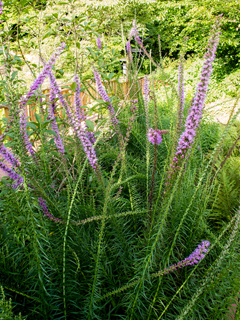
Brundage, Stephanie
Liatris spicata
Liatris spicata (L.) Willd.
Dense Blazing Star, Dense Gayfeather, Dense Liatris, Marsh Blazing Star, Marsh Gayfeather, Marsh Liatris
Asteraceae (Aster Family)
Synonym(s):
USDA Symbol: LISP
USDA Native Status: L48 (N), CAN (N)
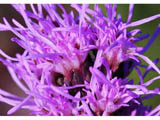
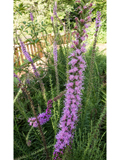
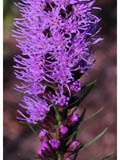
Dense gayfeather or marsh blazing star is an erect, slender perennial reaching a height of 2-6 ft. The linear, grass-like leaves are clumped toward the base of the plant, but extend up the stem to the showy flower cluster. A tall spike of rayless, rose-purple (sometimes white), closely set flower heads. The purple, tufted flower heads are arranged in a long, dense spike blooming from the top down.
The species name describes the elongated inflorescence, with its crowded, stalkless flower heads. The protruding styles give the flower an overall feathery appearance, hence its alternate name, Dense Gayfeather.

Plant Characteristics
Duration: PerennialHabit: Herb
Size Notes: Up to about 6 feet tall.
Leaf: Green
Fruit: Fruit is a cypsela (pl. cypselae). Though technically incorrect, the fruit is often referred to as an achene.
Bloom Information
Bloom Color: PurpleBloom Time: Jul , Aug , Sep , Oct , Nov
Distribution
USA: AL , AR , CT , DC , DE , FL , GA , IL , IN , KY , LA , MA , MD , MI , MO , MS , NC , NJ , NY , OH , PA , SC , TN , VA , WI , WVCanada: ON , QC
Native Distribution: NJ to MI & IL, s. to FL & LA; naturalized northeastward
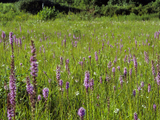
Native Habitat: Moist, wood openings; mesic prairies; marsh edges
Growing Conditions
Water Use: MediumLight Requirement: Sun
Soil Moisture: Moist
Soil pH: Acidic (pH<6.8)
CaCO3 Tolerance: Low
Soil Description: Moist, average soils.
Benefit
Use Wildlife: Butterflies frequent Liatris spp.Conspicuous Flowers: yes
Attracts: Birds , Hummingbirds
Value to Beneficial Insects
Special Value to Native BeesSpecial Value to Bumble Bees
This information was provided by the Pollinator Program at The Xerces Society for Invertebrate Conservation.
Propagation
Description: Scarified seeds may be sown outside in late fall or stored, stratified and sown the following spring. Some sources suggest spring seedlings will appear by simply laying the flowering stalk in an outdoor seedbed and covering with 1/2 in. of soil in the faSeed Collection: Wait until the flower heads on the entire stalk have turned fluffy tan before collecting. Bring the stalks inside to air-dry then shake or brush the nutlets from the heads. Seeds can be stored with chaff in sealed, refrigerated containers.
Seed Treatment: Scarification (lightly nick with knife) and stratification (3 months at 40 degrees).
Commercially Avail: yes
Find Seed or Plants
View propagation protocol from Native Plants Network.
National Wetland Indicator Status
| Region: | AGCP | AK | AW | CB | EMP | GP | HI | MW | NCNE | WMVE |
| Status: | FAC | FAC | FAC | FAC |
From the National Organizations Directory
According to the species list provided by Affiliate Organizations, this plant is on display at the following locations:Native Plant Center at Westchester Community College, The - Valhalla, NY
Texas Discovery Gardens - Dallas, TX
Delaware Nature Society - Hockessin, DE
Crosby Arboretum - Picayune, MS
Longwood Gardens - Kennett Square, PA
Mt. Cuba Center - Hockessin, DE
Bibliography
Bibref 1620 - Gardening with Native Plants of the South (Reprint Edition) (2009) Wasowski, S. with A. WasowskiBibref 946 - Gardening with Prairie Plants: How to Create Beautiful Native Landscapes (2002) Wasowski, Sally
Bibref 841 - Native Alternatives to Invasive Plants (2006) Burrell, C. C.
Bibref 1294 - The Midwestern Native Garden: Native Alternatives to Nonnative Flowers and Plants An Illustrated Guide (2011) Adelman, Charlotte and Schwartz, Bernard L.
Search More Titles in Bibliography
Web Reference
Webref 38 - Flora of North America (2019) Missouri Botanical Garden, St. Louis, MO & Harvard University Herbaria, Cambridge, MA.Research Literature
Reslit 102 - Age of maturity and life span in herbaceous, polycarpic perennials (2000) M. H. Bender, J. M. Baskin and C. C. BaskinReslit 106 - Native wildflower establishment with imidazolinone herbicides (1999) D. D. Beran, R. E. Gaussoin and R. A. Masters
Reslit 415 - The Role of Temperature and Photoperiod on Liatris-Spicata Shoot Development (1991) I. Espinosa, W. Healy and M. Roh
Reslit 1052 - Germination of Liatris spicata (L.) Willd. seed is enhanced by stratification, benzyladenine, or thiourea but not gibberellic acid (2002) C. A. Parks and T. H. Boyle
Reslit 1224 - Effect of four shading levels on flower stem and corm quality of liatris (Liatris spicata) (2007) F. Schiappacasse, G. Carrasco and F. Carrasco
Reslit 1358 - Regenerating adventitious shoots from in vitro culture of Liatris spicata (L) Willd cotyledons (1996) D. P. Stimart and J. C. Mather
Reslit 1801 - Hot-water treatment of Liatris tubers (1993) Z. Gilad and A. Borochov
Reslit 1898 - Studies with Liatris spicata Willd. 1. Effect of temperature on sprouting, flowering and gibberellin content (1983) N. Zieslin and Z. Geller
Reslit 1899 - Studies with Liatris spicata Willd. 2. Effects of photoperiod on stem extension, flowering and gibberellin content (1983) N. Zieslin and Z. Geller
Reslit 1901 - Floating system production of Liatris spicata (L.) willd (2006) G. Zanin and P. Sambo
This information was provided by the Florida WIldflower Foundation.
Search More Titles in Research Literature
Additional resources
USDA: Find Liatris spicata in USDA PlantsFNA: Find Liatris spicata in the Flora of North America (if available)
Google: Search Google for Liatris spicata
Metadata
Record Modified: 2022-12-29Research By: TWC Staff