Native Plants

Plant Database
Search for native plants by scientific name, common name or family. If you are not sure what you are looking for, try the Combination Search or our Recommended Species lists.
Cressler, Alan
Krameria lanceolata
Krameria lanceolata Torr.
Trailing Krameria, Ratany, Crameria, Prairie Sandbur, Trailing Ratany
Krameriaceae (Krameria Family)
Synonym(s): Krameria secundiflora, Krameria spathulata
USDA Symbol: KRLA
USDA Native Status: L48 (N)
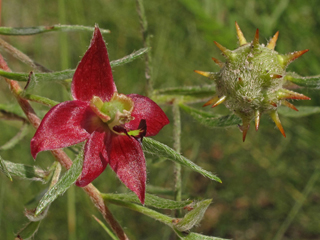
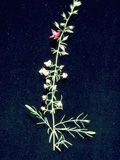
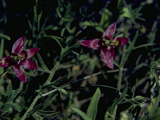
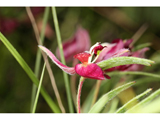
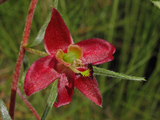
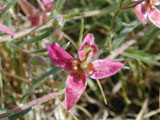
This is not the sandbur of the Grass Family; however, its burs are just as spiny, though densely covered with white hairs. The flowers and short silky leaves grow on prostrate stems, up to 3 feet long, from a thick woody root. The 5 wine-red sepals may be mistaken for the petals, which are smaller and tinged with green, the upper 3 being united. The flowers are about 1 inch broad. Not conspicuous or abundant.
One of the common names "sandbur" comes from the hard, one-seeded, wooly fruit covered with barbless spines.
Plant Characteristics
Duration: PerennialHabit: Herb
Leaf Retention: Deciduous
Fruit Type: Capsule
Size Notes: Stems decumbent, up to about 3 feet long.
Bloom Information
Bloom Color: Red , PurpleBloom Time: Apr , May , Jun , Jul , Aug , Sep , Oct
Distribution
USA: AR , AZ , CO , FL , GA , KS , NM , OK , TXNative Habitat: Distribtution is from Kansas to Arizona and south to Chihuahua and Texas. Widespread over Texas, missing only from the wettest, densest pine forests of east Texas.
Growing Conditions
Light Requirement: Part ShadeBenefit
Use Wildlife: Two petals of the flower of this species produce oils which are collected by members of the bee genus, Centris and fed to their larvae. Centris spp. are the primary pollinators of Krameria lanceolata.Conspicuous Flowers: yes
Interesting Foliage: yes
Propagation
Propagation Material: SeedsDescription: Collect seed in summer when fruit is brown and sharp.
From the National Organizations Directory
According to the species list provided by Affiliate Organizations, this plant is on display at the following locations:Fredericksburg Nature Center - Fredericksburg, TX
Lady Bird Johnson Wildflower Center - Austin, TX
Sibley Nature Center - Midland, TX
Brackenridge Field Laboratory - Austin, TX
Stengl Biological Research Station - Smithville, TX
Herbarium Specimen(s)
NPSOT 0214 Collected May 6, 1992 in Comal County by Mary Beth WhiteNPSOT 0147 Collected Apr 26, 1991 in Bexar County by Lottie Millsaps
NPSOT 0062 Collected May 19,1990 in Bexar County by Lottie Millsaps
Wildflower Center Seed Bank
LBJWC-1169 Collected 2008-06-24 in Hays County by Lady Bird Johnson Wildflower CenterBibliography
Bibref 248 - Texas Wildflowers: A Field Guide (1984) Loughmiller, C. & L. LoughmillerBibref 328 - Wildflowers of Texas (2003) Ajilvsgi, Geyata.
Bibref 286 - Wildflowers of the Texas Hill Country (1989) Enquist, M.
Search More Titles in Bibliography
Web Reference
Webref 38 - Flora of North America (2019) Missouri Botanical Garden, St. Louis, MO & Harvard University Herbaria, Cambridge, MA.Webref 23 - Southwest Environmental Information Network (2009) SEINet - Arizona Chapter
Additional resources
USDA: Find Krameria lanceolata in USDA PlantsFNA: Find Krameria lanceolata in the Flora of North America (if available)
Google: Search Google for Krameria lanceolata
Metadata
Record Modified: 2023-02-15Research By: NPIS