Native Plants

Plant Database
Search for native plants by scientific name, common name or family. If you are not sure what you are looking for, try the Combination Search or our Recommended Species lists.
Bransford, W.D. and Dolphia
Guaiacum angustifolium
Guaiacum angustifolium Engelm.
Texas Lignum-vitae, Soapbush, Guayacan
Zygophyllaceae (Creosote-Bush Family)
Synonym(s): Porlieria angustifolia
USDA Symbol: GUAN
USDA Native Status: L48 (N)
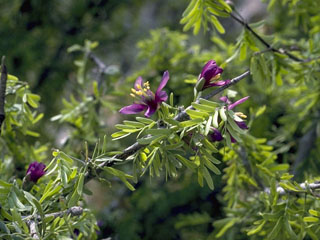
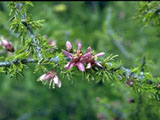
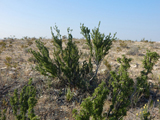
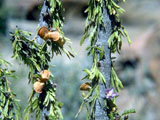
A leafy, compact evergreen, guayacan rarely grows higher than 6 feet, though under favorable conditions it may grow more than twice that high. It is often darker than surrounding shrubs, due to the stems being covered with dark green leaves. Leaves are pinnately compound, with 4-8 pairs of small, leathery leaflets. Flowers, which have 5 petals, are violet to purple, 1 inch across, with prominent yellow anthers. The blossom is followed by small, heart-shaped pods that burst open at maturity, exposing 2 scarlet-red, shiny seeds.
The bark of the roots is sometimes used as soap for washing woolen goods, as it does not fade colors. Guayacan is also a good honeybee plant. It does best at elevations below 4,000 feet.

Plant Characteristics
Duration: PerennialHabit: Tree
Leaf Retention: Evergreen
Leaf Complexity: Pinnate
Fruit Type: Capsule
Size Notes: Up to about 20 feet tall, often much shorter.
Flower: Flower 1 inch.
Fruit: Orange, 1 inch across.
Bloom Information
Bloom Color: White , Blue , Purple , VioletBloom Time: Mar , Apr , May , Jun , Jul , Aug , Sep
Bloom Notes: Rarely white.
Distribution
USA: TXNative Distribution: Chaparral & brush country, Prairie/Plains/Meadows/Pastures/Savannas
Native Habitat: Chaparral & brush country, Prairie, Plains, Meadows, Pastures, Savannas
Growing Conditions
Water Use: LowLight Requirement: Part Shade
Soil Moisture: Dry
Cold Tolerant: yes
Heat Tolerant: yes
Soil Description: Limestone-based, Sandy, Sandy Loam, Medium Loam, Clay Loam, Clay, Caliche type
Benefit
Use Ornamental: Showy, Attractive, Blooms ornamental, Grows in clumps, Aromatic, Long-living, Fruits ornamentalUse Wildlife: Nectar-bees, Nectar-insects, Nesting site, Browse, Fruit-birds, Fruit-mammals.
Conspicuous Flowers: yes
Attracts: Butterflies
Larval Host: Gray hairstreak butterfly, Lyside hairstreak butterfly.
Butterflies and Moths of North America (BAMONA)
|
Gray Hairstreak (Strymon melinus) 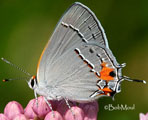 Larval Host |
Propagation
Propagation Material: SeedsFrom the National Organizations Directory
According to the species list provided by Affiliate Organizations, this plant is on display at the following locations:Texas Parks and Wildlife Department - Austin, TX
NPSOT - Austin Chapter - Austin, TX
National Butterfly Center - Mission, TX
Wildflower Center Seed Bank
LBJWC-MLE-12 Collected 2005-11-12 in Terrell County by Lady Bird Johnson Wildflower CenterBibliography
Bibref 355 - Landscaping with Native Plants of Texas and the Southwest (1991) Miller, G. O.Bibref 318 - Native Texas Plants: Landscaping Region by Region (2002) Wasowski, S. & A. Wasowski
Bibref 248 - Texas Wildflowers: A Field Guide (1984) Loughmiller, C. & L. Loughmiller
Bibref 291 - Texas Wildscapes: Gardening for Wildlife (1999) Damude, N. & K.C. Bender
Search More Titles in Bibliography
Web Reference
Webref 38 - Flora of North America (2019) Missouri Botanical Garden, St. Louis, MO & Harvard University Herbaria, Cambridge, MA.Webref 23 - Southwest Environmental Information Network (2009) SEINet - Arizona Chapter
Additional resources
USDA: Find Guaiacum angustifolium in USDA PlantsFNA: Find Guaiacum angustifolium in the Flora of North America (if available)
Google: Search Google for Guaiacum angustifolium
Metadata
Record Modified: 2023-02-13Research By: TWC Staff