Native Plants

Plant Database
Search for native plants by scientific name, common name or family. If you are not sure what you are looking for, try the Combination Search or our Recommended Species lists.
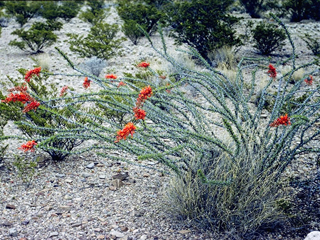
Bransford, W.D. and Dolphia
Fouquieria splendens
Fouquieria splendens Engelm.
Ocotillo, Devil's Walking Stick, Candlewood
Fouquieriaceae (Ocotillo Family)
Synonym(s): Fouquieria splendens ssp. splendens
USDA Symbol: FOSP2
USDA Native Status: L48 (N)
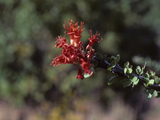
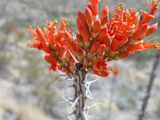
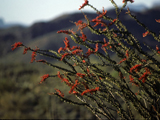
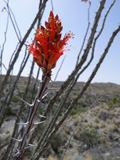
Ocotillo is a spiny shrub to 20 ft. with many long, whip-like, unbranched green stems growing from the base. Stems are leafless most of the year, covering themselves with bright green leaves after a rain. A funnel-shaped plant with several woody, almost unbranched, spiny, commonly straight stems leafless most of the year, and a tight cluster of red flowers at tip of each branch. Scarlet, tubular-shaped flowers are held in terminal clusters.
The family consists of about 11 species, mostly in Mexico, with Ocotillo (pronounced o-ko-tee'-yo) the most northern, and perhaps the Boojum Tree (F. columnaris) of Baja California the most unusual. Leaves appear only after rain and wither when the soil dries, a cycle commonly repeated several times during the warm season. The name Ocotillo means "little pine" in Mexican Spanish, a reference to the fact that, like a pine (ocote), its stalks produce a resin used by humans for various purposes.

Plant Characteristics
Duration: PerennialHabit: Shrub
Leaf Retention: Evergreen
Fruit Type: Capsule
Size Notes: Up to about 20 feet tall.
Leaf: Green
Flower: Flowers in 8 inch spikes
Bloom Information
Bloom Color: Red , OrangeBloom Time: Mar , Apr , May , Jun , Jul
Distribution
USA: AZ , CA , NM , NV , TXNative Distribution: W. TX to s. CA & n. Mex.
Native Habitat: Flat desert areas
Growing Conditions
Water Use: LowLight Requirement: Part Shade
Soil Moisture: Dry
CaCO3 Tolerance: High
Cold Tolerant: yes
Soil Description: Sandy or rocky soils. Sandy, Sandy Loam, Limestone-based, Igneous
Conditions Comments: Drought tolerant. Tall, spreading stems with thorns form an impenetrable enclosure.
Benefit
Use Ornamental: Accent tree or shrub, Screens, Desert landscape, Security hedgeUse Wildlife: Flowers attract hummingbirds, finches and many other birds as well as insects. Nectar-hummingbirds, Nectar-insects, Nectar-bees, Seeds-granivorous birds, Seeds-Small mammals
Use Other: Gum resin in bark used for waxing leather and adhesive/waterproofing agent, and varnish.
Conspicuous Flowers: yes
Propagation
Propagation Material: SeedsDescription: Will sprout from untreated seeds sown in spring or early summer. Reproduces most reliably from cuttings taken any time.
Seed Collection: Gather seeds as the capsules turn brown and begin to dry but before they dehisce. Air dry, remove seeds from capsules, and store in sealed, refrigerated containers.
Seed Treatment: No pretreatment is necessary.
From the National Organizations Directory
According to the species list provided by Affiliate Organizations, this plant is on display at the following locations:Santa Barbara Botanic Garden - Santa Barbara, CA
Tohono Chul Park, Inc. - Tucson, AZ
Texas Parks and Wildlife Department - Austin, TX
NPSOT - Austin Chapter - Austin, TX
Bibliography
Bibref 307 - Edible and Useful Plants of Texas and the Southwest: Including recipes, harmful plants, natural dyes, and textile fibers: A Practical Guide (1999) Tull, D.Bibref 355 - Landscaping with Native Plants of Texas and the Southwest (1991) Miller, G. O.
Bibref 995 - Native Landscaping from El Paso to L.A. (2000) Wasowski, S. and A. Wasowski
Bibref 318 - Native Texas Plants: Landscaping Region by Region (2002) Wasowski, S. & A. Wasowski
Bibref 248 - Texas Wildflowers: A Field Guide (1984) Loughmiller, C. & L. Loughmiller
Bibref 291 - Texas Wildscapes: Gardening for Wildlife (1999) Damude, N. & K.C. Bender
Search More Titles in Bibliography
From the Archive
Wildflower Newsletter 1990 VOL. 7, NO.2 - Preservation Blooms in Recreated Prairies, New Wildflower Center Prairie Welcome...Additional resources
USDA: Find Fouquieria splendens in USDA PlantsFNA: Find Fouquieria splendens in the Flora of North America (if available)
Google: Search Google for Fouquieria splendens
Metadata
Record Modified: 2009-05-14Research By: TWC Staff