Native Plants

Plant Database
Search for native plants by scientific name, common name or family. If you are not sure what you are looking for, try the Combination Search or our Recommended Species lists.
Cressler, Alan
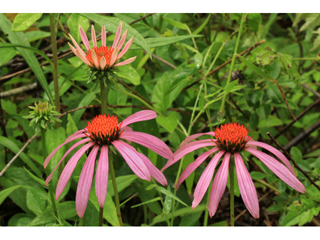
Echinacea purpurea
Echinacea purpurea (L.) Moench
Eastern Purple Coneflower, Purple Coneflower
Asteraceae (Aster Family)
Synonym(s): Brauneria purpurea, Echinacea purpurea var. arkansana, Rudbeckia purpurea
USDA Symbol: ECPU
USDA Native Status: L48 (N), CAN (I)
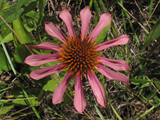
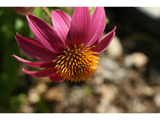
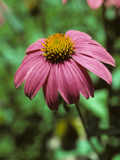
A popular perennial with smooth, 2-4 ft. stems and long-lasting, lavender flowers. Rough, scattered leaves that become small toward the top of the stem. Flowers occur singly atop the stems and have domed, purplish-brown, spiny centers and drooping, lavender rays. An attractive perennial with purple (rarely white), drooping rays surrounding a spiny, brownish central disc.
The genus name is from the Greek echinos, meaning "hedgehog," an allusion to the spiny, brownish central disc. The flowers of Echinacea species are used to make an extremely popular herbal tea, purported to help strengthen the immune system; an extract is also available in tablet or liquid form in pharmacies and health food stores. Often cultivated, Purple Coneflower is a showy, easily grown garden plant.


Plant Characteristics
Duration: PerennialHabit: Herb
Root Type: Fibrous
Leaf Shape: Lanceolate , Ovate
Leaf Margin: Dentate , Serrate
Leaf Base: Cordate , Rounded
Size Notes: Up to about 4 feet tall.
Leaf: Green
Fruit: Fruit is a cypsela (pl. cypselae). Though technically incorrect, the fruit is often referred to as an achene.
Bloom Information
Bloom Color: Pink , PurpleBloom Time: Apr , May , Jun , Jul , Aug , Sep
Distribution
USA: AL , AR , GA , IA , IL , IN , KS , KY , LA , MI , MO , MS , NC , OH , OK , TN , TX , WINative Distribution: GA to extreme n.e. TX, n. to NC, OH, IL & IA
Native Habitat: Well-drained limestone, sand, clay, loam. Rocky, open woods; thickets; prairies.
Growing Conditions
Water Use: MediumLight Requirement: Sun , Part Shade
Soil Moisture: Dry
CaCO3 Tolerance: Low
Soil Description: Well-drained, sandy or richer soils.
Conditions Comments: Echinacea is a suitable addition to a prairie garden and attractive in flower arrangements. It is a popular perennial with smooth stems and long-lasting, lavender flowers. Rough, scattered leaves that become small toward the top of the stem. Flowers occur singly atop the stems and have domed, purplish-brown, spiny centers and drooping, lavender rays. Purple coneflower can become very aggressive.
Benefit
Use Wildlife: Echinacea spp. attract butterflies and hummingbirds.Use Medicinal: Extracts thought to improve white blood count. Echinacin stops bacteria from forming the hyaluronidase enzyme, which helps make cells more susceptible to infection. It’s a mild natural antibiotic. Small amounts taken a few times daily are better than large dose
Conspicuous Flowers: yes
Nectar Source: yes
Deer Resistant: No
Value to Beneficial Insects
Special Value to Native BeesThis information was provided by the Pollinator Program at The Xerces Society for Invertebrate Conservation.
Propagation
Propagation Material: SeedsDescription: Seeds may be sown outside in late fall or stored, stratified and sown in the spring. Plants can be multiplied by making root divisions in early spring however division seems to stimulate the development of too many stems and too few flowers.
Seed Collection: Collect mature seedheads in the fall and break them open to extract seeds.
Seed Treatment: Cold-moist stratification for two months improves germination.
Commercially Avail: yes
Find Seed or Plants
Order seed of this species from Native American Seed and help support the Wildflower Center.
Find seed sources for this species at the Native Seed Network.
Mr. Smarty Plants says
Native flowers for Door County, Wisconsin
September 02, 2009
We recently were required to put in a new septic system on our vacation property in Door County, WI. This left us with a clearing on our wooded lot where the septic field is now located. The installer...
view the full question and answer
Tentative identification of Echinacea purpurea
June 29, 2007
We have a garden plant that is 18 inches high with a purple coned shaped flower sticking straight into the air. Can someone help us identify it?
view the full question and answer
Native, non-invasive plant seeds for each region in U.S.
June 09, 2006
I need to identify a wildflower from each region that we can package in custom packaging to use as giveaways at our member zoos and aquariums. Our project this year is called Conservation Made Simple...
view the full question and answer
Medicinal plants at the Wildflower Center
April 19, 2006
What kinds of medicinal plants do you have at the Wildflower Center?
view the full question and answer
From the National Organizations Directory
According to the species list provided by Affiliate Organizations, this plant is on display at the following locations:Lady Bird Johnson Wildflower Center - Austin, TX
Native Plant Center at Westchester Community College, The - Valhalla, NY
Texas Discovery Gardens - Dallas, TX
Delaware Nature Society - Hockessin, DE
United States Botanic Garden - Washington, DC
NPSOT - Native Plant Society of Texas - Fredericksburg, TX
Texas Parks and Wildlife Department - Austin, TX
NPSOT - Fredericksburg Chapter - Fredericksburg, TX
Longwood Gardens - Kennett Square, PA
NPSOT - Austin Chapter - Austin, TX
Native Seed Network - Corvallis, OR
NPSOT - Williamson County Chapter - Georgetown, TX
Mt. Cuba Center - Hockessin, DE
Bibliography
Bibref 1620 - Gardening with Native Plants of the South (Reprint Edition) (2009) Wasowski, S. with A. WasowskiBibref 946 - Gardening with Prairie Plants: How to Create Beautiful Native Landscapes (2002) Wasowski, Sally
Bibref 841 - Native Alternatives to Invasive Plants (2006) Burrell, C. C.
Bibref 318 - Native Texas Plants: Landscaping Region by Region (2002) Wasowski, S. & A. Wasowski
Bibref 1294 - The Midwestern Native Garden: Native Alternatives to Nonnative Flowers and Plants An Illustrated Guide (2011) Adelman, Charlotte and Schwartz, Bernard L.
Search More Titles in Bibliography
Web Reference
Webref 38 - Flora of North America (2019) Missouri Botanical Garden, St. Louis, MO & Harvard University Herbaria, Cambridge, MA.Research Literature
Reslit 263 - Detection of somaclonal variation in micro-propagated Echinacea purpurea using AFLP marker (2009) S. J. Chuang, C. L. Chen, J. J. Chen, W. Y. Chou a...Reslit 264 - Using morphological diagnosis and molecular markers to assess the clonal fidelity of micropropagated Echinacea purpurea regenerants (2010) S. J. Chuang, C. L. Chen, J. J. Chen and J. M. Sun...
Reslit 241 - Field Guide to the Rare Plants of Florida (2000) L. G. Chafin and J. C. P. Hancock
Reslit 159 - Stratification improves seed-germination of 5 native wildflower species (1993) C. B. Bratcher, J. M. Dole and J. C. Cole
Reslit 102 - Age of maturity and life span in herbaceous, polycarpic perennials (2000) M. H. Bender, J. M. Baskin and C. C. Baskin
Reslit 44 - Root Colonization by an Arbuscular Mycorrhizal (AM) Fungus Increases Growth and Secondary Metabolism of Purple Coneflower, Echinacea purpurea (L.) Moench (2009) G. Araim, A. Saleem, J. T. Arnason and C. Charest
Reslit 42 - How well do herbarium data predict the location of present populations? A test using Echinacea species in Missouri (2007) W. L. Applequist, D. J. McGlinn, M. Miller, Q. G. ...
Reslit 425 - Germination, survival, and growth of grass and forb seedlings: effects of soil moisture variability (2009) P. A. Fay and M. J. Schultz
Reslit 377 - Soil fertility increases with plant species diversity in a long-term biodiversity experiment (2008) R. Dybzinski, J. E. Fargione, D. R. Zak, D. Fornar...
Reslit 342 - Wildflower tolerance to metolachlor and metolachlor combined with other broadleaf herbicides (1993) J. F. Derr
This information was provided by the Florida WIldflower Foundation.
Search More Titles in Research Literature
From the Archive
Wildflower Newsletter 1985 VOL. 2, NO.2 - Guide to Black-Eyed Susan, Parkways, Wildflowers for the East, Arboretum Mall to...Wildflower Newsletter 1986 VOL. 3, NO.3 - Fall Planting Tips, Growth Provides Enthusiasm, 1985 Financial Facts, Gathering ...
Wildflower Newsletter 1987 VOL. 4, NO.4 - Wildflower Center Sows Seeds for the Country, Hotline for Texas, New Goals Plans...
Wildflower Newsletter 1989 VOL. 6, NO.3 - Butterfly Gardens, Director\'s Report, Proper Care Gives Staying Power to Cut Fl...
Wildflower Newsletter 1990 VOL. 7, NO.5 - Naturalistic Landscaping Takes Careful Planning, Director\'s Report, Breaking th...
Wildflower Newsletter 1991 VOL. 8, NO.1 - New Board President Dana Leavitt Named for Center, Stop Pests Naturally, Diversi...
Wildflower Newsletter 1993 VOL. 10, NO.3 - Miss Helen Hayes Memorial, Director's Report, Monarda Medicinal Mints of Distinc...
Additional resources
USDA: Find Echinacea purpurea in USDA PlantsFNA: Find Echinacea purpurea in the Flora of North America (if available)
Google: Search Google for Echinacea purpurea
Metadata
Record Modified: 2022-12-26Research By: TWC Staff, TMH